On This Day: 1974 - The British election ended in a hung parliament after the Jeremy Thorpe-led Liberal Party achie
However, a cold interrogation of the archival data and the parliamentary arithmetic suggests that the "kingmaker" label was a mathematical mirage.
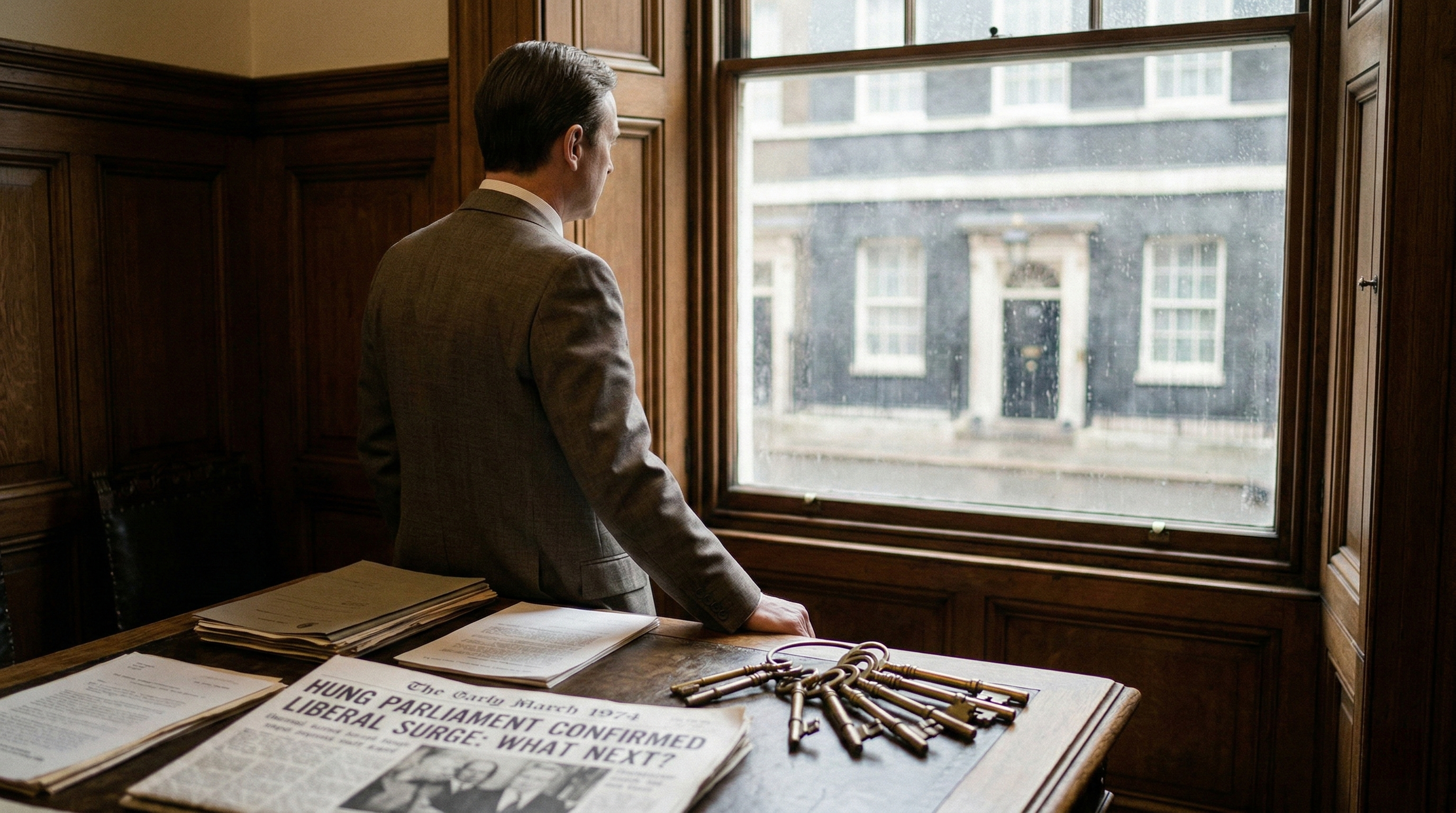
The Liberal surge of February 28, 1974, transformed Jeremy Thorpe into the ultimate kingmaker, a man who held the keys to 10 Downing Street and simply failed to turn the lock. This narrative has persisted in the collective memory of British politics for decades, framing Thorpe as a tragic or incompetent figure who fumbled a golden opportunity to force proportional representation upon the United Kingdom. However, a cold interrogation of the archival data and the parliamentary arithmetic suggests that the “kingmaker” label was a mathematical mirage. While the Liberal Party achieved its greatest electoral performance in nearly half a century, the reality of the 1974 hung parliament was far more constrained by systemic rigidity and the mutual exhaustion of the two major parties than by the personal whims of Jeremy Thorpe.
Misconceptions in Public Memory
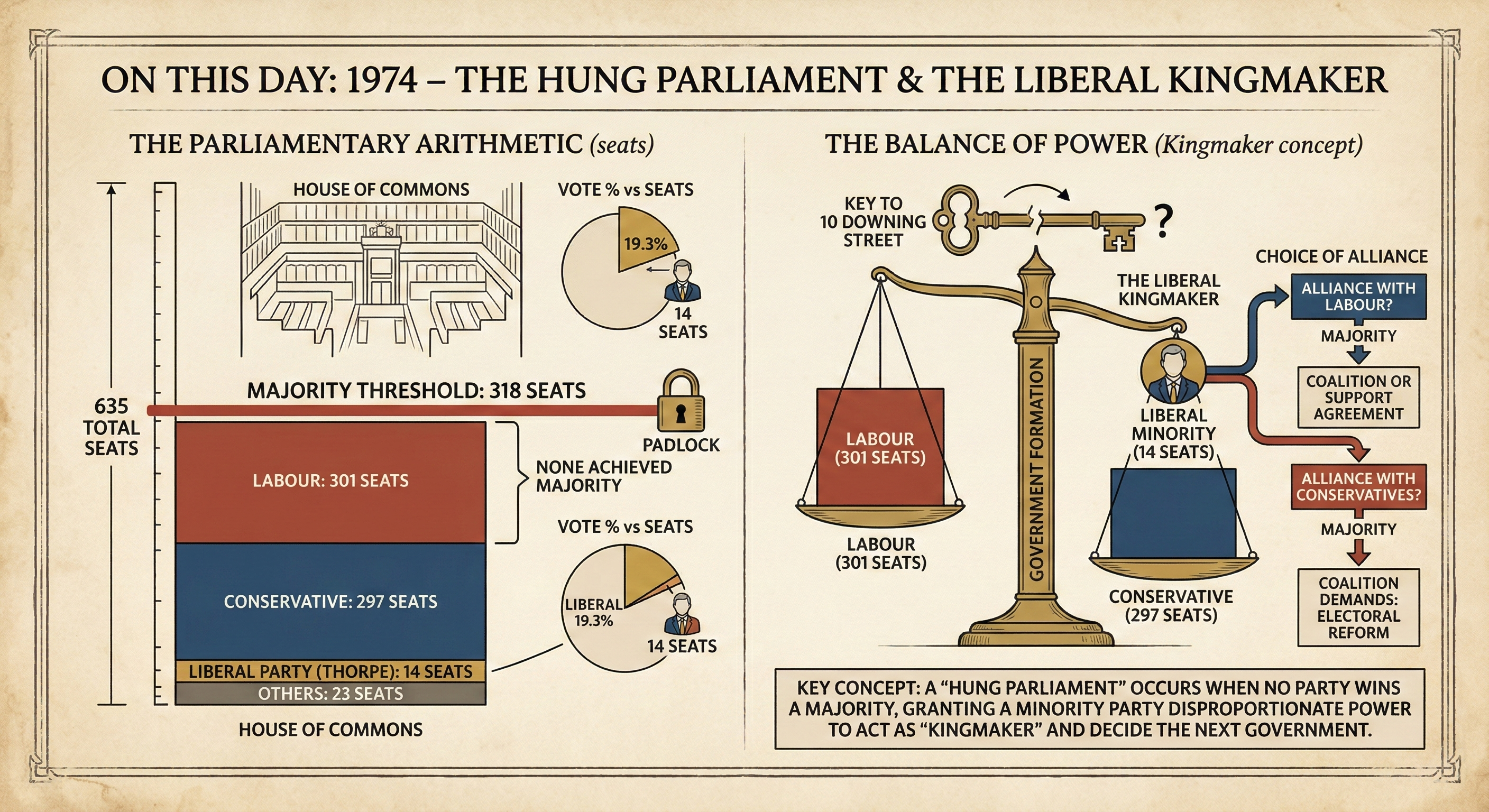
A prevalent myth regarding the February 28, 1974, election is that the British public delivered a clear “anti-Tory” mandate that Jeremy Thorpe squandered. In this version of history, Edward Heath’s Conservative government was resoundingly defeated by the electorate following the “Three-Day Week” and the bitter strikes of the National Union of Mineworkers. The record, however, shows a more confusing picture. The Conservative Party actually won the popular vote on February 28, 1974, securing 11,872,180 votes (37.9%) compared to Labour’s 11,645,616 (37.2%). The misconception that Labour won a “victory” ignores the fact that Harold Wilson’s party achieved fewer votes than the incumbent Conservatives, yet gained more seats (301 to 297) due to the quirks of the First Past the Post system.
Another enduring misconception is that Thorpe and the Liberals held a strong hand in negotiations during the first week of March 1974. The image of Thorpe at the center of a power-sharing drama often obscures the reality that his 14 seats were insufficient to provide Edward Heath with a stable majority. Even if the Liberals had joined a formal coalition with the Conservatives, the combined 311 seats would still have been short of the 318 required for an absolute majority in the 635-seat House of Commons. The idea that Thorpe “threw away” the chance to govern fails to account for the fact that a Conservative-Liberal pact would have remained vulnerable to every minor party and backbench rebel, making it a “coalition of the losers” in the eyes of many voters.
The numbers simply did not match the noise.
Documentary Evidence
The statistical record of February 28, 1974, provides a stark illustration of the “democratic deficit” that the Liberal Party spent the subsequent decades highlighting. On that day, the Liberal Party secured 6,063,470 votes, representing 19.3% of the total ballots cast. This was the highest vote share for the party since 1929. Despite this massive surge in popular support, the documentary evidence of the seat count shows they were awarded only 14 seats. This discrepancy meant that while it took approximately 38,000 votes to elect a Conservative MP and 40,000 to elect a Labour MP, it required over 430,000 votes to elect a single Liberal MP.
Internal party records and correspondence from the following days indicate that Thorpe’s demands during the negotiations with Edward Heath were not merely a matter of personal ego, but a desperate attempt to rectify this electoral imbalance. On March 3, 1974, Thorpe formally requested a commitment to electoral reform as the price of Liberal support. The documents from the Cabinet Office during this period reveal that Heath was unable to offer such a concession because his own backbenchers, already skeptical of a deal with the “unreliable” Thorpe, viewed proportional representation as an existential threat to the Conservative Party’s future. The failure of the talks was documented in Heath’s resignation letter to the Queen on March 4, 1974, which noted the impossibility of forming a government that could command the confidence of the House.
Main Turning Points
The first major turning point occurred on the evening of February 28, 1974, as the exit polls and early returns indicated that no party would achieve a majority. Unlike modern conventions where an incumbent prime minister might resign immediately if they fail to win the most seats, Edward Heath remained in 10 Downing Street. He spent the weekend of March 2-3, 1974, attempting to woo Thorpe. This period of “squatting” in power, as some critics called it, created an atmosphere of constitutional crisis that had not been seen in the United Kingdom since the early 20th century.
The second turning point was the specific rejection of the Liberal-Conservative alliance by the Liberal Party’s own governing bodies on March 4, 1974. Thorpe was personally inclined toward a deal, but the party’s radical wing and its activists were horrified by the prospect of propping up a Conservative government that had been at war with the trade unions. When the Liberal MPs met in the House of Commons, they realized that a coalition would likely destroy the party’s new-found momentum among protest voters. By 6:30 PM on March 4, 1974, the negotiations were dead, and Heath was forced to drive to Buckingham Palace to resign.
Finally, the appointment of Harold Wilson as Prime Minister later that same evening marked the transition to a minority Labour government. Wilson’s refusal to enter into any formal pact with the Liberals or the Scottish National Party (SNP) changed the tactical landscape. He gambled on the idea that no other party would want to trigger another election immediately, allowing him to govern by “ad hoc” majorities for several months.
Sources, Bias, and Debate
Historical analysis of the February 1974 election is often colored by the personal reputation of Jeremy Thorpe, which was later destroyed by the Norman Scott scandal and the trial at the Old Bailey in 1979. Many retrospective accounts written after 1979 tend to project Thorpe’s later perceived character flaws-vanity, impulsiveness, and deception-onto his leadership during the March 1974 negotiations. This creates a bias where the failure to reach a deal is blamed on Thorpe’s “unreliability” rather than the structural impossibilities of the 1974 parliament.
The central debate among historians concerns whether 1974 represented a missed opportunity for the “center ground” of British politics. Centrist historians often argue that if a Liberal-Conservative coalition had been formed, the UK might have avoided the hyper-polarization of the late 1970s and the radicalism of the Thatcher and Foot eras. Conversely, left-leaning historians argue that any such coalition would have been seen as an illegitimate attempt to circumvent the working-class rejection of Heath’s policies. The primary source material, including the memoirs of participants like Tony Benn and Lord Carrington, reflects these deep ideological divides, with Benn viewing the Liberal surge as a bourgeois distraction and Carrington viewing it as a missed chance for national unity.
The first 1974 election serves as a primary case study for proponents of electoral reform because it demonstrates how a party can gain millions of supporters while remaining mathematically marginalized. The 19.3% vote share achieved by the Liberals remains one of the most significant “what if” moments in British constitutional history. If the UK had used a proportional system on February 28, 1974, the Liberals would have held approximately 120 seats, making a coalition not just possible, but inevitable. This structural reality suggests that the “hung” nature of the parliament was not a result of voter indecision, but a result of a voting system that could no longer contain the three-party reality of the electorate.
What Shifted Next
The immediate aftermath of the February 28, 1974, election was a period of intense instability. Harold Wilson’s minority government survived on a day-to-day basis, unable to pass significant legislation without the threat of a snap defeat. This tension led directly to a second general election on October 10, 1974. In that contest, Wilson sought a “working majority” but achieved only a precarious lead of three seats. The Liberal vote share dipped slightly to 18.3%, and their seat count fell from 14 to 13, signaling that the momentum of the “Thorpe Surge” had hit a ceiling imposed by the electoral system.
Long-term, the events of 1974 broke the post-war consensus. The failure of both major parties to win a decisive mandate, combined with the rising influence of the SNP (who won 7 seats in February and 11 in October 1974), signaled the beginning of the end for the “two-party” era. The economic turmoil of 1974, characterized by 15% inflation and the continuing energy crisis, set the stage for the rise of Margaret Thatcher within the Conservative Party. By the time the next election arrived on May 3, 1979, the political landscape had shifted from the “who governs” question of 1974 to a fundamental debate about the role of the state, a shift that arguably would not have been so radical had the 1974 hung parliament resulted in a stable, centrist coalition.
Sources
- February 1974 United Kingdom general election: https://wikipedia.org/wiki/February_1974_United_Kingdom_general_election
- Hung parliament: https://wikipedia.org/wiki/Hung_parliament
- Jeremy Thorpe: https://wikipedia.org/wiki/Jeremy_Thorpe
- Liberal Party (UK): https://wikipedia.org/wiki/Liberal_Party_(UK)
- The British General Election of February 1974 by David Butler and Dennis Kavanagh (Reference lookup recommended)
- The Path to 1974: British Politics in the Age of Crisis (Institutional archive lookup recommended)