On This Day: 1844 - A gun explodes on board the steam warship USS Princeton during a pleasure cruise down the Potom
The cold waters of the Potomac River carried the weight of the nation's technological aspirations on February 28, 1844.
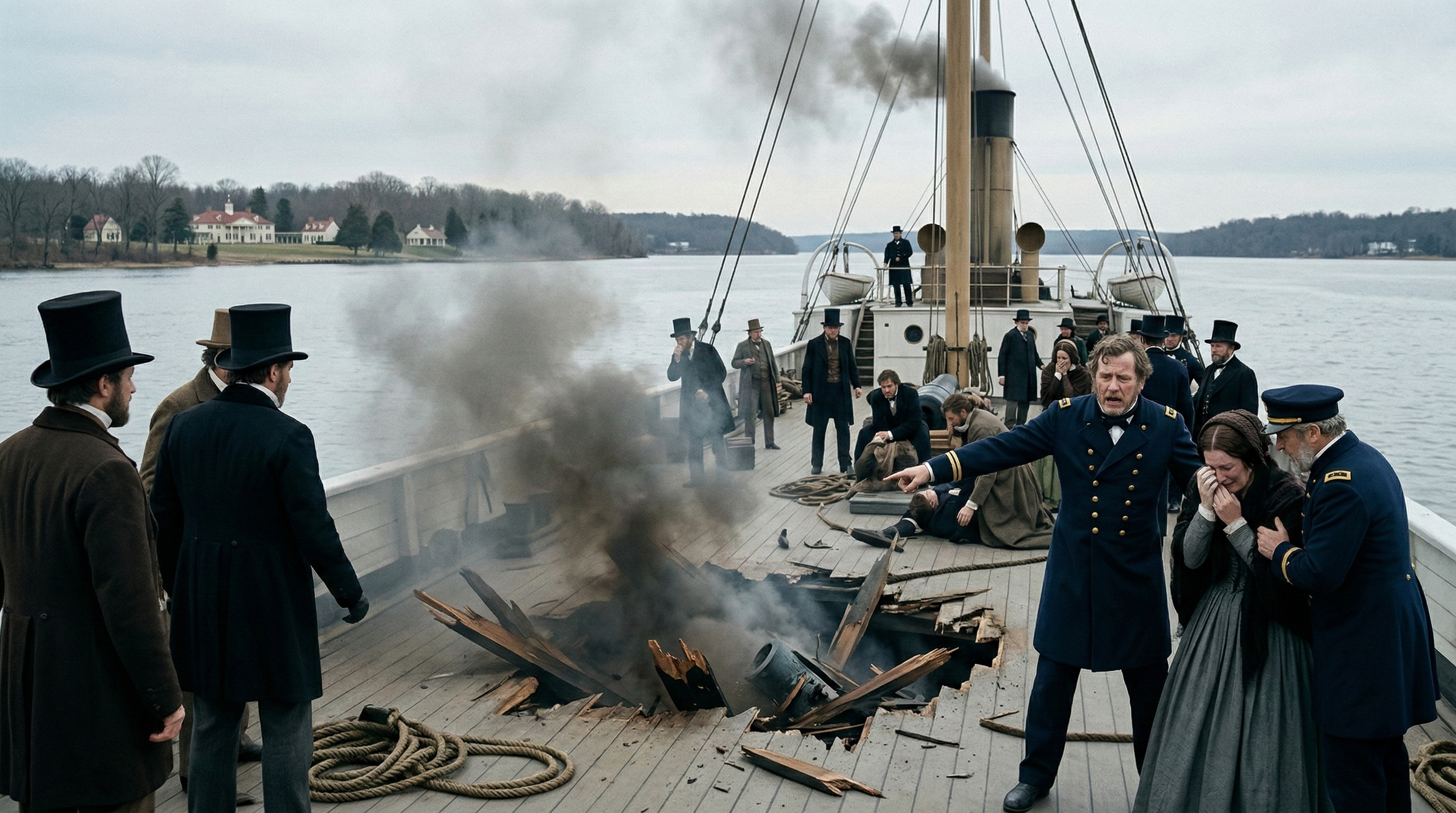
The cold waters of the Potomac River carried the weight of the nation’s technological aspirations on February 28, 1844. As the USS Princeton glided past Mount Vernon, the ship represented the cutting edge of naval innovation-a screw-propelled steamer that promised to redefine American power. The immediate tragedy, occurring within sight of the Virginia and Maryland shorelines, did more than kill high-ranking officials; it shattered the fragile political equilibrium of the Mid-Atlantic states. From the blood-stained decks, a wave of instability surged outward, reaching the disputed borders of Texas and the legislative halls of the Deep South, ultimately reshaping the path toward the American Civil War.
Local Context
In the early months of 1844, Washington D.C. was a city of spectacle and nascent industrial pride. The USS Princeton, launched in late 1843, was the brainchild of Captain Robert F. Stockton and the brilliant Swedish engineer John Ericsson. It was the first ship of its kind to be powered by a submerged screw propeller rather than the cumbersome paddle wheels that characterized earlier steam vessels. To match its revolutionary propulsion, Stockton commissioned the “Peacemaker,” a massive 12-inch wrought-iron gun designed to fire 225-pound cannonballs over distances previously thought impossible for naval ordnance.
On February 28, 1844, the Princeton departed from Alexandria, Virginia, for a pleasure cruise down the Potomac River. The guest list was a “who’s who” of the American political elite, including President John Tyler, members of his cabinet, and over 400 other dignitaries and their families. The atmosphere was celebratory, fueled by music, fine wines, and the rhythmic thrum of the new steam engine.
The ship made several successful test fires of the Peacemaker during the voyage downriver. As the vessel turned back toward the capital, Stockton was persuaded to fire a final salute for the guests. At approximately 4:00 PM, near the mouth of Piscataway Creek, the breach of the Peacemaker failed catastrophically upon firing. The resulting explosion did not just destroy the gun; it sent jagged iron shards through the crowd of spectators on the deck.
The festive atmosphere evaporated into a shroud of sulfurous smoke and iron shards.
Six people were killed instantly or shortly thereafter. Among the dead were Secretary of State Abel P. Upshur, Secretary of the Navy Thomas Walker Gilmer, and Virgil Maxcy, a former American chargé d’affaires to Belgium. Also killed were David Gardiner, a former New York state senator, and Beverly Kennon, a high-ranking naval officer. President Tyler, who had been delayed below deck by a toast, narrowly escaped the carnage, though the loss of his most trusted advisors left his administration in a state of sudden, localized collapse.
Regional Situation During the Event
The regional landscape of 1844 was defined by a volatile mix of expansionism and sectional tension. In Virginia and Maryland, the political class was deeply invested in the “Tyler Doctrine,” a strategy largely orchestrated by Abel Upshur to integrate Texas into the Union as a slave state. The Mid-Atlantic region served as the intellectual and political hub for these maneuvers, with the James River aristocracy and the Maryland planter class providing the ideological backbone for the administration’s policies.
At the time of the explosion, the Texas annexation treaty was in its final stages of secret negotiation. The deaths of Upshur and Gilmer-both prominent Virginians-were seen as a devastating blow to the Tidewater region’s influence over national policy. Without their leadership, the “Virginia Dynasty” style of expansionist diplomacy was momentarily headless. The disaster occurred just as the neighboring regions of the North were beginning to mobilize against the annexation, viewing it as a scheme to expand the political power of the slave-holding South.
The regional panic following the explosion was palpable. In Richmond, the news was received with a mix of grief and political anxiety, as Gilmer had recently served as the Governor of Virginia. The loss of such key figures meant that the upcoming spring elections in the Mid-Atlantic states would be fought under a cloud of uncertainty, with the Whig and Democratic parties both scrambling to fill the power vacuum left by the sudden removal of the administration’s key architects.
Wider Regional Effects
The ripples from the Princeton disaster moved westward and southward with remarkable speed. The most significant regional consequence was the elevation of John C. Calhoun of South Carolina to the position of Secretary of State. President Tyler, desperate to maintain momentum for his expansionist agenda, appointed Calhoun in March 1844 to succeed the fallen Upshur. This change in leadership shifted the gravity of American foreign policy from the more moderate Virginian approach to the hardline, sectionalist stance of the Deep South.
The sudden vacancy of the Secretary of State position allowed for the rise of John C. Calhoun, a move that fundamentally altered the character of American sectionalism. While Abel Upshur had pursued the annexation of Texas through a lens of national security and regional balance, Calhoun framed the acquisition almost exclusively as a defense of the “peculiar institution” of slavery. This shift in rhetoric, triggered by the explosion on the Potomac, solidified Northern opposition to expansion and bridged the gap between anti-slavery advocates and moderate Whigs. Consequently, the smoke from the Peacemaker gun did not just signal a naval disaster; it acted as a catalyst for the hardening of regional identities that would collide in 1861.
In the Republic of Texas, the news of the explosion created a momentary diplomatic freeze. President Sam Houston and the Texas leadership had been working closely with Upshur; the sudden change to Calhoun introduced a layer of Southern radicalism that made the annexation treaty a lightning rod for controversy in the U.S. Senate. When the treaty was finally presented in April 1844, it was rejected, largely because Calhoun’s involvement had made the issue purely about the expansion of slavery, alienating the Free States of the Northeast and the Great Lakes region.
Sources, Bias, and Debate
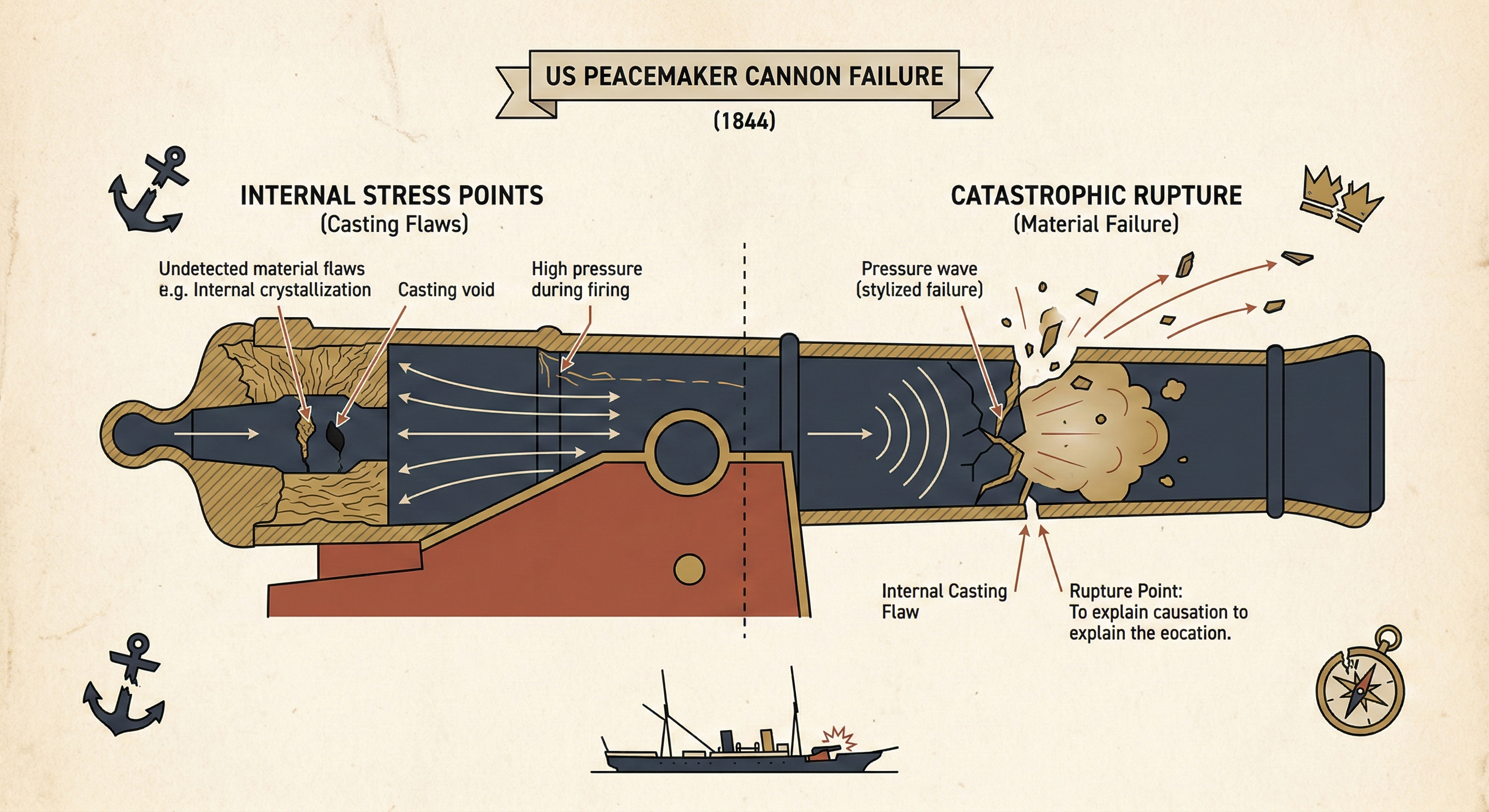
Historical accounts of the Princeton disaster often grapple with the question of culpability, specifically regarding the relationship between Robert Stockton and John Ericsson. Early reports and the subsequent naval court of inquiry, concluded in March 1844, largely exonerated Stockton, citing a “hidden flaw” in the wrought iron. However, modern metallurgical analysis and contemporary engineering critiques suggest a different story. Ericsson had warned that the Peacemaker was built using an inferior method compared to his own gun, the “Orator,” which had successfully withstood similar pressures.
There is a significant bias in 19th-century accounts toward protecting Stockton’s reputation, as he was a politically connected figure with aspirations of his own. Many newspapers of the era, depending on their partisan leanings, either painted the event as an act of God or a failure of “foreign” engineering (referring to Ericsson). The debate continues among naval historians regarding whether the disaster was an inevitable result of the limitations of wrought-iron forging in the 1840s or a direct consequence of Stockton’s hubris in ignoring Ericsson’s technical specifications.
Furthermore, the romanticized narrative of President Tyler’s survival often overshadows the cold political reality that his narrow escape did not prevent the total derailment of his legislative agenda. Some historians argue that the explosion effectively ended Tyler’s hopes for a third-party run in the 1844 election, as it stripped him of his most effective cabinet advocates during the peak of the campaign season.
Long-Range Historical Impact
The long-range impact of the explosion on February 28, 1844, is visible in the evolution of American naval technology and the acceleration of the Civil War. In the immediate aftermath, the U.S. Navy moved away from the use of massive wrought-iron guns, recognizing that the material was prone to “work hardening” and fatigue. This led to the development of hooped guns and eventually steel-reinforced ordnance by the 1860s. The disaster served as a brutal lesson in the dangers of pushing industrial limits without standardized testing protocols, a realization that would eventually lead to the establishment of more rigorous naval engineering standards in the late 19th century.
Politically, the disaster is often cited as a “turning point” that made the American Civil War more likely. By bringing John C. Calhoun into the cabinet, the Princeton disaster ensured that the annexation of Texas would be processed in the most divisive manner possible. When Texas was finally admitted to the Union in December 1845, the sectional wounds were already deep. The war with Mexico that followed in 1846, fueled by the same expansionist fervor, further exacerbated the divide between North and South.
Additionally, the event underscored the vulnerability of the executive branch. The loss of two cabinet members in a single afternoon was unprecedented and highlighted the need for more robust presidential security and succession planning. While it would take the assassination of Abraham Lincoln in 1865 to trigger more formal changes to presidential protection, the Princeton disaster remained a haunting reminder for decades of how easily the leadership of the Republic could be decimated by a single technological failure.
Sources
- USS Princeton disaster of 1844: https://wikipedia.org/wiki/USS_Princeton_disaster_of_1844
- USS Princeton (1843): https://wikipedia.org/wiki/USS_Princeton_(1843)
- Potomac River: https://wikipedia.org/wiki/Potomac_River
- Abel P. Upshur: https://wikipedia.org/wiki/Abel_P._Upshur
- John Tyler: https://wikipedia.org/wiki/John_Tyler
- “The Slaveholding Republic: An Account of the United States Government’s Relations to Slavery” by Don E. Fehrenbacher (reference lookup recommended).
- National Archives and Records Administration (NARA), Record Group 45: Naval Records Collection regarding the Court of Inquiry on the USS Princeton (reference lookup recommended).