On This Day: 1776 - The Battle of Moore's Creek Bridge in North Carolina breaks up a Loyalist militia
By the winter of 1775, Royal Governor Josiah Martin of North Carolina was a ruler without a realm.
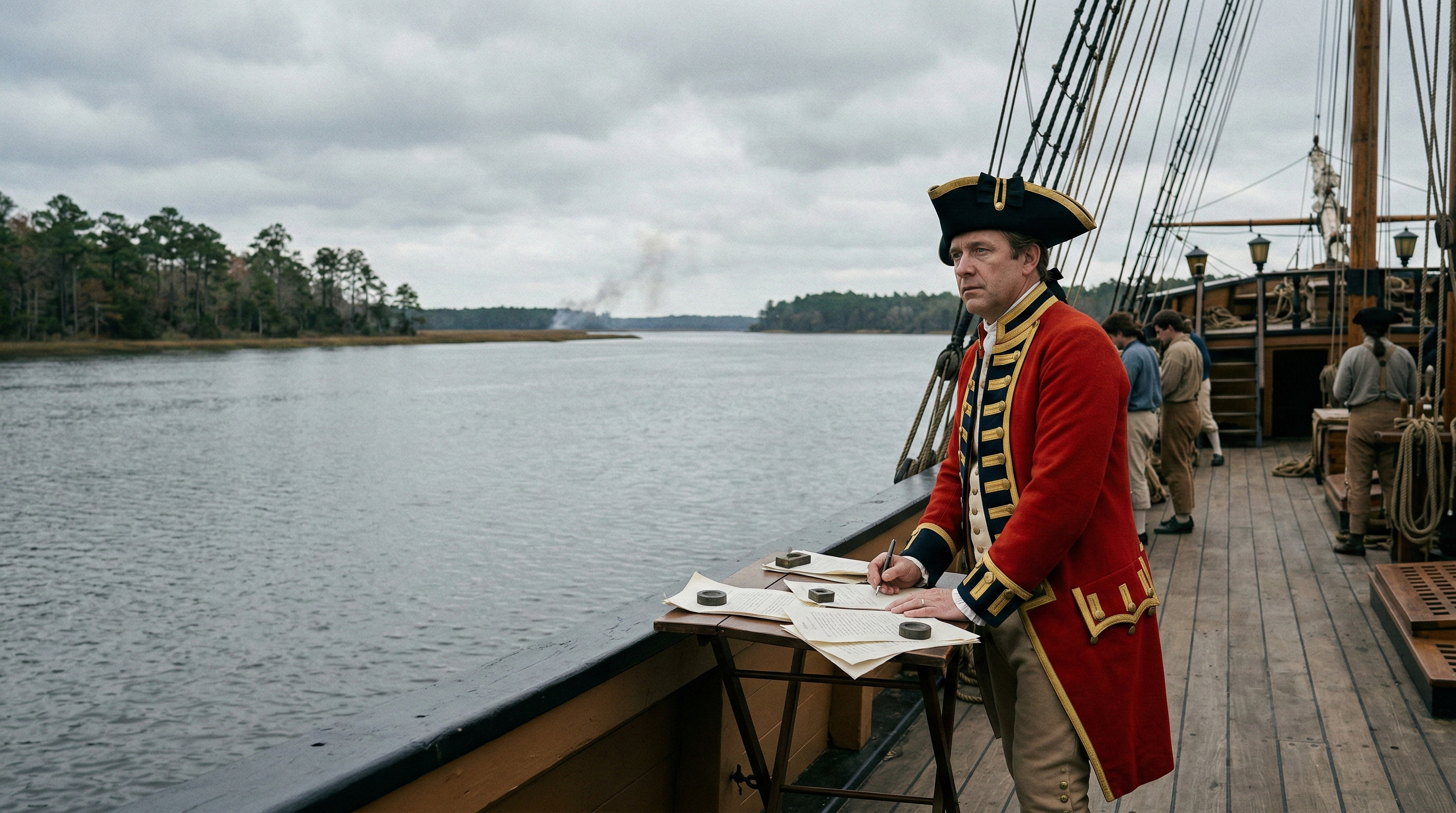
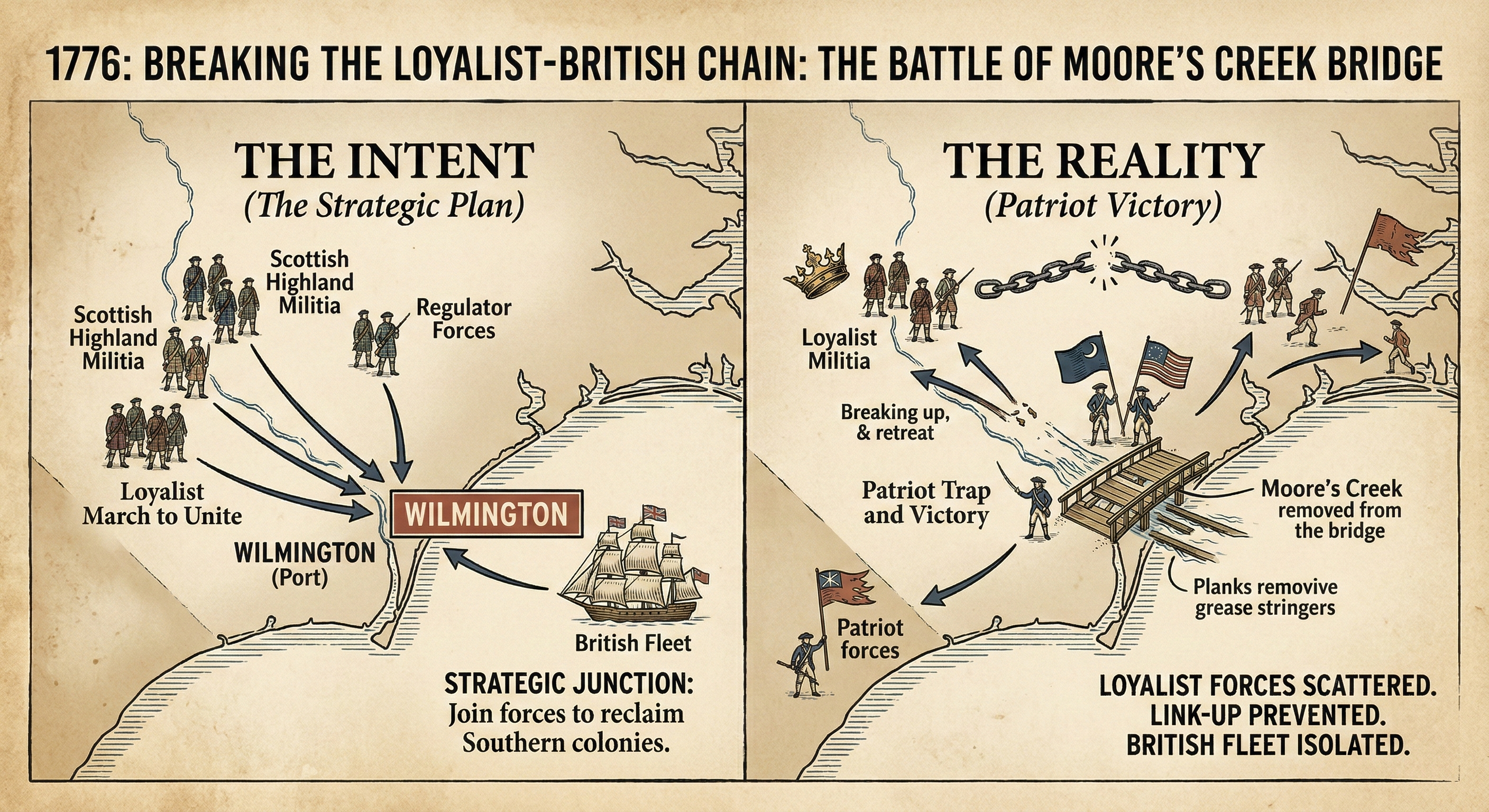
The authority of the British Crown in the Southern colonies did not vanish with a single declaration; it eroded through a series of tactical blunders and a fundamental failure to recognize the speed of Patriot mobilization. By the winter of 1775, Royal Governor Josiah Martin of North Carolina was a ruler without a realm. Forced to flee his palace in New Bern in May 1775, he had taken refuge aboard the HMS Cruizer in the Cape Fear River, where he spent months drafting desperate pleas to London. Martin believed that a “silent majority” of King George III’s subjects-specifically the Scottish Highlanders who had recently settled in the Cape Fear valley-awaited only a signal to rise and crush the burgeoning rebellion. This conviction led to a high-stakes gamble: if a local Loyalist militia could reach the coast to rendezvous with a massive British naval expedition, North Carolina could be reclaimed as a base of operations to split the colonies in two.
Short-Term Triggers
The immediate catalyst for the conflict was Governor Martin’s official proclamation on January 10, 1776, which authorized the raising of the King’s standard. He commissioned Donald MacDonald, a veteran of the Battle of Bunker Hill and the Jacobite Rising of 1745, as a brigadier general to lead this new force. MacDonald and his fellow officers began recruiting heavily among the Highland Scots near Cross Creek, which is known as Fayetteville in modern times. While the British expected thousands to flock to the cause, the reality was more modest. By mid-February 1776, roughly 1,600 men had assembled, many of them armed only with traditional broadswords because they lacked sufficient muskets and powder.
Simultaneously, the Patriot leadership in North Carolina, operating through the Provincial Council, recognized the existential threat posed by an organized Loyalist army. Colonel James Moore of the 1st North Carolina Regiment took command of the Patriot response, orchestrating a series of maneuvers designed to trap MacDonald’s forces before they could reach the Atlantic. Throughout February 1776, Moore and his subordinates, including Richard Caswell and Alexander Lillington, tracked the Loyalist movement through the dense swamps and pine barrens. They successfully funneled the Highlanders toward a narrow crossing over Moore’s Creek, approximately 20 miles north of Wilmington, where the terrain stripped the Loyalists of their ability to maneuver.
The Event Itself
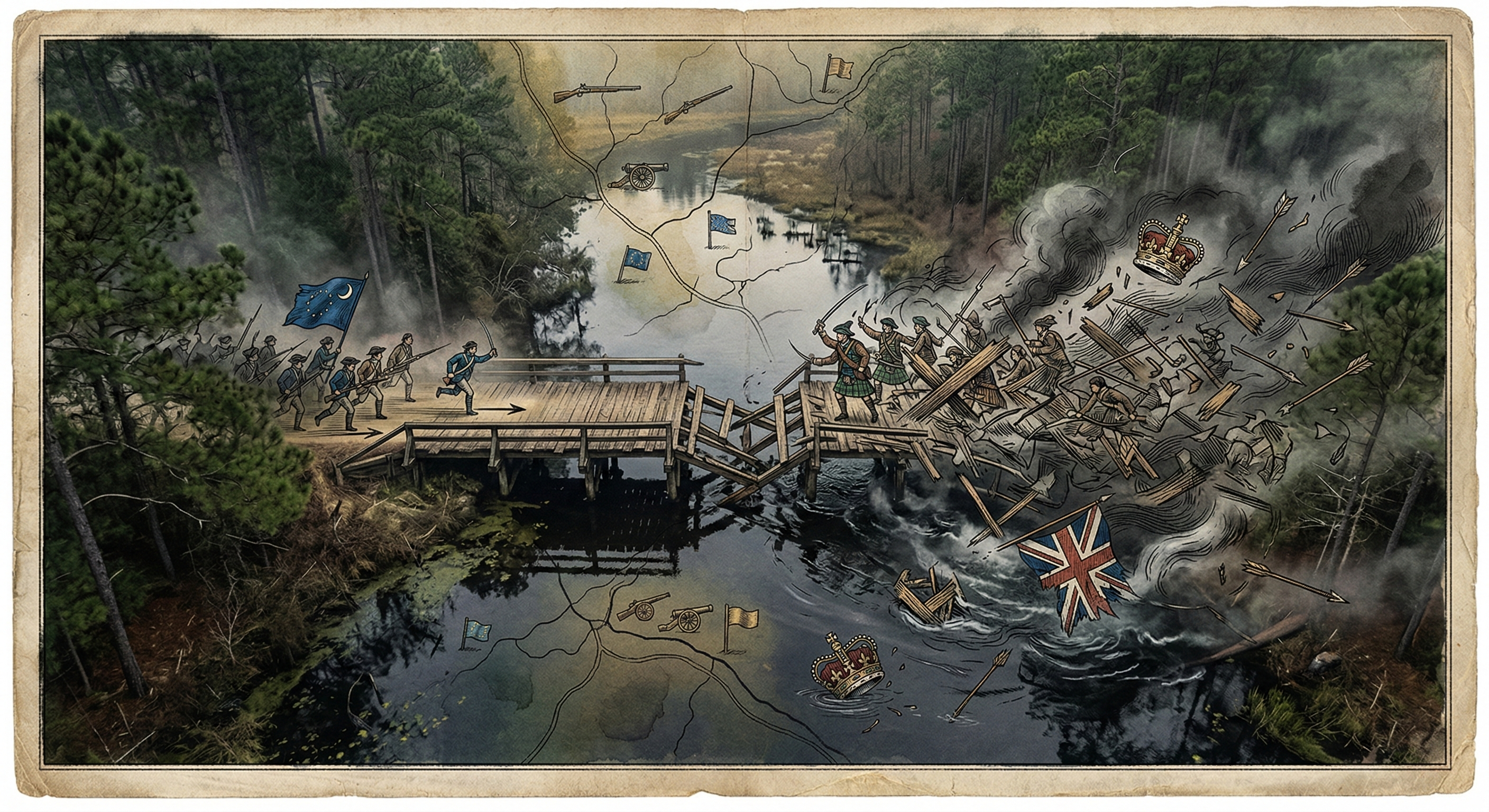
In the pre-dawn darkness of February 27, 1776, the Loyalist militia approached the bridge spanning the black waters of Moore’s Creek. They expected to find a small, fleeing Patriot rear guard, but Colonel Alexander Lillington had arrived the day before and fortified the high ground on the eastern bank. Crucially, the Patriot forces had engaged in a clever piece of tactical sabotage. They had removed the planks from the bridge and greased the remaining horizontal support beams, known as sleepers, with a mixture of tallow and lard. This made the crossing a treacherous bottleneck that required any attacker to balance precariously over the freezing water.
As the sun began to rise, a force of about 80 Loyalists, led by Captains John Campbell and Alexander McLeod, initiated a charge. Waving their broadswords and shouting the Gaelic war cry “King George and Broadswords!”, they attempted to navigate the greased sleepers. The Patriot forces held their fire until the Highlanders were midway across the bridge and within point-blank range. Two cannons, nicknamed “Mother Covington” and her daughter, were unmasked and unleashed a devastating discharge of grapeshot and canister.
The brief, violent clash at the bridge lasted no longer than three minutes.
McLeod and Campbell were killed instantly, and the men following them were either shot or fell into the creek to drown. Seeing their vanguard annihilated, the remaining Loyalist force-mostly unseasoned recruits-broke and fled into the surrounding woods. The Patriot militia, realizing the enemy was in full retreat, quickly replaced the bridge planks and gave chase, transforming a successful defense into a decisive rout.
Early Consequences
The immediate aftermath of the engagement on February 27, 1776, was a total collapse of the Loyalist military infrastructure in North Carolina. Within days of the battle, Patriot forces captured 850 soldiers and nearly all of the Loyalist leadership, including General MacDonald himself. The spoils of war were significant for the cash-strapped revolutionaries: the Patriots seized 1,500 rifles, 350 muskets, 150 swords, and a chest containing £15,000 in gold. This windfall provided the North Carolina militia with the equipment they desperately needed to formalize their defense of the province.
The political impact was even more profound than the military tally. On April 12, 1776, emboldened by the victory at Moore’s Creek, the North Carolina Provincial Congress met and adopted the Halifax Resolves. This document was the first official provincial action in the American colonies to explicitly authorize its delegates to the Continental Congress to vote for total independence from Great Britain. The victory at the bridge had effectively ended Royal government in the colony, leaving Governor Martin to watch from his ship as his plans for a Southern restoration crumbled.
Evidence and Historical Debate
Historians frequently refer to the Battle of Moore’s Creek Bridge as the “Lexington and Concord of the South.” This comparison is supported by the fact that the engagement ended British hopes for a quick resolution to the conflict in the Southern theater. However, a point of ongoing historical debate concerns the actual number of participants and the composition of the Loyalist force. While early accounts often emphasized the “Highland” nature of the force to paint them as foreign mercenaries, more recent scholarship suggests a significant minority of the Loyalists were actually regulators and locally born farmers who were motivated more by a desire for stability than by an ancestral devotion to the House of Hanover.
There is also a persistent debate regarding the specific role of Flora Macdonald, the famous Jacobite heroine who had moved to North Carolina in 1774. Legend suggests she rode among the troops on a white horse to inspire them before the march, but many modern historians view this as a romanticized narrative developed in the 19th century to heighten the drama of the “Scottish” defeat. Regardless of the mythic elements, the physical evidence of the Patriot fortifications and the surviving reports from Colonel Richard Caswell confirm that the use of the greased bridge was a deliberate and recorded tactical choice rather than a later embellishment.
Structural Consequences
The Battle of Moore’s Creek Bridge serves as a seminal example of the “people’s war” aspect of the American Revolution, where localized militia and ideological fervor outmaneuvered traditional loyalties. By greasing the sleepers of the bridge, the Patriots demonstrated a tactical ingenuity that compensated for their lack of professional military training. This specific engagement effectively decapitated the Loyalist leadership in North Carolina before the British Army could arrive to support them. Consequently, the victory ensured that the transition from a colonial assembly to a revolutionary government occurred with minimal internal resistance during the critical months of 1776.
On a broader strategic level, the defeat forced the British to rethink their entire approach to the war. When the British fleet under General Henry Clinton finally arrived off the North Carolina coast in May 1776, they found no Loyalist army to greet them and no safe port to occupy. This forced Clinton to divert his forces further south to attempt an attack on Charleston, South Carolina, which ultimately failed at the Battle of Sullivan’s Island in June 1776. Because of the failure at Moore’s Creek, the British largely abandoned the Southern colonies for the next two years, focusing their primary efforts on New York and Pennsylvania. It would not be until 1778 that the British returned to a “Southern Strategy,” but by then, the Patriot governments in the South were firmly entrenched and far better prepared for a protracted war of attrition.
Sources
- American Revolutionary War: https://wikipedia.org/wiki/American_Revolutionary_War
- Battle of Moore’s Creek Bridge: https://wikipedia.org/wiki/Battle_of_Moore%27s_Creek_Bridge
- North Carolina: https://wikipedia.org/wiki/North_Carolina
- Loyalist (American Revolution): https://wikipedia.org/wiki/Loyalist_(American_Revolution)