On This Day: 1617 - Sweden and the Tsardom of Russia sign the Treaty of Stolbovo, ending the Ingrian War and shutti
This perspective ignores the intense internal pressures facing the Swedish King, Gustavus Adolphus.
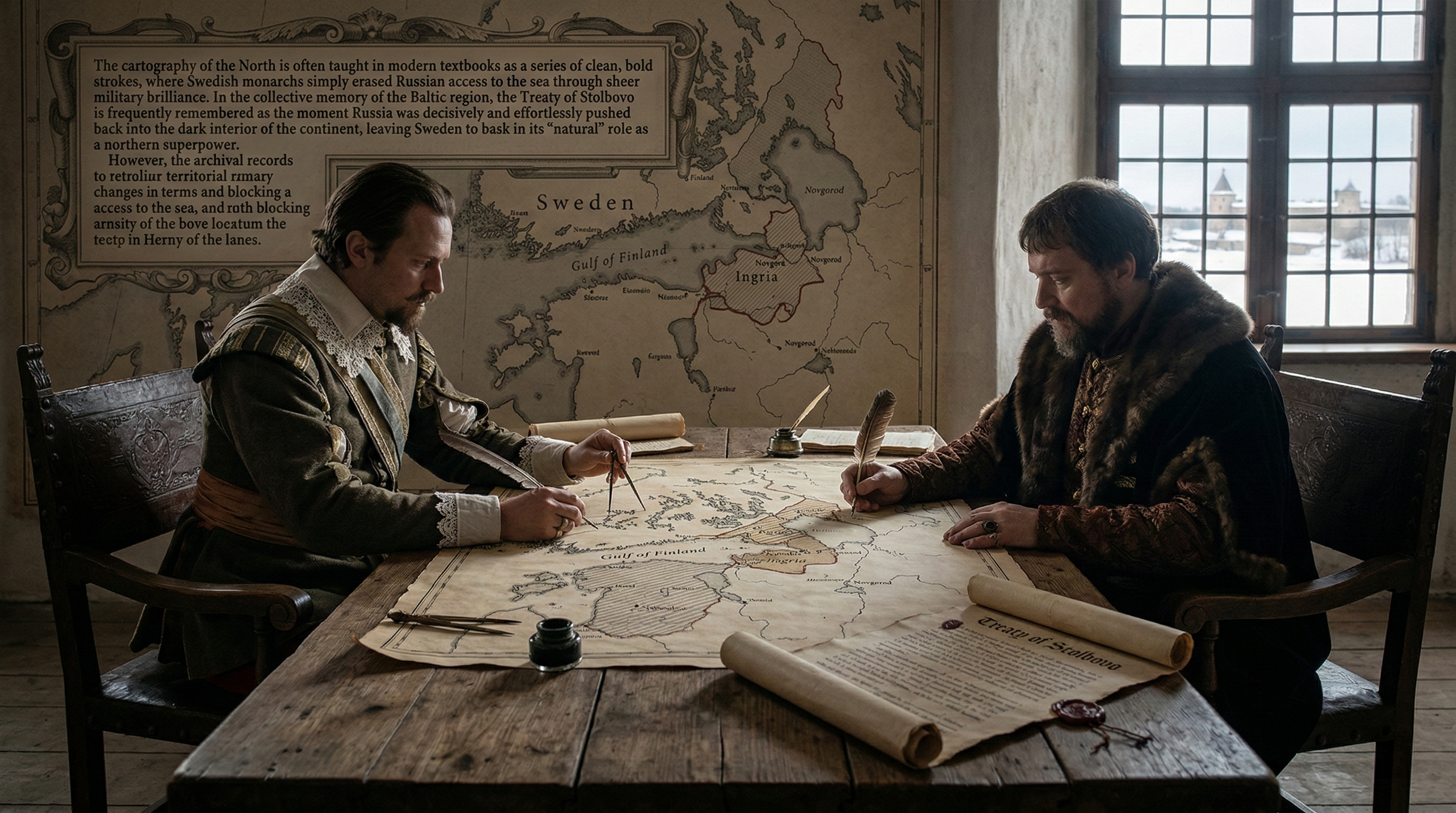
The cartography of the North is often taught in modern textbooks as a series of clean, bold strokes, where Swedish monarchs simply erased Russian access to the sea through sheer military brilliance. In the collective memory of the Baltic region, the Treaty of Stolbovo is frequently remembered as the moment Russia was decisively and effortlessly pushed back into the dark interior of the continent, leaving Sweden to bask in its “natural” role as a northern superpower. However, the archival records from the early seventeenth century tell a far more chaotic story of negotiated exhaustion, where neither side truly achieved their maximalist goals. The diplomatic table at Stolbovo, a village near Lake Ladoga, was not a place of grand triumph, but a site where two battered entities-the Swedish Empire and the Tsardom of Russia-sought an exit from a conflict that neither could afford to continue.
Popular Misreadings
A common misconception regarding the Ingrian War and its conclusion on February 27, 1617, is the idea that the Tsardom of Russia was a helpless victim of Swedish expansionism. Popular narratives often paint the first Romanov Tsar, Michael I, as a passive figure who inherited a ruined state and simply surrendered to the superior Swedish war machine. This perspective ignores the intense internal pressures facing the Swedish King, Gustavus Adolphus. While Sweden was indeed on the ascendant, the Swedish treasury was nearly empty by 1616, and the Swedish military was stretched thin across several fronts, including ongoing tensions with Poland-Lithuania.
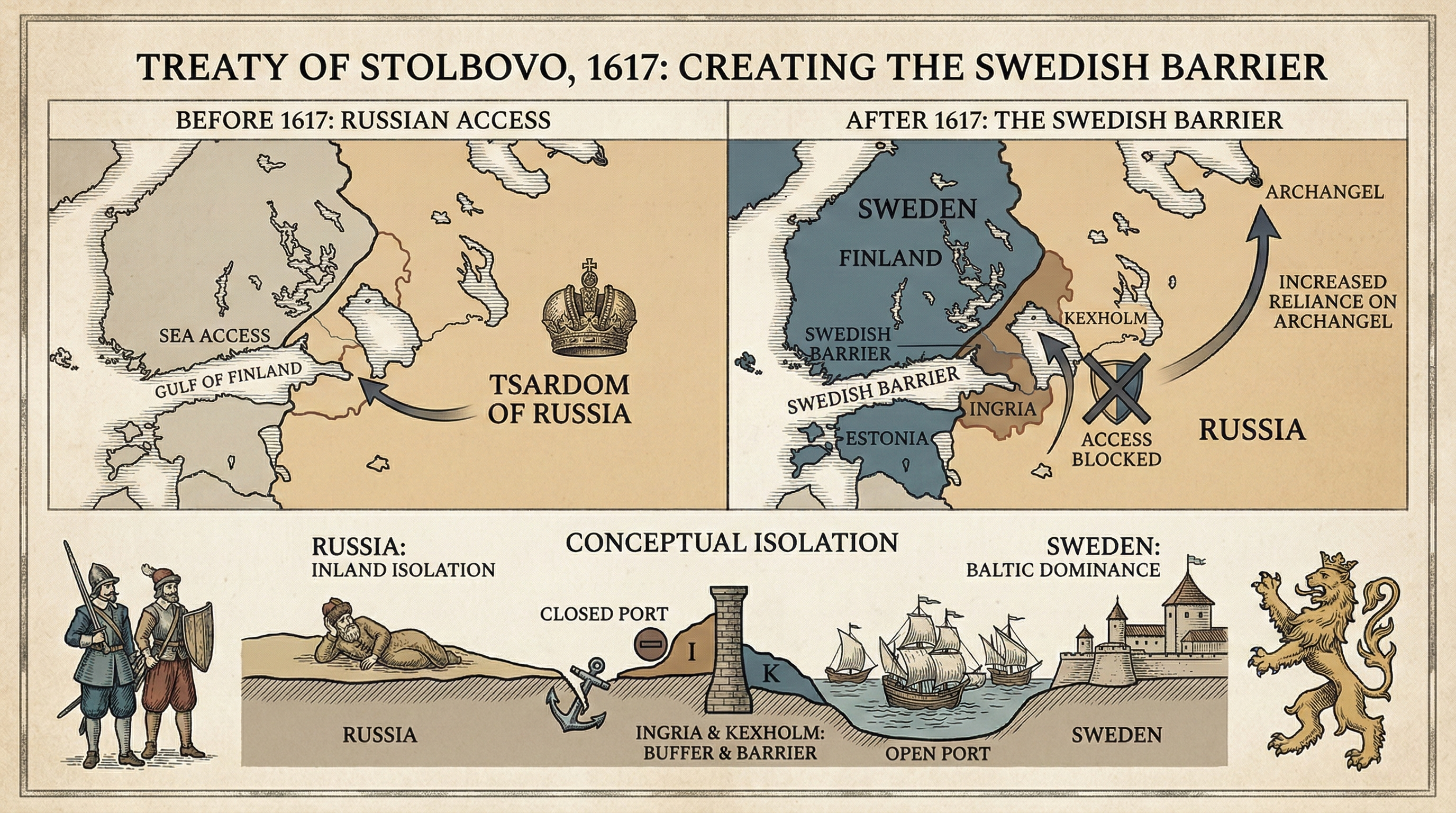
Another frequent misreading is the belief that the Treaty of Stolbovo was a total blockade of Russian trade. Many historical summaries suggest that Russia was “sealed off” from the West entirely. While the treaty did deprive Russia of its direct coastline on the Baltic Sea, it did not end Russian commerce. The record shows that specific provisions were made for Russian merchants to continue trading through the ports they had just lost, albeit under Swedish customs and control. The “shutting out” was a geopolitical and military reality, but economically, the door remained slightly ajar, as Sweden was desperate for the tax revenue that Russian trade provided.
Finally, there is a myth that the Swedish acquisition of Ingria and Kexholm was a “natural” expansion of their borders. On the contrary, the locals in these territories were often linguistically and religiously tied to Russia. The annexation was a difficult administrative undertaking that required decades of forced integration and religious pressure, rather than a smooth transition into a Swedish “homeland.”
What the Record Supports
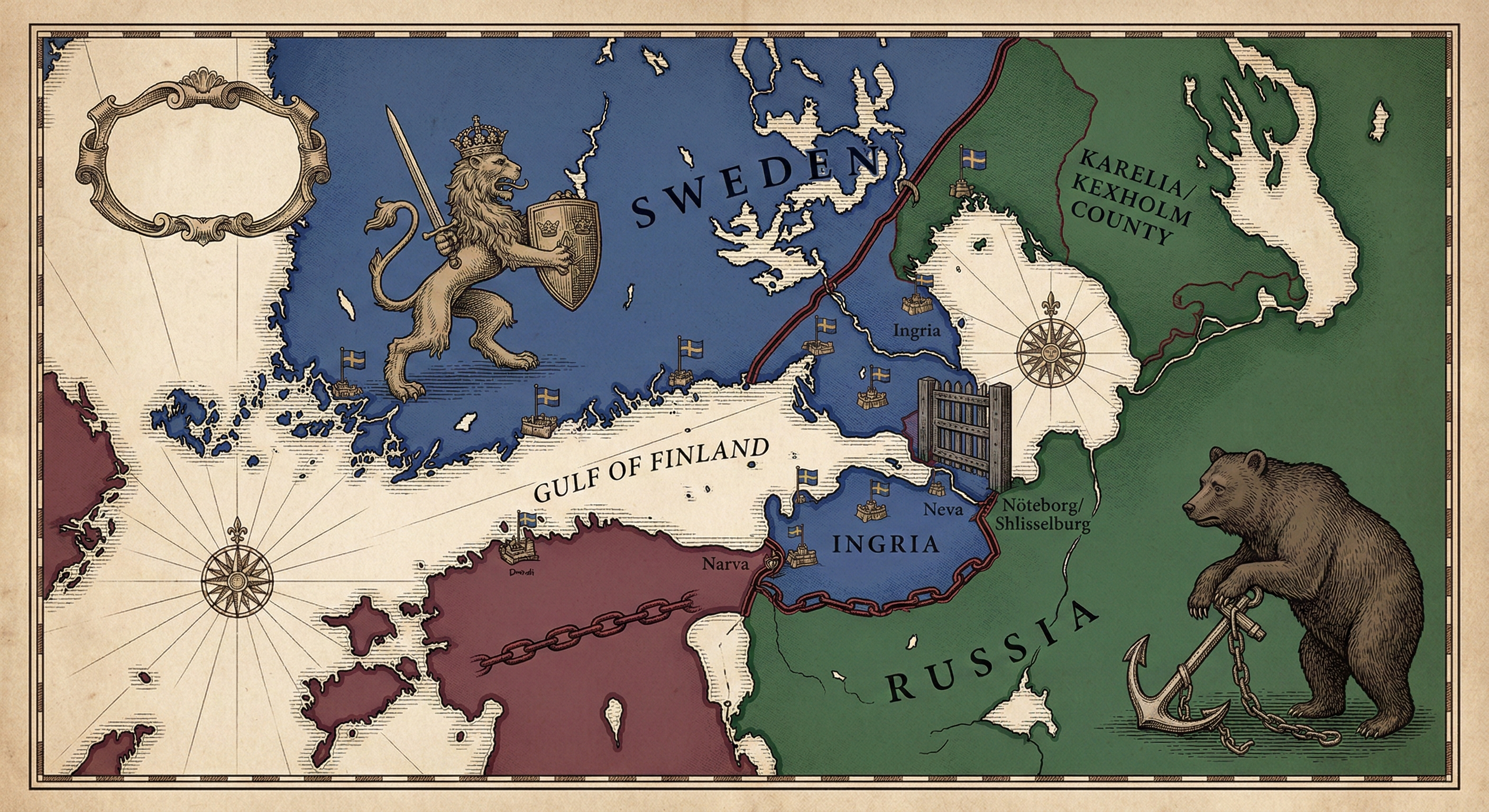
The documented facts of the Treaty of Stolbovo, signed on February 27, 1617, confirm a massive shift in territorial holdings. Sweden received the province of Ingria and the county of Kexholm, which included strategic fortresses such as Ivangorod, Yam, Koporye, and Noteborg (now Shlisselburg). These acquisitions effectively created a land bridge between the Swedish province of Estonia and the Finnish territories, forming a continuous Swedish perimeter around the eastern Baltic.
By the time the ink dried, the strategic map of Northeastern Europe had been fundamentally rewritten.
The records also highlight the financial components of the peace. The Tsardom of Russia agreed to pay an indemnity of 20,000 rubles to Sweden. In the context of 1617, this was a significant sum that helped stabilize the Swedish economy after years of mobilization. In exchange for these concessions, Sweden returned the city of Novgorod, which it had occupied since 1611, and recognized Michael Romanov as the legitimate Tsar of Russia. This recognition was crucial for the young Romanov dynasty, which was still struggling to establish its authority after the “Time of Troubles,” a period of civil war and foreign intervention that lasted from 1598 to 1613.
Main Turning Points
The path to Stolbovo was paved by several critical military and political shifts. The first major turning point was the Swedish occupation of Novgorod in July 1611. Led by Jacob De la Gardie, Swedish forces seized the city not merely as a conquest, but as a bargaining chip to influence the Russian succession. At one point, there were serious discussions about placing a Swedish prince on the Russian throne, a prospect that only collapsed with the rise of a national Russian resistance movement.
A second turning point occurred in 1613 with the election of Michael Romanov. This event provided the Russian state with a centralized focal point for the first time in over a decade. While the Swedish military continued to hold the advantage, the Russian defense became more organized. The failure of the Swedish siege of Pskov in August 1615 served as a definitive reality check for Gustavus Adolphus. After months of failing to breach the city’s walls and suffering significant losses, the Swedish King realized that a total conquest of the Russian heartland was impossible.
The final turning point was the intervention of English and Dutch mediators. John Merick, an English diplomat representing the Muscovy Company, arrived in 1615 to facilitate talks. The English were motivated by a desire to protect their own trade routes and prevent either side from becoming too dominant. These negotiations took place throughout 1616 and culminated in the final assembly at Stolbovo in early 1617.
Evidence and Historical Debate
The diplomatic intervention of John Merick, representing the English Muscovy Company and King James I, serves as a primary piece of evidence against the idea that the Treaty of Stolbovo was a purely regional affair. Merick’s presence at the negotiations, which stretched from late 1615 through the final signing on February 27, 1617, highlights the international stakes involving trade routes to the East. England sought to preserve its own commercial interests by ensuring that neither Sweden nor the Tsardom of Russia completely collapsed, thereby maintaining a delicate balance that allowed English merchants continued access to Russian resources. Furthermore, the meticulous preservation of the 20,000-ruble indemnity records suggests that the treaty was less about a total defeat and more about a calculated financial settlement intended to fund Sweden’s further ambitions in Central Europe.
Historians continue to debate whether the “shutting out” of Russia from the Baltic Sea was the primary driver of Peter the Great’s later wars. Some scholars argue that the loss of the coastline in 1617 created a “security trauma” in the Russian psyche that made a future conflict inevitable. Others suggest that the 1617 borders were actually quite stable and might have persisted if not for the aggressive expansionism of Peter I in the 1700s. There is also ongoing debate regarding the demographic impact of the treaty. As Sweden took control of Ingria, thousands of Orthodox peasants fled into Russian territory to escape the Lutheran administration, a mass migration that some historians classify as one of the earliest examples of state-driven religious displacement in the region.
Immediate Aftermath
The immediate consequence of the Treaty of Stolbovo was the birth of the Swedish “Stormaktstiden,” or the Age of Greatness. With its eastern flank secured and its treasury bolstered by Russian rubles, Sweden was free to turn its attention toward the Holy Roman Empire. This geopolitical shift allowed Gustavus Adolphus to intervene in the Thirty Years’ War in 1630, a move that would eventually make Sweden the dominant power in Europe for nearly a century.
For the Tsardom of Russia, the treaty provided a much-needed breathing room. Although the loss of the Baltic coast was a bitter pill, the return of Novgorod allowed the Romanovs to begin the long process of internal reconstruction. The year 1617 marked the end of the foreign interventions that had nearly destroyed the Russian state. While Russia was landlocked in the north, it began to look south and east for expansion, laying the groundwork for its eventual push toward the Black Sea and Siberia. The borders established at Stolbovo remained largely intact until the Great Northern War began in 1700, making it one of the most durable, if controversial, peace settlements of the seventeenth century.
Sources
- Sweden: https://wikipedia.org/wiki/Sweden
- Tsardom of Russia: https://wikipedia.org/wiki/Tsardom_of_Russia
- Treaty of Stolbovo: https://wikipedia.org/wiki/Treaty_of_Stolbovo
- Ingrian War: https://wikipedia.org/wiki/Ingrian_War
- Baltic Sea: https://wikipedia.org/wiki/Baltic_Sea
- Frost, Robert I. The Northern Wars: War, State and Society in Northeastern Europe, 1558-1721. Longman, 2000. (Reference lookup recommended)
- Roberts, Michael. The Swedish Imperial Experience 1560-1718. Cambridge University Press, 1979. (Reference lookup recommended)