On This Day: 1876 - Japan and Korea sign the Treaty of Kangwha, which grants Japanese citizens extraterritoriality
To the west, the Qing dynasty stood as the traditional suzerain, the center of a tributary system that had defined regional order for centuries.
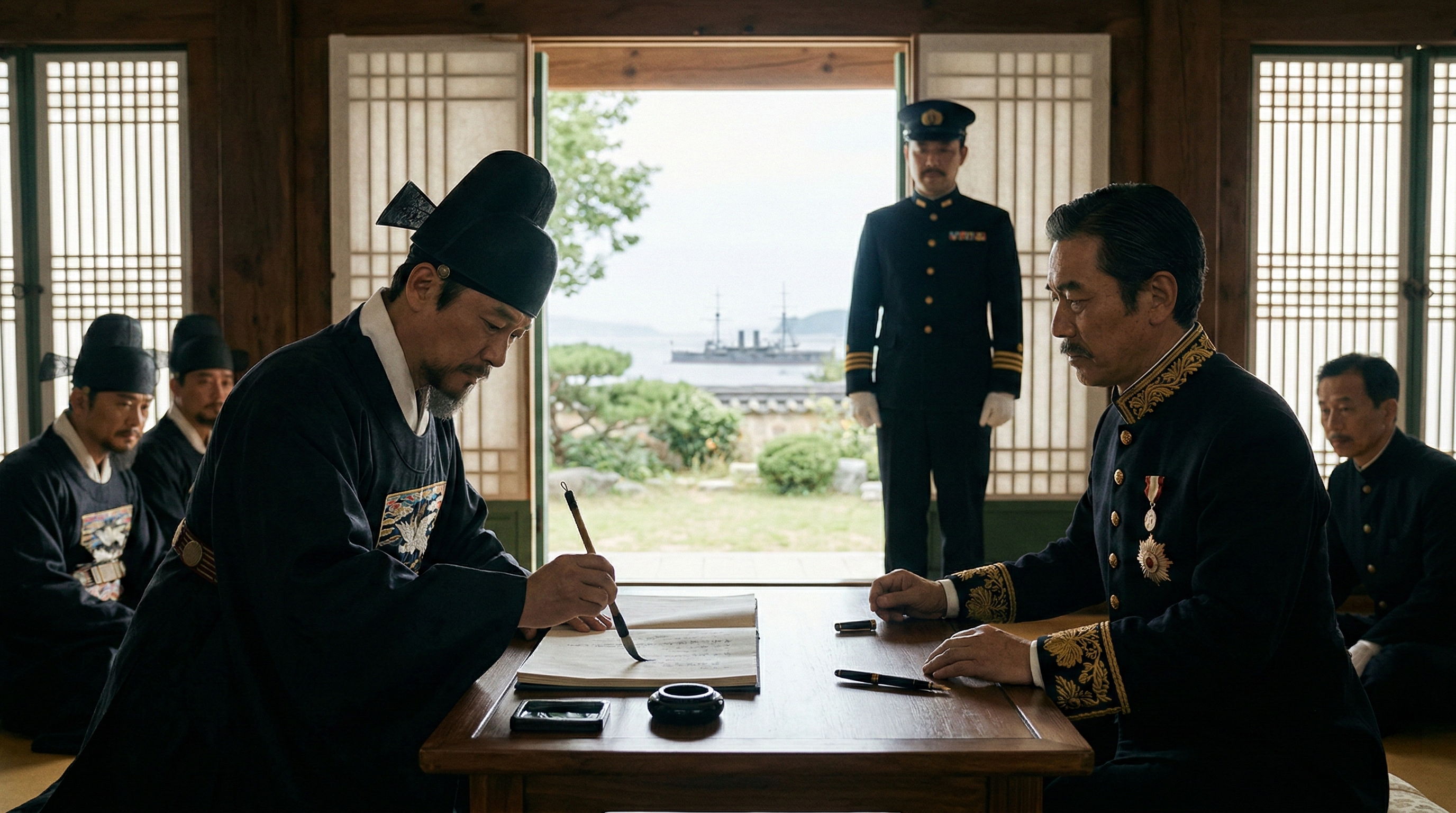
For decades, the Joseon Dynasty maintained a policy of strict isolation, earning the Korean Peninsula the moniker of the “Hermit Kingdom.” This isolation was not merely a matter of cultural preference but a calculated defense mechanism against the encroaching influence of Western powers and the shifting dynamics of East Asian geopolitics. To the west, the Qing dynasty stood as the traditional suzerain, the center of a tributary system that had defined regional order for centuries. However, the mid-19th century brought a violent upheaval to this equilibrium. The arrival of Commodore Matthew Perry in Japan in 1853 and the subsequent Meiji Restoration of 1868 transformed Japan from a feudal shogunate into a burgeoning industrial empire. This new Japanese state was eager to shed the “unequal treaties” imposed upon it by the West and sought to establish itself as a modern regional power.
Conditions Before the Crisis
The internal pressure within Japan to engage Korea reached a boiling point in 1873 during the Seikanron debate. Military leaders and restless samurai, dispossessed by the abolition of their class, argued for an immediate invasion of Korea to punish the Joseon government for refusing to recognize the new Meiji Emperor. While the Japanese government ultimately opted for diplomacy over immediate war, the underlying intent remained coercive. Japan viewed Korea’s refusal to modernize or open its borders as a strategic threat-a potential vacuum that a Western power like Russia might fill.
In Korea, the political climate was dominated by the Heungseon Daewongun, the regent for King Gojong, who adamantly resisted foreign contact. He had successfully repelled a French expedition in 1866 and an American flotilla in 1871, reinforcing a belief in the efficacy of isolation. However, by 1874, the Daewongun was forced into retirement, and King Gojong, under the influence of Queen Min and her family, began to explore a more flexible foreign policy. Despite this slight thaw, the Korean court remained deeply divided and militarily unprepared for a modern confrontation.
The catalyst for the eventual treaty was a deliberate provocation known as the Unyo Incident. On September 20, 1875, the Japanese gunboat Unyo, commanded by Inoue Yoshika, entered restricted Korean waters near Ganghwa Island under the guise of searching for potable water. When Korean shore batteries opened fire, the technically superior Japanese vessel responded with devastating force, destroying the fortifications and landing a shore party that inflicted significant casualties. This skirmish provided the Empire of Japan with the pretext it needed to demand a formal treaty, mirroring the “gunboat diplomacy” that the United States had used against Japan twenty-two years earlier.
The Event Itself
On February 10, 1876, a Japanese delegation led by Kuroda Kiyotaka and Inoue Kaoru arrived off the coast of Korea with six naval vessels and several hundred troops. The message was clear: Korea would either sign a treaty of “friendship” or face a full-scale military invasion. The negotiations took place on Ganghwa Island, a location of immense symbolic and strategic importance near the mouth of the Han River. The Korean representative, Shin Heon, faced an impossible choice between a war the Joseon military could not win and a diplomatic surrender that would upend centuries of tradition.
The silent guns of the Unyo had spoken louder than any diplomatic dispatch sent to Seoul in the preceding decade.
On February 26, 1876, the two nations signed the Japan-Korea Treaty of 1876, commonly known as the Treaty of Ganghwa. The document consisted of twelve articles that fundamentally altered Korea’s sovereign status. Article 1 was perhaps the most deceptive and significant; it declared that “Chosun, being an independent state, enjoys the same sovereign rights as does Japan.” While this appeared to grant Korea equality, its primary purpose was to legally sever the historical ties between Korea and the Qing dynasty. By defining Korea as “independent,” Japan sought to nullify the Qing’s traditional role as Korea’s protector, clearing the path for Japanese intervention.
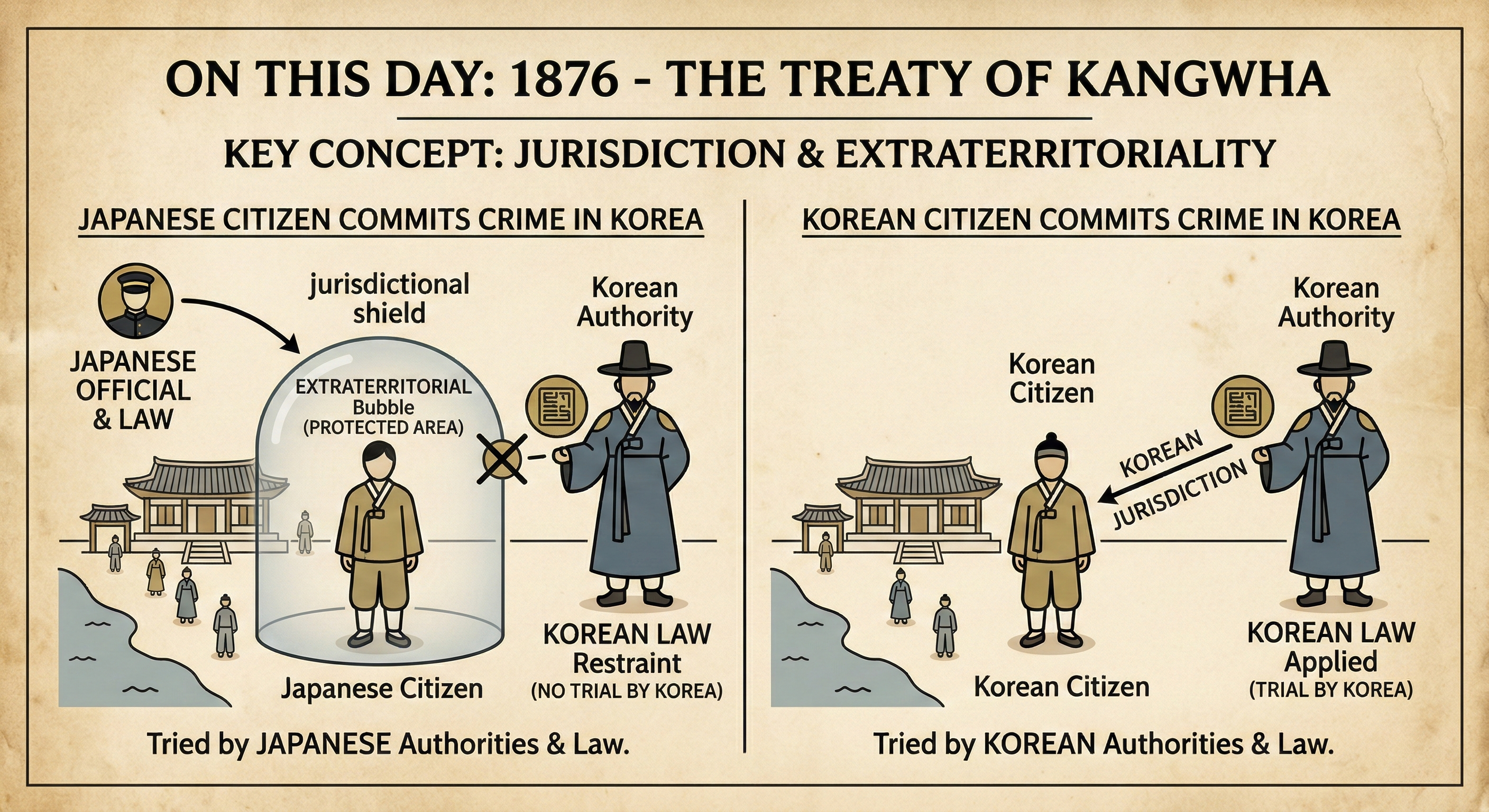
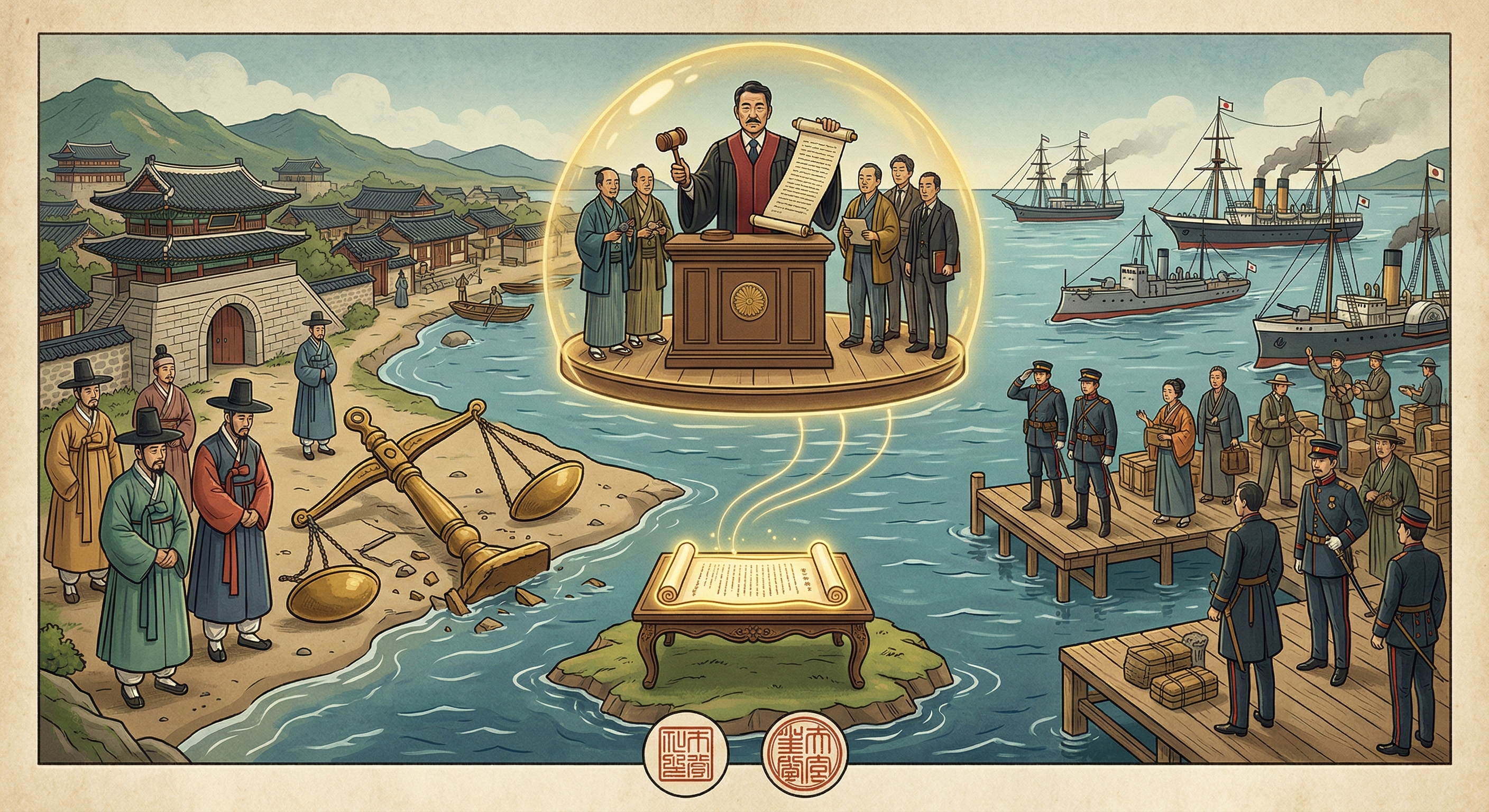
The treaty also secured significant economic and legal concessions for Japan. It mandated the opening of three Korean ports to Japanese trade: Busan was to be opened immediately, followed by Wonsan and Incheon over the next several years. Furthermore, the treaty granted Japanese citizens the right of extraterritoriality. This meant that any Japanese national who committed a crime on Korean soil would be tried by Japanese officials under Japanese law, rather than by Korean authorities. This provision stripped the Korean government of legal jurisdiction over foreigners within its own borders, creating a precedent that would be exploited for decades.
Early Consequences
The immediate aftermath of the treaty was characterized by a rapid influx of Japanese influence that the Korean state was ill-equipped to manage. Japanese merchants flooded into Busan, bringing with them manufactured goods that often undercut local Korean producers. By 1877, the Japanese population in Busan had grown significantly, establishing a commercial foothold that would serve as the vanguard for political expansion. This economic disruption contributed to rising inflation and social unrest among the Korean peasantry, who saw their traditional livelihoods threatened by foreign competition.
The treaty also triggered a profound shift in the regional balance of power, as the Qing dynasty realized that its traditional hegemony was being directly challenged. In an attempt to counter Japanese influence, the Qing official Li Hongzhang encouraged Korea to sign treaties with Western powers, including the United States in 1882, hoping that a “multi-power” presence would prevent Japan from achieving total dominance. This strategy, however, only served to turn the Korean Peninsula into a chaotic theater of international rivalry. Inside the Korean court, the treaty exacerbated the rift between the Sadae (pro-Chinese) faction and the Gaehwa (pro-modernization/pro-Japanese) faction.
The instability born from the 1876 agreement led directly to the Imo Incident of July 23, 1882. This was a violent uprising by Korean soldiers who were angry over poor rations and the preferential treatment given to a new, Japanese-trained “Special Skills Force.” The rioters attacked the Japanese legation in Seoul and briefly restored the Daewongun to power. Japan responded by sending troops to demand compensation and further concessions, while the Qing dynasty sent an even larger force to suppress the rebellion and kidnap the Daewongun. This cycle of domestic revolt and foreign intervention became a recurring theme in Korean history following the opening of the ports.
Competing Historical Interpretations
Historians have long debated the true nature and intent of the Treaty of Ganghwa, with interpretations often falling along nationalistic or ideological lines. In Japanese historiography during the early 20th century, the treaty was frequently framed as a “civilizing” mission. Proponents of this view argued that Japan was acting as a modernizing force, pulling Korea out of its “stagnant” isolation and introducing it to the benefits of international law and global commerce. From this perspective, Japan was not an aggressor but a mentor, helping a neighbor adapt to the realities of a Western-dominated world.
Conversely, Korean historians almost universally view the treaty as the first step in a calculated process of colonial encroachment. They emphasize the coercive nature of the negotiations and the inherent inequality of the terms, particularly the clause regarding extraterritoriality. The “independence” mentioned in Article 1 is interpreted not as a gift of sovereignty, but as a tactical maneuver to isolate Korea from its long-time ally, China. For these scholars, February 26, 1876, marks the beginning of the “Age of Humiliation,” a period characterized by the erosion of national dignity and the eventual loss of independence.
A third school of thought, often found in modern Western and revisionist East Asian scholarship, focuses on the “colonial modernity” framework. This interpretation seeks to move beyond the binary of “victim and aggressor” to examine how the treaty facilitated the introduction of modern institutions-such as telegraphs, modern banking, and centralized bureaucracy-while simultaneously serving imperialist ends. These scholars argue that the treaty forced Korea into a global capitalist system that it was not prepared to join, creating a hybrid society where modernization and exploitation were inextricably linked.
Long-Range Effects
The long-range effects of the Treaty of Ganghwa were catastrophic for the sovereign existence of the Korean Empire. By breaking the tributary bond with the Qing dynasty, Japan set the stage for the First Sino-Japanese War (1894-1895). The Japanese victory in that conflict, formalized by the Treaty of Shimonoseki, forced China to definitively recognize the “full and complete independence” of Korea, which in reality meant the end of Chinese protection and the beginning of Japanese hegemony. Without the Qing buffer, Korea became a direct prize for the competing interests of Japan and the Russian Empire.
The legal precedents established in 1876 regarding extraterritoriality and port access served as the blueprint for further encroachment. These “unequal” provisions were expanded in the Eulsa Treaty of November 17, 1905, which turned Korea into a Japanese protectorate following Russia’s defeat in the Russo-Japanese War. The final culmination of this process occurred on August 29, 1910, with the formal annexation of Korea by the Empire of Japan. The independence that was ostensibly “guaranteed” by the 1876 treaty had been systematically dismantled over thirty-four years, leading to a period of colonial rule that would last until the end of World War II in 1945.
The Treaty of Ganghwa remains a pivotal moment in the history of East Asian international relations because it represented the first time a non-Western power successfully utilized the tools of Western imperialism against its neighbor. By adopting the methods of the “Great Powers,” Japan not only secured its own security but also initiated the transformation of the regional order from a Confucian hierarchy to a system of competing nation-states. The legacy of this shift continues to influence the diplomatic friction and historical grievances that characterize the relationship between Japan and the two Koreas in the 21st century.
Sources
- Empire of Japan: https://wikipedia.org/wiki/Empire_of_Japan
- Korean Empire: https://wikipedia.org/wiki/Korean_Empire
- Japan-Korea Treaty of 1876: https://wikipedia.org/wiki/Japan%E2%80%93Korea_Treaty_of_1876
- Extraterritoriality: https://wikipedia.org/wiki/Extraterritoriality
- Tributary state: https://wikipedia.org/wiki/Tributary_state
- Qing dynasty: https://wikipedia.org/wiki/Qing_dynasty
- Duus, Peter. The Abacus and the Sword: The Japanese Penetration of Korea, 1895-1910. University of California Press, 1995. (Reference lookup recommended)
- Lee, Ki-baik. A New History of Korea. Harvard University Press, 1984. (Reference lookup recommended)