On This Day: 1266 - Battle of Benevento: An army led by Charles, Count of Anjou, defeats a combined German and Sici
To him, this was a defense of the only home his people had found in Italy, protected by the Hohenstaufen kings who valued their bows and their loyalty.
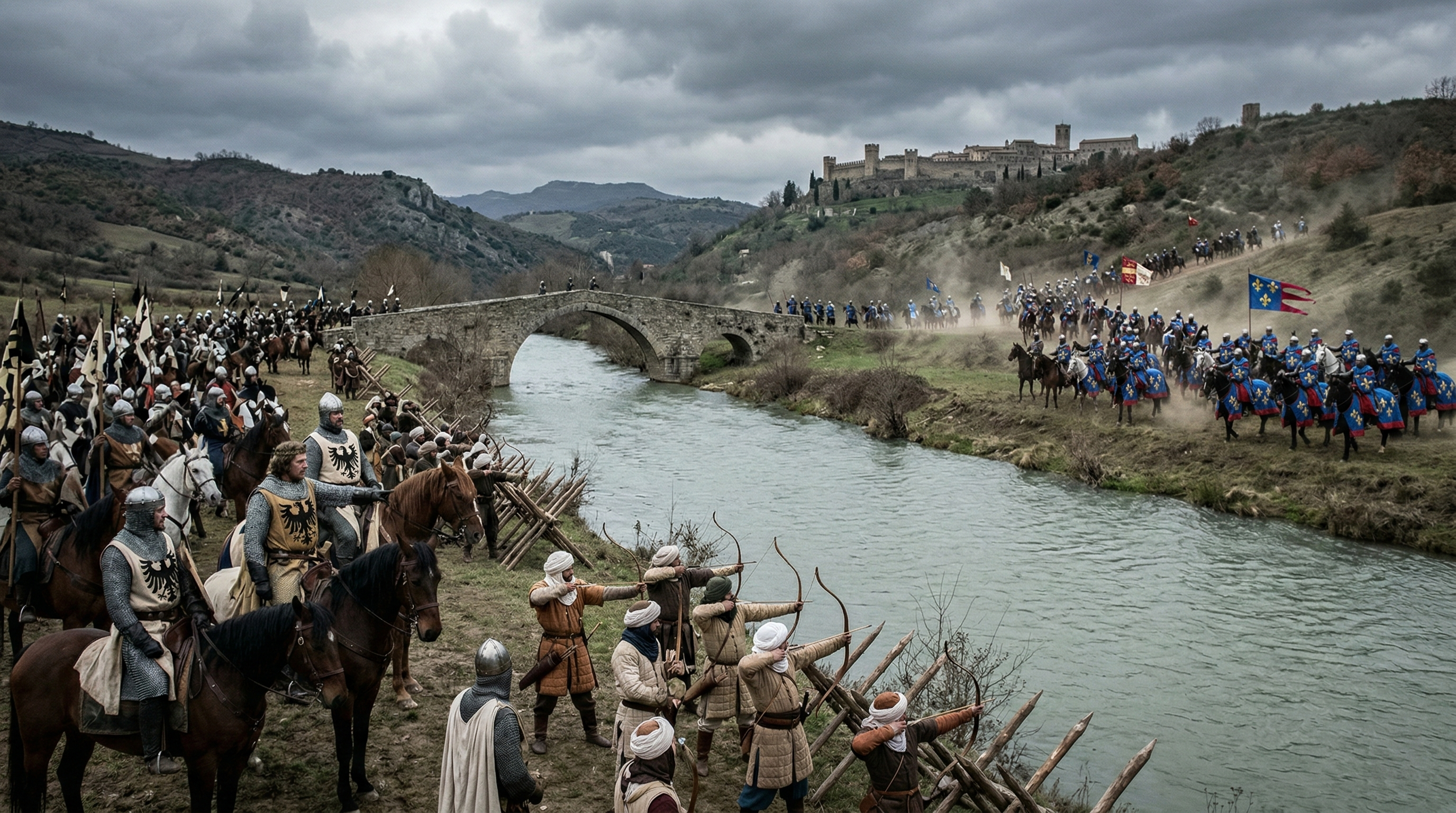
A Saracen archer, stationed by King Manfred at the bridge over the Calore River, watched the glint of French steel emerging from the mountain passes with a sense of fatalistic duty. To him, this was a defense of the only home his people had found in Italy, protected by the Hohenstaufen kings who valued their bows and their loyalty. Across the field, Charles of Anjou felt the weight of a different burden: the heavy debts owed to the Pope and the crushing expectation of his brother, King Louis IX of France. For Charles, the plain of Grandella represented the final hurdle between his current status as a land-hungry count and his destiny as the King of Sicily. Between these two men stood thousands of German mercenaries and French knights, each group recognizing that by the evening of February 26, 1266, the political map of the Mediterranean would be irrevocably redrawn.
Who Was Involved
The primary protagonist of the Angevin cause was Charles I, Count of Anjou and Provence. As the youngest brother of the French King, Charles was a man of intense ambition and religious fervor, characterized by contemporary chroniclers as a cold, tireless, and efficient administrator. He was invited into the Italian theater by Pope Clement IV, who sought a compliant secular sword to destroy the “viper brood” of the Hohenstaufen family. The Papacy viewed the presence of a strong, independent Sicilian kingdom as a permanent existential threat to the independence of the Papal States.
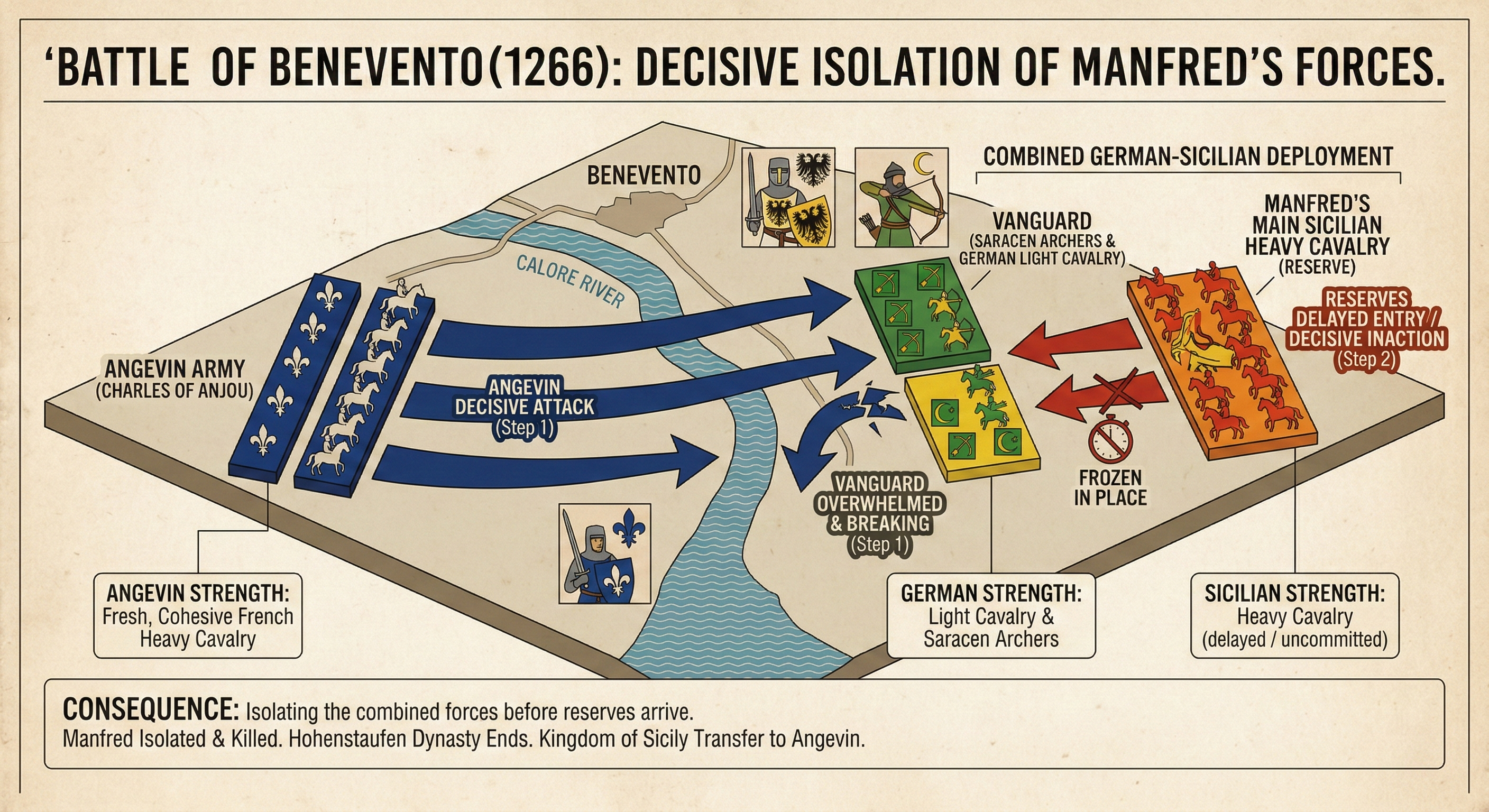
Opposing him was Manfred, the King of Sicily. Manfred was the illegitimate son of the Holy Roman Emperor Frederick II, the “Stupor Mundi.” Manfred was a cultured, multilingual prince who had spent years consolidating his power over the Kingdom of Sicily and Southern Italy, often relying on the Saracen colony of Lucera for his most loyal troops. His army on February 26, 1266, was a mosaic of medieval European and Mediterranean society: 1,200 German heavy cavalry, roughly 1,000 Italian mercenaries, and a massive contingent of 10,000 Saracen archers and light infantry.
On the other side, Charles led a force of roughly 6,000 to 7,000 men. This included 3,000 French heavy cavalry, organized into three distinct battles or divisions. The conflict was not merely a clash of kings but a clash of cultural and religious alliances, with the French knights fighting under the banner of a Crusade, granted full remission of sins by the Pope for their role in ousting Manfred.
Decisions and Constraints
The strategic landscape of February 1266 was dictated by Charles’s precarious financial position as much as his military prowess. Having crossed the Alps with a massive force underwritten by Papal loans, he could not afford a protracted campaign of attrition or a multi-month siege of a fortified city. Every day that passed without a decisive engagement drained the coffers of the Roman Curia and threatened the stability of his mercenary-heavy army, which relied on the promise of immediate plunder. Consequently, Charles’s aggressive movement toward the plains of Grandella was a calculated risk intended to force Manfred into a field battle where the superior weight of French heavy cavalry could be exploited before the winter supply lines collapsed entirely.
Manfred, conversely, faced a constraint of loyalty. While he held a strong defensive position within the walls of Benevento, he was aware that many of his Italian barons were wavering, watching to see which way the wind of Papal favor blew. He decided to leave the safety of the city and cross the Calore River to meet Charles on the open plain. It was a choice born of both necessity and pride; he believed his German heavy cavalry, who were larger and more heavily armored than the French, would dominate the field in a direct charge.
However, a tactical error during the opening phases of the battle proved fatal. Manfred’s Saracen archers and light infantry initially performed brilliantly, crossing the river and harassing the French ranks with deadly accuracy. Seeing this success, Manfred’s first line of German cavalry launched a premature charge to support the infantry without waiting for the second and third lines. This lack of coordination meant that when the French counter-charged with their own reserves, they were able to isolate and destroy the German divisions piecemeal.
Social Cost and Consequences
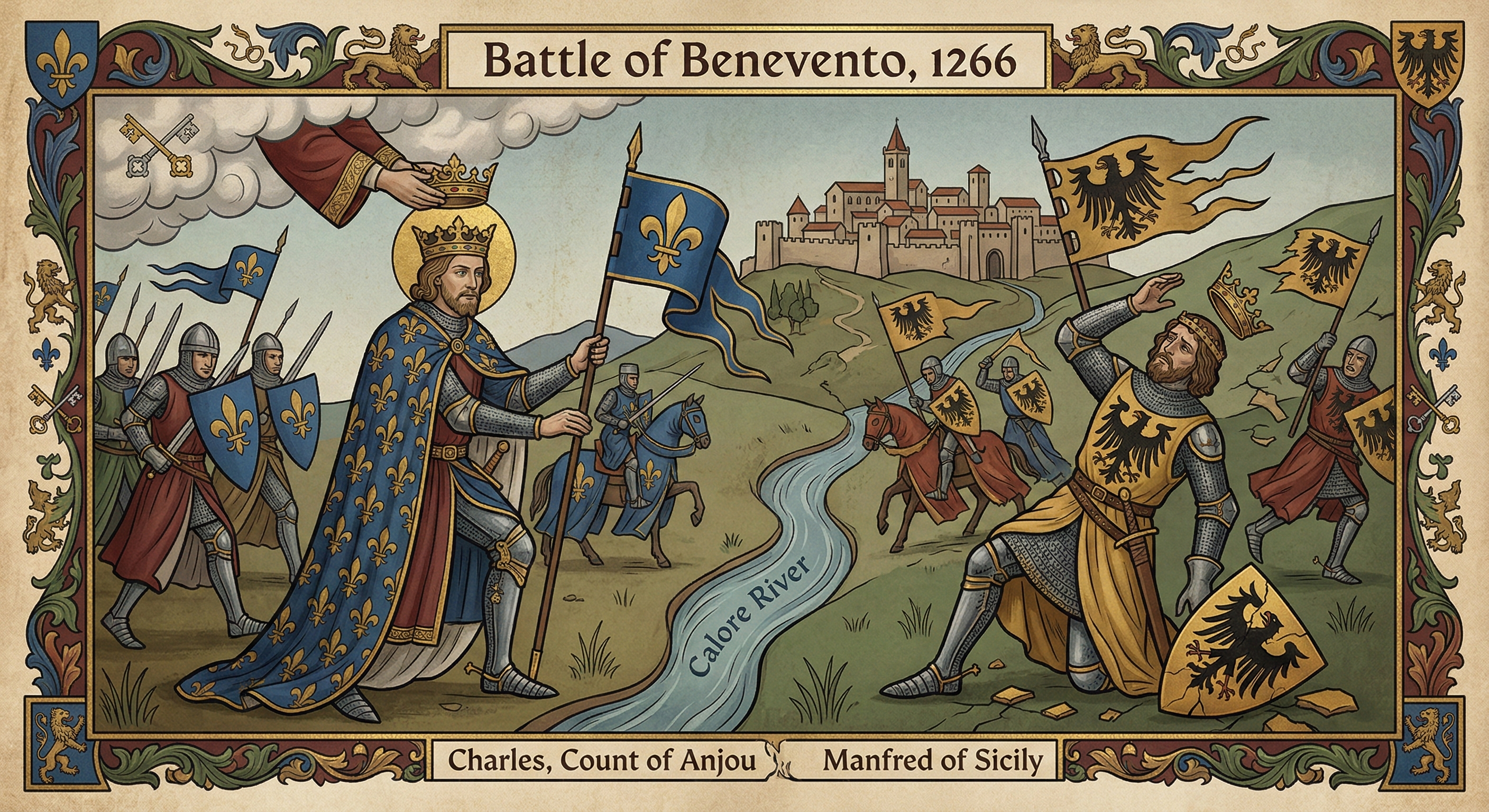
The crown of Sicily had become a blood-soaked prize passed from the House of Hohenstaufen to the House of Anjou.
The immediate social cost of the battle was the collapse of the Hohenstaufen legacy in Italy. Manfred was killed in the fray, his body reportedly found under a heap of corpses days later. Because he had been excommunicated by the Pope, his remains were initially denied a Christian burial and were interred under a simple rock cairn by the bridge of Benevento. Later, on the orders of the Papal Legate, the body was disinterred and cast out of the Kingdom’s territory, reflecting the bitter religious and political animosity that fueled the conflict.
The victory of Charles I of Naples on February 26, 1266, inaugurated a period of French “Angevin” dominance over Southern Italy that would last for decades. This shift brought a more centralized, northern-European style of feudalism to the region. The native Sicilian nobility were largely displaced by French lords, leading to deep-seated resentment. This friction eventually ignited the “Sicilian Vespers” in 1282, a violent uprising that saw thousands of Frenchmen murdered and eventually split the Kingdom into two: the Kingdom of Naples (mainland) and the Kingdom of Sicily (island).
Evidence and Historical Debate
Historians rely heavily on the accounts of Giovanni Villani and Saba Malaspina to reconstruct the maneuvers on the Grandella plain. These chronicles provide the specific numbers of cavalry and the sequence of the “three battles” utilized by Charles. However, a significant debate exists regarding the “dirty” tactics allegedly used by the French knights. Some contemporary sources claim the French were ordered to strike at the horses of the German knights-a move considered dishonorable in the chivalric code of the 13th century.
Another point of contention is the role of the local population. While the Battle of Benevento is often portrayed as a clash of foreign powers-French vs. German-local records suggest that the Southern Italian peasantry and urban classes were divided. The archaeological evidence near the Calore River is sparse, but the topographical reality of the “Grandella” plain confirms the bottleneck effect that likely hampered Manfred’s larger force as they attempted to deploy across the narrow bridge. Modern military historians continue to debate whether Manfred was betrayed by his reserve commanders or if the defeat was purely a failure of command and control during the chaotic German charge.
Interpreting the Event
The Battle of Benevento serves as a stark reminder of the power of the medieval Papacy as a geopolitical kingmaker. By declaring a crusade against a fellow Christian king, the Pope redefined the boundaries of “holy war” to include purely territorial and political disputes within Europe. This precedent signaled a shift away from the universalist dreams of the Holy Roman Empire and toward the rise of sovereign national dynasties, like the House of Anjou, which would dominate the late Middle Ages.
The event also illustrates the fragility of mercenary-based armies. Manfred’s reliance on German and Saracen troops, while effective in the short term, meant that his power lacked a deep-rooted national identity to withstand a single catastrophic defeat. When the French heavy cavalry finally broke the German lines on that February afternoon, it did more than just kill a king; it extinguished a 200-year-old cultural fusion of Norman, German, and Arabic influence that had characterized the Kingdom of Sicily under the Hohenstaufens. The battlefield at Benevento remains a site of transition where the High Middle Ages began their slow descent into the more fragmented, factional conflicts of the 14th century.
Sources
- Battle of Benevento: https://wikipedia.org/wiki/Battle_of_Benevento
- Charles I of Naples: https://wikipedia.org/wiki/Charles_I_of_Naples
- Sicily: https://wikipedia.org/wiki/Sicily
- Manfred, King of Sicily: https://wikipedia.org/wiki/Manfred,_King_of_Sicily
- Pope Clement IV: https://wikipedia.org/wiki/Pope_Clement_IV
- Kingdom of Naples: https://wikipedia.org/wiki/Kingdom_of_Naples
- Runciman, Steven. The Sicilian Vespers: A History of the Mediterranean World in the Later Thirteenth Century. (Reference lookup recommended)
- Villani, Giovanni. Nuova Cronica. (Reference lookup recommended)