On This Day: 1932 - Adolf Hitler, having been stateless for seven years, obtains German citizenship when he is appo
Within the Brunswick government, the decision was not without internal friction.

In a quiet administrative office within the Free State of Brunswick, Dietrich Klagges, a staunch National Socialist serving as the state’s Minister of the Interior, dipped his pen into ink to sign a document that would effectively bypass the spirit of the Weimar Republic’s constitutional safeguards. For Klagges, the signature was a triumphant act of partisan maneuvering, a bureaucratic sleight of hand designed to elevate his party leader from a legal non-entity to a viable political contender. Across the political landscape, members of the Social Democratic Party and various centrist observers watched with a growing sense of dread as the technicalities of administrative law were weaponized against the democracy they were intended to uphold. To the man at the center of the paperwork-an Austrian-born veteran who had remained a man without a country for nearly seven years-this moment was the final prerequisite for a direct assault on the German Presidency. By the end of February 25, 1932, the legal obstacle of statelessness was dissolved, replaced by a title that offered the veneer of respectability required for the highest office in the land.
Who Was Involved
The primary architect of this administrative maneuver was Dietrich Klagges, a member of the Nazi Party who had risen to power in the Free State of Brunswick. Klagges realized that as a state minister, he possessed the unique power to grant citizenship through the “back door” by appointing an individual to a government post. This strategy was specifically designed for Adolf Hitler, who had renounced his Austrian citizenship on April 7, 1925, to avoid extradition and to distance himself from the Habsburg state he despised. Consequently, Hitler had spent seven years as a person experiencing statelessness, a condition that barred him from holding public office or even voting in the nation he sought to lead.
Within the Brunswick government, the decision was not without internal friction. Members of the coalition government, including more traditional conservatives, were forced to grapple with the implications of using a mid-level bureaucratic appointment to resolve a national political crisis. On the opposing side, the incumbent President of Germany, Paul von Hindenburg, and his advisors viewed the maneuvers in Brunswick with a mixture of aristocratic disdain and tactical concern. They understood that if Hitler became a citizen, the 1932 presidential election would be transformed from a coronation of the status quo into a volatile struggle for the soul of the Republic.
Decisions and Constraints
The path to February 25, 1932, was littered with failed attempts to secure Hitler’s status. In 1930, an effort was made to appoint Hitler as a police officer in the small town of Hildburghausen, a plan that collapsed under the weight of public ridicule and political pushback. Hitler and his inner circle were constrained by the 1913 Nationality Law, which dictated that citizenship was typically tied to the individual states rather than a central federal authority. This meant that if any one of the German states within the federation appointed Hitler to a civil service position, he would automatically acquire German citizenship by default of his office.
The decision-makers in Brunswick settled on a specific role: Regierungsrat, or Government Counselor, at the Brunswick legation in Berlin. This was a calculated choice intended to minimize Hitler’s actual administrative duties while maximizing his legal standing. By framing the appointment as a service to the state of Brunswick, Klagges and his allies created a legal “fait accompli” that the central government in Berlin found difficult to overturn without sparking a constitutional crisis. The constraint was time; the deadline for submitting candidacies for the presidential election was rapidly approaching, and Hitler could not afford another public failure like the Hildburghausen incident.
The law became a ladder for those who intended to burn it once they reached the top.
Human Cost and Tradeoffs
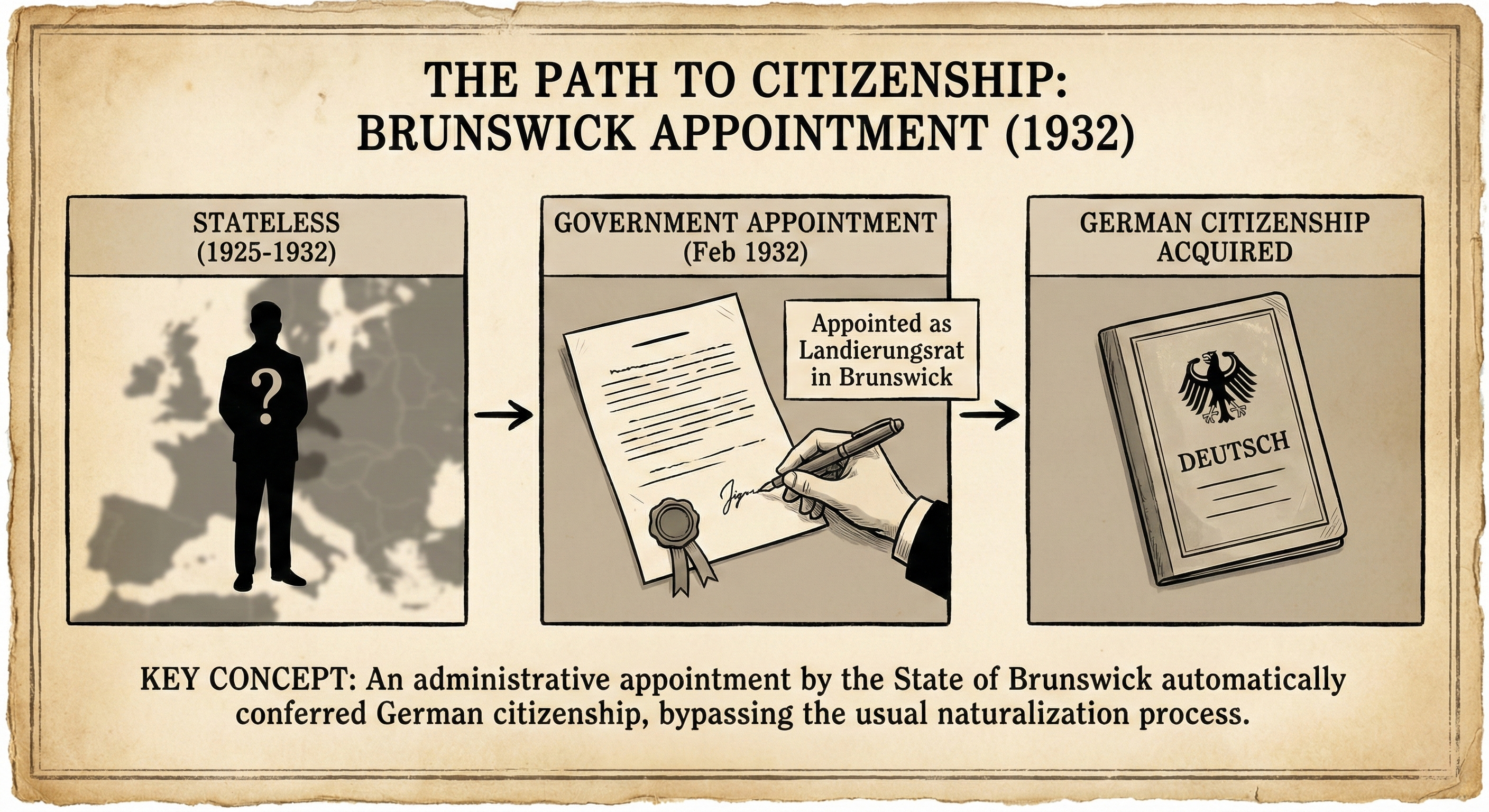
The immediate human cost of this decision was the erosion of the perceived integrity of the German civil service. By turning a professional administrative post into a political gift, the Brunswick government signaled that the neutral machinery of the state was now a prize for partisan combat. This tradeoff-sacrificing the impartiality of the law for political expediency-had profound consequences for the millions of German citizens who still believed in the “Rechtsstaat,” or a state governed by the rule of law. The appointment was confirmed on February 25, 1932, and just days later, Hitler announced his candidacy for the Presidency.
In the ensuing 1932 election cycles, the social cost was measured in street violence and political polarization. During the campaign for the first ballot on March 13, 1932, and the runoff on April 10, 1932, clashes between the Nazi Sturmabteilung (SA) and the communist Red Front Fighters’ League resulted in dozens of deaths and hundreds of injuries across German cities. The legitimization of Hitler as a candidate allowed him to capture 11.3 million votes in the first round and 13.4 million in the second. While he lost to Hindenburg, the tradeoff for his “legal” citizenship was a platform that normalized radicalism, eventually leading to the appointment of Hitler as Chancellor on January 30, 1933, and the subsequent dismantling of democratic protections.
Sources, Bias, and Debate
Historical accounts of the Brunswick appointment often vary based on the emphasis placed on the “legality” of the Nazi rise to power. Some historians, particularly in the mid-20th century, focused heavily on the “legal revolution” theory, arguing that Hitler’s obsession with following the letter of the law-such as obtaining citizenship through an official appointment-was a key factor in winning over the German middle class. They suggest that without this specific event on February 25, 1932, the conservative establishment might have found a stronger legal basis to exclude him from the political process.
Conversely, more recent scholarship debates whether the citizenship issue was merely a hurdle that would have been cleared by other means regardless of the Brunswick maneuver. There is a bias in some earlier German historiography that seeks to portray the Weimar Republic’s collapse as an inevitable consequence of legal loopholes, potentially downplaying the active complicity of conservative elites who could have blocked the appointment. The debate continues regarding the role of Dietrich Klagges; was he a visionary strategist for the party, or merely a provincial official acting on direct orders from the Munich leadership? Most primary sources from the Brunswick archives suggest a high degree of coordination between the state ministry and Hitler’s personal staff.
Interpreting the Event
The events of February 25, 1932, serve as a stark reminder of the vulnerability of institutional gatekeeping. When the Free State of Brunswick granted citizenship to a man who had openly declared his intent to destroy the Republic, it highlighted a fundamental paradox: a democracy must be robust enough to withstand those who use its own rules to undermine it. This was not merely a story of a man getting a passport; it was the story of how administrative norms are discarded when they become inconvenient to those holding local power. The “Government Counselor” title was a mask, yet the legal system of 1932 was unable or unwilling to look behind it.
The collapse of the Weimar Republic was not a single explosive event but a cumulative sequence of technical surrenders where the letter of the law was used to strangulate its intent. When Klagges granted Hitler citizenship through a mid-level bureaucratic appointment, he demonstrated that a determined minority could exploit the administrative machinery of a state to bypass the electorate’s gatekeeping. This transformation of a stateless agitator into a “Government Counselor” provided the necessary veneer of respectability that conservative voters required to justify their support for a radical movement. Ultimately, the survival of a constitutional order depends less on the rigidity of its statutes and more on the integrity of those tasked with their stewardship. By the time the German public went to the polls in 1932, the procedural defense of the Republic had already been compromised from within.
Sources
- Adolf Hitler: https://wikipedia.org/wiki/Adolf_Hitler
- Statelessness: https://wikipedia.org/wiki/Statelessness
- Free State of Brunswick: https://wikipedia.org/wiki/Free_State_of_Brunswick
- Dietrich Klagges: https://wikipedia.org/wiki/Dietrich_Klagges
- President of Germany (1919-1945): https://wikipedia.org/wiki/President_of_Germany_(1919%E2%80%931945)
- The Coming of the Third Reich by Richard J. Evans (reference lookup recommended)
- Hitler: Hubris, 1889-1936 by Ian Kershaw (reference lookup recommended)
- Federal Archives of Germany (Bundesarchiv), records regarding the 1932 Presidential Elections (reference lookup recommended)