On This Day: 1917 - The U
Fast Background By the early months of 1917, the global landscape of World War I was one of stagnant horror and mounting desperation.
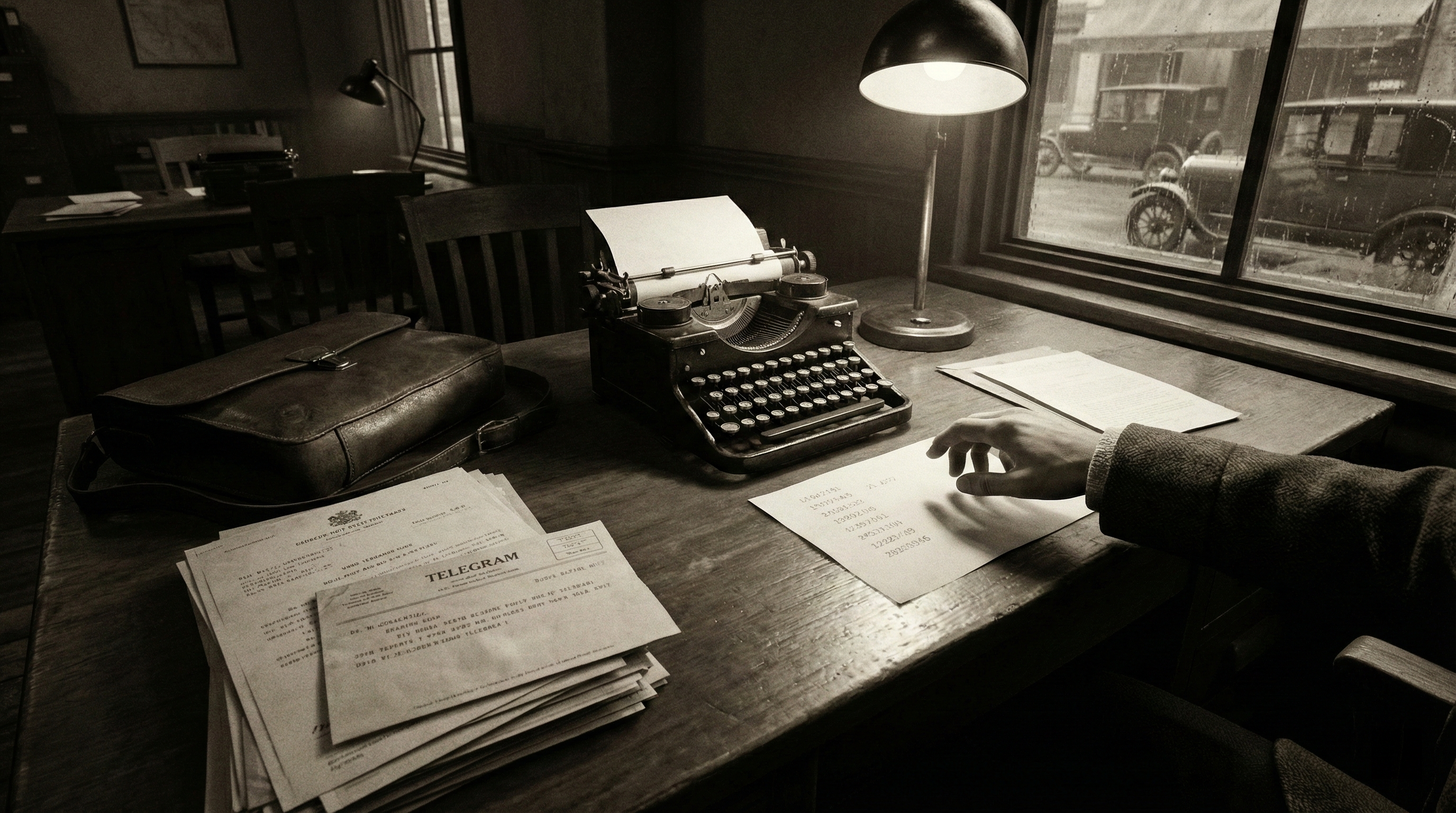
January 16, 1917: A coded message, encrypted in the 0075 code, leaves the desk of German Foreign Secretary Arthur Zimmermann in Berlin, headed for the German Ambassador in Washington, D.C., Johann von Bernstorff.
January 19, 1917: British naval intelligence cryptographers in Room 40 intercept the transmission, identifying a proposal that could fundamentally alter the borders of the North American continent.
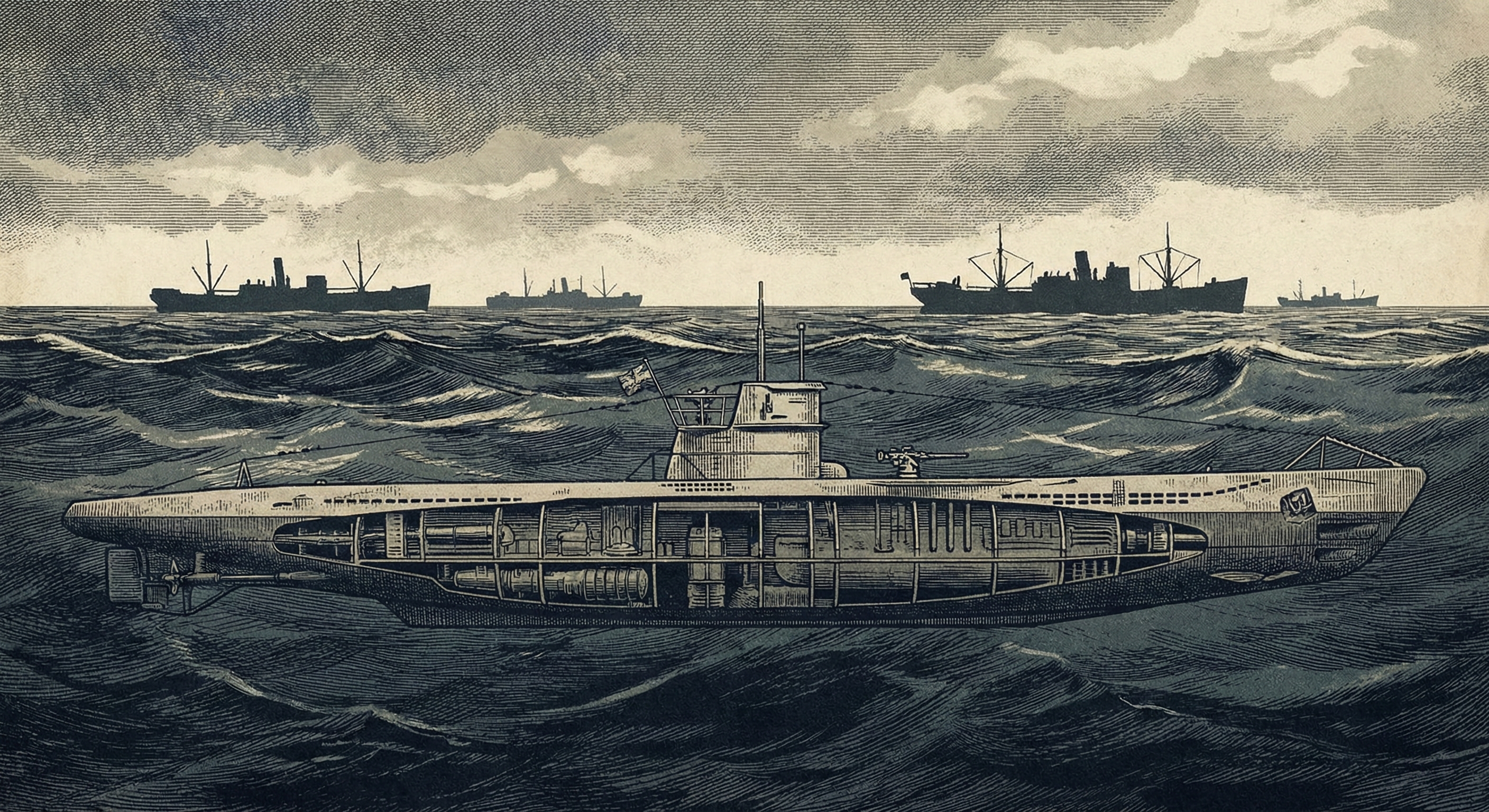
February 1, 1917: Germany officially resumes unrestricted submarine warfare, declaring that any ship-neutral or otherwise-heading for Allied ports would be sunk without warning.
February 24, 1917: Walter Hines Page, the United States Ambassador to the United Kingdom, enters the British Foreign Office to receive a decrypted document that serves as the final catalyst for American entry into the Great War.
Fast Background
By the early months of 1917, the global landscape of World War I was one of stagnant horror and mounting desperation. For nearly three years, the United States had maintained a policy of official neutrality, guided by President Woodrow Wilson’s desire to act as a mediator rather than a combatant. This neutrality, however, was increasingly precarious. The sinking of the Lusitania on May 7, 1915, which resulted in the deaths of 128 Americans, had already pushed public sentiment toward the Allies.
Despite the outrage, Wilson won re-election in 1916 on the slogan “He Kept Us Out of War.” While the American public remained divided-with significant German-American and Irish-American populations wary of joining the British cause-the economic ties between the U.S. and the Entente powers were deepening. Germany, feeling the stranglehold of the British naval blockade, realized that its only hope for victory lay in cutting off the supply lines across the Atlantic. This led to the fateful decision to resume unrestricted submarine warfare, a move Berlin knew would likely provoke the United States into the conflict. To mitigate this, German officials sought a distraction that would keep American troops and resources tied to their own hemisphere.
Chronology of the Event
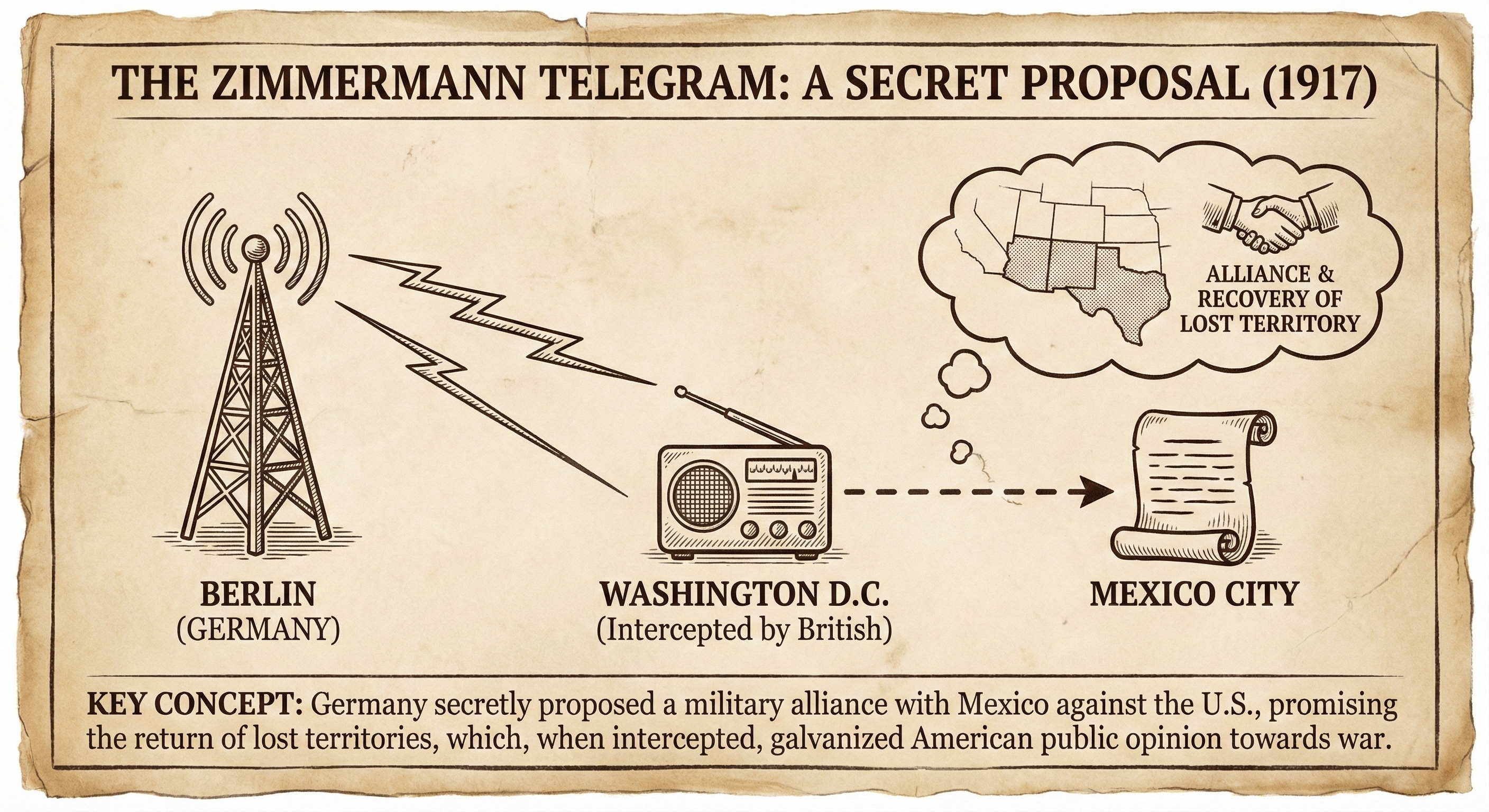
The timeline of the Zimmermann Telegram is a masterclass in espionage and diplomatic maneuvering. After the message was sent on January 16, 1917, it traveled through several channels, including a Swedish cable and an American diplomatic line that Wilson had ironically opened to the Germans to facilitate peace talks. The British, who had been tapping these lines, intercepted the message almost immediately.
For several weeks, the British authorities held the information close. Admiral William Hall, the head of Room 40, faced a significant dilemma: how to inform the United States about the German plot without revealing that the British were routinely intercepting American diplomatic communications. The breakthrough came when the British managed to obtain a copy of the telegram that had been sent from Washington to Mexico City over commercial telegraph lines. This version used an older code (13040), which the British had already broken, allowing them to present the evidence as something discovered in Mexico rather than intercepted in transit.
On February 24, 1917, British Foreign Secretary Arthur Balfour handed the translated text to Walter Hines Page. The document was a bombshell. It proposed that if the United States entered the war against Germany, Germany would provide financial support and an alliance to Mexico. In exchange, Mexico was to “reconquer the lost territory in Texas, New Mexico, and Arizona.” Furthermore, the telegram suggested that Mexican President Venustiano Carranza should mediate an alliance between Germany and Japan.
The American sense of continental security vanished in a single afternoon.
Page immediately cabled the text to President Wilson. When the President read the transcript on February 26, 1917, his initial reaction was one of “profound indignation.” The existence of the telegram was released to the Associated Press on February 28, 1917, and appeared in newspapers across the country on March 1, 1917.
Inflection Point
The receipt of the telegram on February 24, 1917, represents the specific moment when the American policy of neutrality became untenable. While the resumption of submarine warfare provided a legal and moral casus belli regarding freedom of the seas, the Zimmermann Telegram provided a visceral, territorial threat that resonated with the American public in a way that abstract maritime law could not.
This was no longer a “European” war. By suggesting the dismemberment of the United States and the return of Texas, New Mexico, and Arizona to a foreign power, Germany had effectively brought the trenches of the Western Front to the Rio Grande. The psychological shift was instantaneous. Western and Midwestern states, which had previously been the strongest bastions of isolationism, suddenly saw the conflict as a matter of national defense. The telegram transformed the war from a distant diplomatic dispute into an existential struggle for the integrity of the American union.
Evidence and Historical Debate
Historians have long debated the sincerity of the German proposal and the competence of its delivery. Arthur Zimmermann’s decision to personally confirm the telegram’s authenticity on March 3, 1917, remains one of the most baffling diplomatic blunders in history. Had he claimed the telegram was a British forgery, he might have sowed enough doubt to delay American intervention. Instead, his admission solidified the American resolve.
The British role in the event also remains a subject of scrutiny. The timing of the delivery-waiting until February 24, 1917, after Germany had already resumed unrestricted submarine warfare-suggests a calculated effort by Balfour and Hall to maximize the impact on American opinion.
The strategic logic employed by the British cryptographers was a complex gamble involving the preservation of intelligence secrets versus the necessity of securing an American alliance. If Admiral Hall had released the telegram in January, the United States might have remained hesitant, seeing it as a desperate British ploy. By waiting until the German submarines were already sinking American ships in February, the British ensured that the telegram would be the “last straw” in a series of provocations. This period of waiting allowed the British to secure a second copy of the telegram, which they used to mask their intelligence-gathering methods. This elaborate ruse allowed the British to present the intelligence as a find from Mexico rather than a breach of American communications, a distinction that preserved the Anglo-American relationship during a time of extreme sensitivity.
What Followed
The fallout from the February 24, 1917, revelation was swift and decisive. In Mexico, President Carranza tasked a military commission to assess the feasibility of the German offer. The commission concluded that reclaiming the lost territories was impossible; Mexico was still reeling from its own revolution, and a war with the United States would lead to total national collapse. On April 14, 1917, Mexico formally declined the German proposal.
In Washington, the path to war was now clear. On April 2, 1917, President Wilson stood before a joint session of Congress to request a declaration of war. He cited the submarine warfare and the German attempts to incite Mexico as primary reasons. Congress moved quickly, and on April 6, 1917, the United States formally entered World War I.
The entry of American industrial might and manpower eventually broke the stalemate on the Western Front. By the time the Armistice was signed on November 11, 1918, the geopolitical map of the world had changed forever. The Zimmermann Telegram, handed over in a quiet London office on a February afternoon, had served as the pivot point for the American century, ending over a hundred years of isolationism and signaling the rise of the United States as a global superpower.
Sources
- World War I: https://wikipedia.org/wiki/World_War_I
- Walter Hines Page: https://wikipedia.org/wiki/Walter_Hines_Page
- Zimmermann Telegram: https://wikipedia.org/wiki/Zimmermann_Telegram
- New Mexico: https://wikipedia.org/wiki/New_Mexico
- Texas: https://wikipedia.org/wiki/Texas
- Arizona: https://wikipedia.org/wiki/Arizona
- Tuchman, Barbara W. The Zimmermann Telegram. New York: Viking Press, 1958. (Reference lookup recommended).
- National Archives and Records Administration (NARA), “The Zimmermann Telegram.” (Reference lookup recommended).