On This Day: 1895 - Revolution breaks out in Baire, a town near Santiago de Cuba, beginning the Cuban War of Indepe
Another common misconception is that the revolution was a purely military affair from its inception, driven by a desire for battlefield glory.
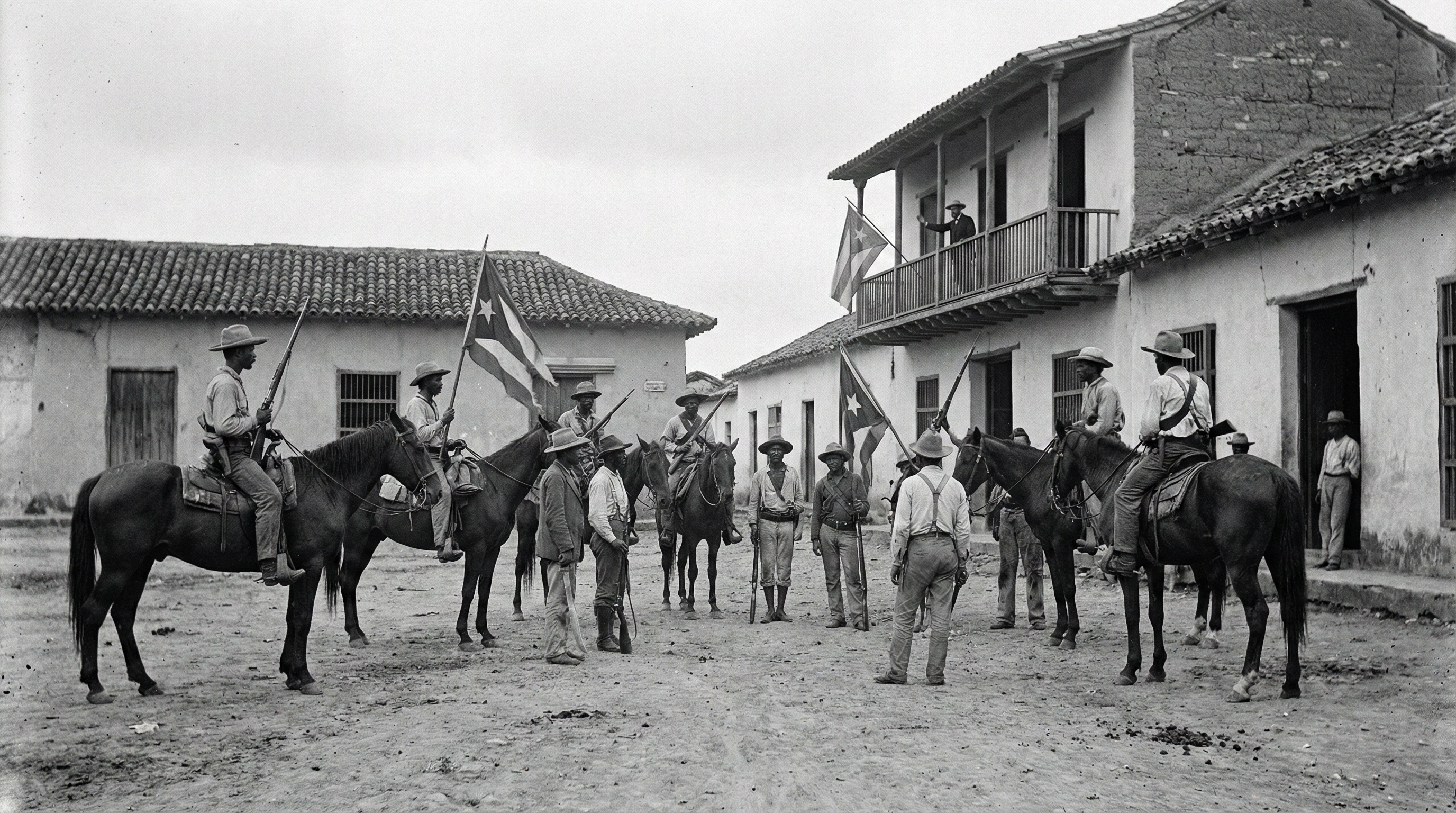
History often paints the “Grito de Baire” as a singular, thunderous roar of defiance that spontaneously and harmoniously united the Cuban archipelago against the Spanish Crown on a single Sunday afternoon. According to this popular narrative, the town of Baire, located near Santiago de Cuba, served as the definitive and primary spark that ignited a pre-planned, perfectly synchronized explosion of nationalist fervor across the entire island. However, the archival record and the frantic communications between revolutionary cells tell a much more fractured story of logistical delays, regional hesitation, and a movement that very nearly collapsed in its infancy. While the events of February 24, 1895, are celebrated as a moment of absolute clarity, the reality was a messy, decentralized series of uprisings that succeeded more through Spanish administrative exhaustion than through immediate Cuban military cohesion.
Misconceptions in Public Memory
The most pervasive myth regarding the start of the conflict is that the “Grito de Baire” was the only significant uprising on that day or that it represented a unanimous decision by all regional leaders to take up arms. In reality, the Cuban Revolutionary Party, led by the intellectual and poet José Martí, had coordinated for a simultaneous insurrection in thirty-five different locations to prevent the Spanish military from concentrating its forces in any one province. Public memory focuses on Baire because the local leaders there, including Saturnino Lora and his brother Mariano, managed to hold their ground and project an image of victory that resonated through the eastern mountains. In the Western provinces, particularly around Havana and Pinar del Río, the planned uprisings were almost entirely suppressed by Spanish authorities before they could begin, leading to the arrest of key conspirators like Juan Gualberto Gómez.
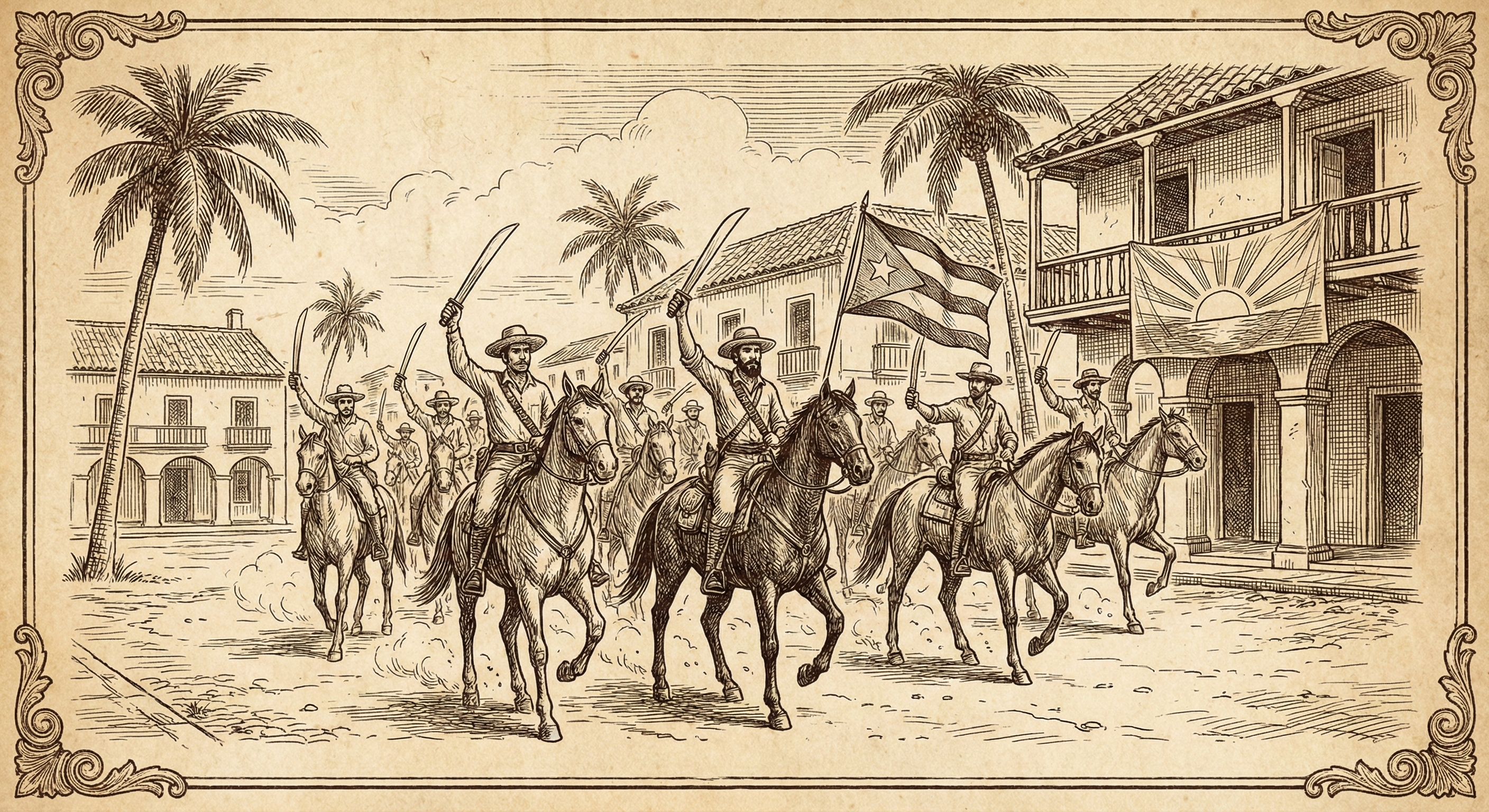
Another common misconception is that the revolution was a purely military affair from its inception, driven by a desire for battlefield glory. The popular image of the mambí-the Cuban guerrilla fighter-charging Spanish lines with a machete often overshadows the political and economic desperation that fueled the ranks. The collapse of the sugar market and the restrictive Spanish trade duties had created a tinderbox that transcended mere political ideology. The insurrection was not just a fight for a flag; it was a desperate response to a colonial system that had failed to provide economic stability after the abolition of slavery in 1886.
Documentary Evidence
The blueprint for the revolution was not a series of oral legends but a set of precisely drafted documents that outlined the moral and strategic framework of the war. The most critical of these was the “Order of Uprising,” signed on January 29, 1895, in New York City by José Martí, Enrique Collazo, and José María Rodríguez. This document was smuggled into Cuba hidden inside a cigar, a detail that has been verified through the memoirs of the messengers involved. It gave the specific command for the insurrection to commence during the second half of February, specifically targeting the carnival season when Spanish vigilance was expected to be lower.
On March 25, 1895, Martí and General Máximo Gómez signed the Manifesto of Montecristi in the Dominican Republic. This document is essential for understanding the 1895 revolution because it explicitly stated that the war was not directed against the Spanish people, but against the colonial administration. It remains one of the few revolutionary manifestos of the nineteenth century to specifically address race, asserting that the “republic cannot be the exclusive property of any one race.” These records demonstrate that the uprising was an intellectual project as much as a tactical one, aimed at preventing the “Africanization” of Cuba-a fear the Spanish used to keep white Creoles from joining the rebellion.
The pen and the sword were rarely so intertwined as they were in the documents governing the 1895 revolution.
Main Turning Points
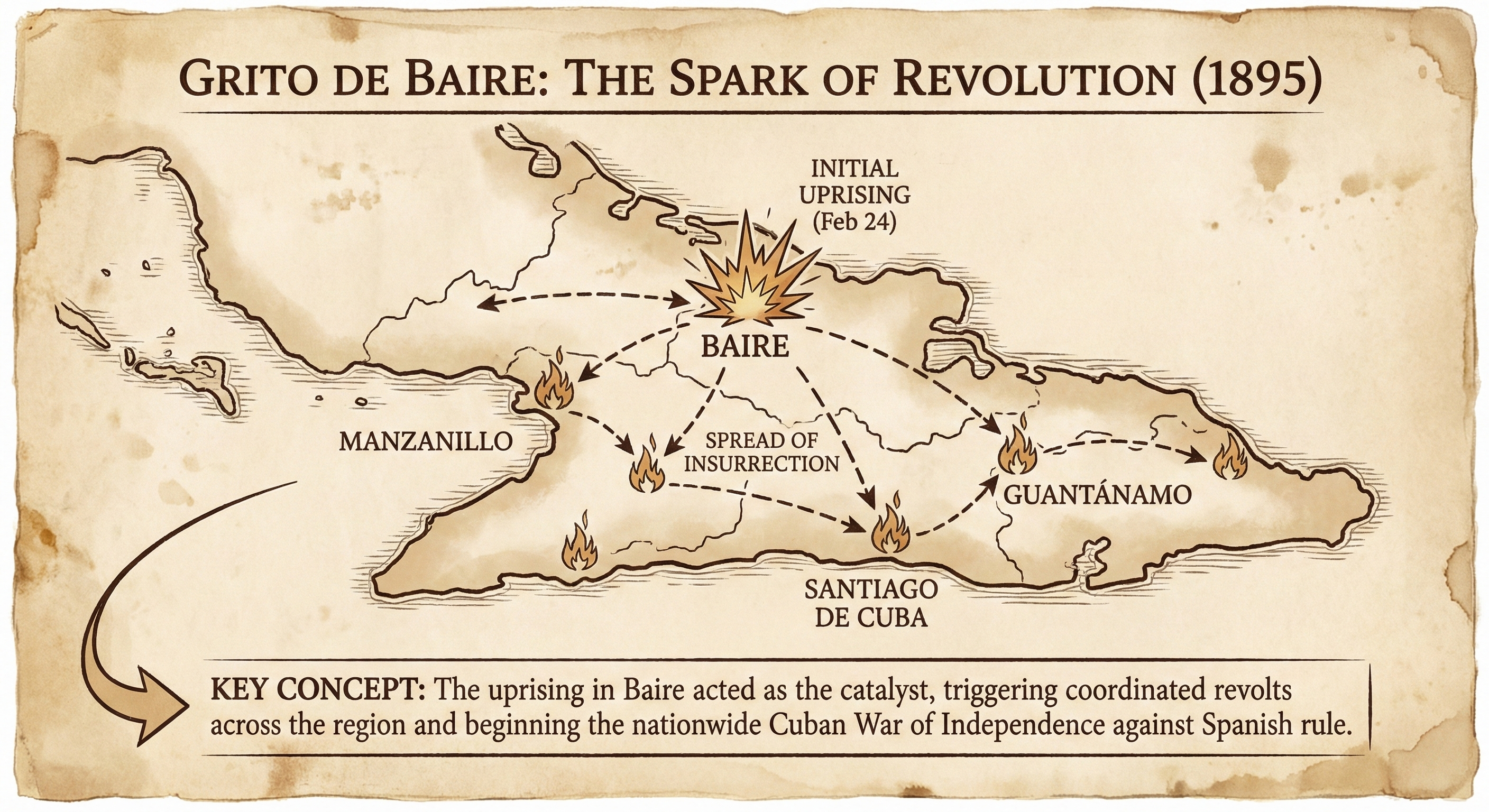
The initial success of the eastern uprisings provided a foothold, but the revolution truly transformed when the veteran generals of the previous Ten Years’ War returned to the island. On April 1, 1895, Antonio Maceo, known as the “Bronze Titan,” landed at Duaba near Baracoa. His arrival, followed by Martí and Máximo Gómez on April 11, 1895, shifted the momentum from scattered local riots to a formal campaign. However, the movement suffered a devastating blow on May 19, 1895, during the Battle of Dos Ríos, where José Martí was killed in action. His death threatened to decapitate the revolution’s political leadership, yet it ultimately served to martyr him, providing a symbolic “apostle” that the disparate rebel factions could rally around.
By early 1896, the rebels executed a daring “Invasion of the West,” a military maneuver that brought the war from the mountainous east to the rich sugar-producing provinces of the west. Antonio Maceo and Máximo Gómez burned plantations and destroyed rail lines to starve the Spanish treasury. In response, the Spanish government sent General Valeriano Weyler, who implemented the “Reconcentración” policy in February 1896. This policy forced hundreds of thousands of rural Cubans into fortified towns to prevent them from aiding the rebels. The resulting famine and disease killed an estimated 300,000 civilians by 1898, a quantified tragedy that turned international opinion sharply against Spain.
Competing Historical Interpretations
The interpretation of the 1895 revolution has long been a battleground between Spanish, Cuban, and American historians. Spanish accounts from the late nineteenth century frequently characterized the events of February 24, 1895, as the work of “bandits” and “foreign agitators” funded by American interests, rather than a legitimate domestic movement. This perspective sought to delegitimize the rebels as a disorganized rabble incapable of self-governance. Conversely, traditional Cuban nationalist historiography has often framed the revolution as an inevitable and unified march toward liberty, downplaying the intense internal rivalries between the civilian provisional government and the military commanders like Máximo Gómez, who frequently clashed over the direction of the war.
The Spanish colonial administration initially characterized the events of February 24, 1895, not as a political revolution but as a series of isolated bandit raids led by “indistinguishable agitators.” This dismissive posture ignored the deep-seated structural rot within the colonial tax system and the burgeoning identity of the mambises. For decades, historians have debated whether the revolution was a coherent movement toward liberal democracy or a radical social upheaval intended to dismantle racial hierarchies once and for all. By analyzing the rhetoric of José Martí, it becomes clear that the revolution was intended to be a “war without hate,” yet the reality on the ground quickly devolved into a brutal conflict of attrition that targeted the economic infrastructure of the island. American historians, particularly during the mid-twentieth century, tended to view the 1895 revolution merely as a chaotic prelude to the Spanish-American War, suggesting that Cuban independence was a “gift” of the United States rather than a victory earned through three years of grueling insurrection.
What Shifted Next
The stalemate between the exhausted Spanish forces and the resilient but undersupplied Cuban rebels was broken by the entry of a third power. On February 15, 1898, the USS Maine exploded in Havana Harbor, providing the United States with the casus belli it needed to intervene. What the Cubans had called the War of Independence was rebranded by the American press as the Spanish-American War. By the time the Treaty of Paris was signed on December 10, 1898, Spain had agreed to relinquish its claim to Cuba, but the Cuban revolutionaries were notably excluded from the peace negotiations.
This exclusion marked the beginning of a new era of interventionism. Although the war that began in Baire on February 24, 1895, ostensibly ended Spanish rule, it did not result in the immediate, sovereign republic Martí had envisioned. Instead, the United States occupied the island from 1898 until 1902. The subsequent inclusion of the Platt Amendment in the Cuban constitution ensured that while the Spanish were gone, the revolutionary struggle for true autonomy would continue to define Cuban politics for the next half-century.
Sources
- Revolution: https://wikipedia.org/wiki/Revolution
- Santiago de Cuba: https://wikipedia.org/wiki/Santiago_de_Cuba
- Cuban War of Independence: https://wikipedia.org/wiki/Cuban_War_of_Independence
- Spanish-American War: https://wikipedia.org/wiki/Spanish%E2%80%93American_War
- Foner, Philip S. The Spanish-Cuban-American War and the Birth of American Imperialism. (Reference lookup recommended for detailed accounts of the 1895 uprisings).
- Ferrer, Ada. Insurrection and Revolution: Cuba, 1868-1898. (Reference lookup recommended for analysis of racial dynamics during the war).
- Archivo Nacional de la República de Cuba. Documents regarding the Grito de Baire and the Order of Uprising. (Reference lookup recommended for primary source telegrams).