On This Day: 1945 - During the Battle of Iwo Jima, a group of United States Marines reach the top of Mount Suribach
The singular image of six men heaving a flagpole into the sulfurous sky of Iwo Jima exists in the modern public consciousness as the definitive visual shorthand for American victory in the Pacific Theater. For many ob...
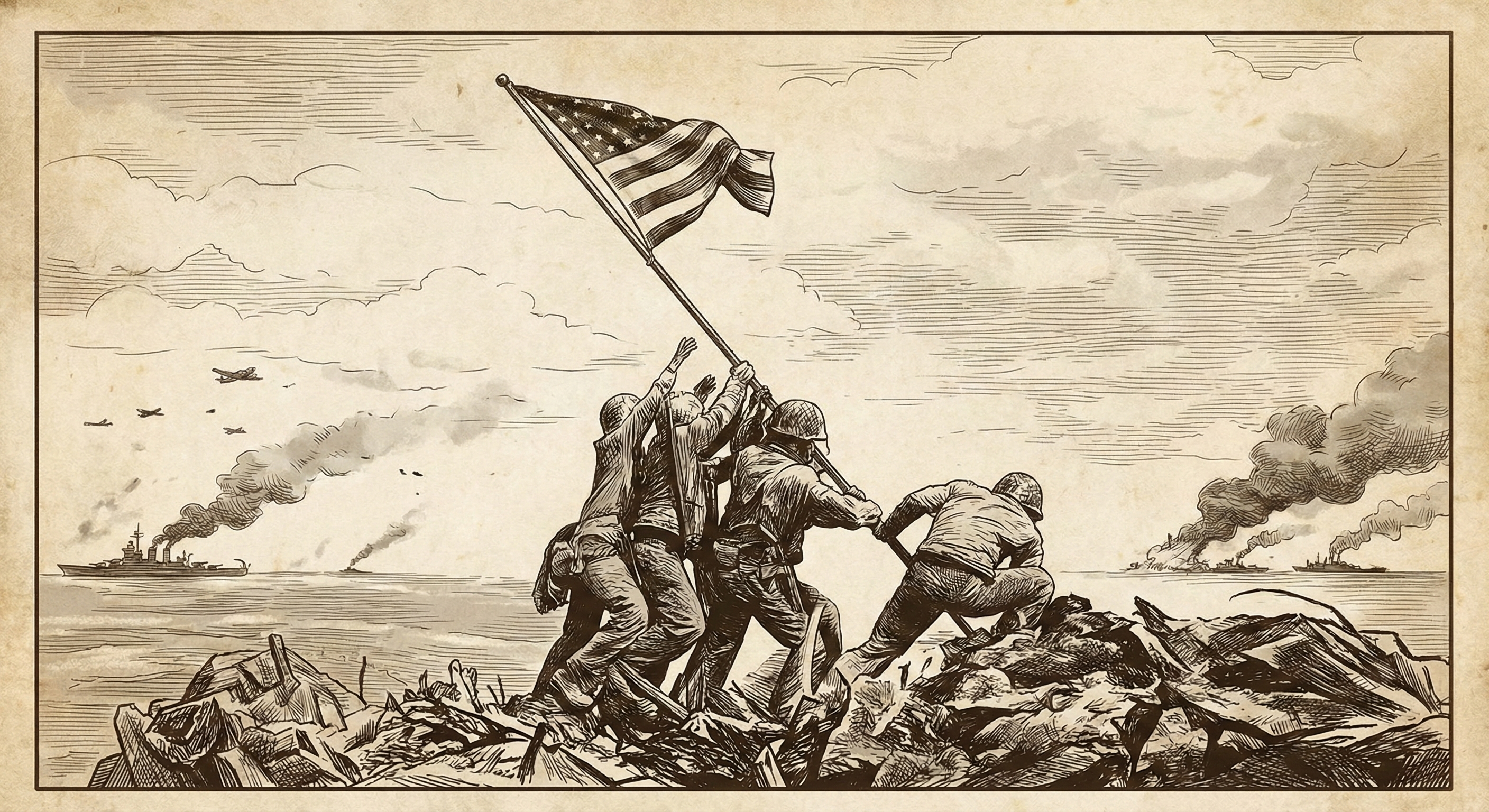
The singular image of six men heaving a flagpole into the sulfurous sky of Iwo Jima exists in the modern public consciousness as the definitive visual shorthand for American victory in the Pacific Theater. For many observing the legacy of World War II on February 23, 2026, the photograph captured by Joe Rosenthal represents a spontaneous burst of triumph that signaled the end of a grueling campaign. However, the historical record of February 23, 1945, paints a far more fractured and complicated picture than the bronze silhouettes of the Marine Corps War Memorial suggest. What the public often remembers as a climax was actually a mid-point transition, and the men celebrated as heroes were often obscured by a fog of administrative errors and propaganda requirements that took decades to resolve.
Core Event Summary
The ascent of Mount Suribachi on February 23, 1945, was a tactical necessity during the early phase of the Battle of Iwo Jima. Mount Suribachi, a 554-foot dormant volcanic cone at the southern tip of the island, provided the Japanese defenders with a lethal vantage point from which to direct artillery fire onto the landing beaches. By the morning of the fifth day of the invasion, the 28th Marines, 5th Marine Division, had managed to isolate the mountain. At approximately 8:00 AM, a 40-man patrol led by First Lieutenant Harold G. Schrier began the steep climb. They reached the rim of the crater without significant resistance, as the Japanese defenders remained largely in deep underground bunkers to avoid the preliminary naval bombardment.
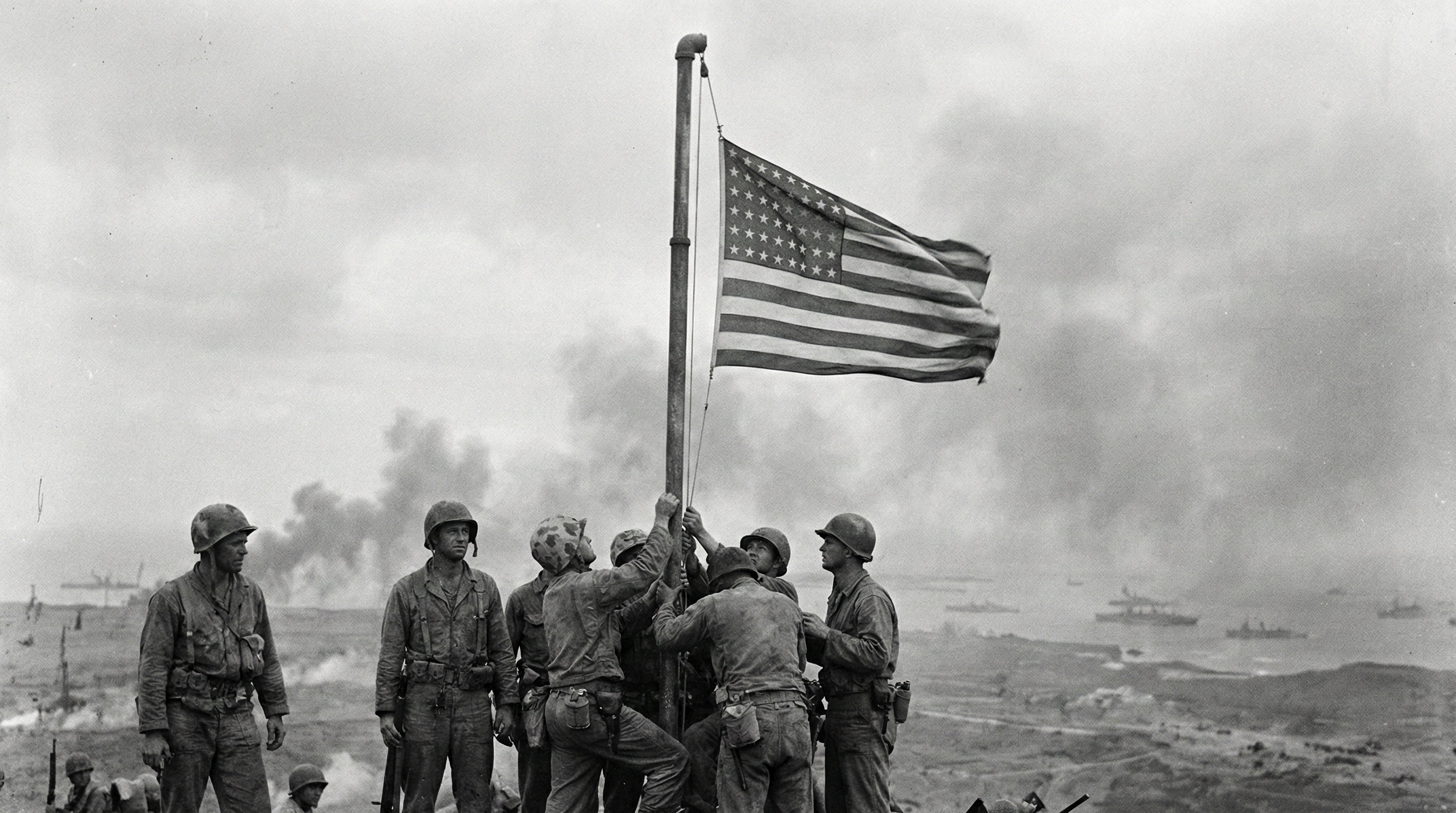
At roughly 10:20 AM, Schrier and his men raised a small American flag-measuring 54 by 28 inches-that had been carried up the slope in a map case. This first flag raising was met with cheers from the troops on the beaches and a chorus of whistles from the ships offshore. However, Lieutenant Colonel Chandler Johnson, the battalion commander, deemed the first flag too small to be seen clearly across the island. He ordered a second, larger flag (measuring 96 by 56 inches) to be taken to the summit. It was during this second raising, which occurred around 12:00 PM, that Associated Press photographer Joe Rosenthal captured the iconic image. While the flags were being swapped, the combat was far from over; the island would not be declared secure until March 26, 1945, more than a month after the banners were planted on the peak.
Narrative Disputes
The primary dispute surrounding the events of February 23, 1945, concerns the “staged” nature of the famous photograph. Because Rosenthal’s image captured the second flag raising rather than the first, skeptics have frequently claimed the event was a pre-planned media stunt. This narrative ignores the reality that the second flag was raised for tactical visibility, not for the camera. Rosenthal himself nearly missed the shot, swinging his camera upward at the last second without even looking through the viewfinder. The confusion was compounded when Rosenthal, asked later if he had posed the shot, thought the question referred to a subsequent “gung-ho” group photo he took of the Marines cheering under the flag. His “yes” to that question was misinterpreted for years as a confession that the main action shot was a setup.
The mountain was won, but the island remained a slaughterhouse.
Furthermore, the identity of the men in the photograph has been the subject of intense official revision. For over seventy years, the Marine Corps and the American public identified a specific set of six men as the flag-raisers: Harlon Block, Rene Gagnon, Ira Hayes, Paul Ivey, Franklin Sousley, and John Bradley. However, internal and independent investigations eventually proved these identifications were riddled with errors born of the chaotic combat environment. On June 23, 2016, the Marine Corps officially announced that John Bradley-long the central figure of the “Flags of Our Fathers” narrative-was not in the Rosenthal photo, though he had participated in the first flag raising earlier that morning. He had been misidentified in the second photo, and the man in his place was actually Harold Schultz. A subsequent correction on October 16, 2019, further identified Harold “Pie” Keller as being in the photo in place of Rene Gagnon. These corrections highlight how the need for immediate wartime icons can override the slow, meticulous work of forensic history.
Surviving Source Base
The historical reconstruction of this day relies on a remarkably dense but often contradictory source base. The most famous piece of evidence is, of course, Joe Rosenthal’s Pulitzer Prize-winning photograph, which was transmitted via radiophoto and appeared in American newspapers by February 25, 1945. Supplementing this is the 16mm color motion picture film shot by Sergeant Bill Genaust, who was standing just feet away from Rosenthal. Genaust’s film is crucial because it provides a continuous temporal record of the second raising, proving that the motion was fluid and un-staged. Genaust never saw his film’s impact; he was killed in action on Iwo Jima on March 4, 1945.
In addition to the visual media, the “Iwo Jima Action Report” and the unit diaries of the 28th Marines provide the logistical framework for the ascent. These documents offer the sterile, military counterpoint to the emotional weight of the photos. There is also the “Lowery Collection,” a series of photographs taken by Sergeant Louis Lowery of the first flag raising. These images remained largely in the shadow of Rosenthal’s work for decades, yet they are essential for understanding the actual progression of the morning’s events. The personal letters and later interviews of survivors like Ira Hayes and Harold Schultz provide a more somber, psychological layer to the archive, often expressing the survivors’ guilt and their discomfort with the celebrity status foisted upon them by the United States government.
Competing Historical Interpretations
Historians have long debated the strategic versus symbolic value of the Mount Suribachi flag raising. From a strictly military perspective, some scholars argue that the emphasis on February 23, 1945, distorts the true nature of the Battle of Iwo Jima. The struggle for the mountain, while visually dramatic, was relatively brief compared to the weeks of attrition that followed in the northern “meatgrinder” sections of the island, such as the fight for Hill 362A. By focusing on the flag, the public memory often elides the fact that the majority of the 6,821 American deaths on the island occurred after the flag was already flying. This interpretation suggests that the image served as a convenient “full stop” for a public weary of war, providing a sense of closure to a battle that was actually only in its infancy.
Conversely, a more cultural-historical interpretation posits that the flag raising was the most significant event of the campaign precisely because of its psychological impact. The sight of the American flag atop the island’s highest point acted as a massive morale booster for the thousands of troops still fighting in the black sands below. This view argues that the “contested” nature of the photo’s origins is secondary to its function as a tool of national mobilization. In April 1945, the U.S. government utilized the image for the Seventh War Loan drive, which raised over $26 billion for the war effort. In this framework, the photo was not a lie but a necessary condensation of the American spirit of persistence, regardless of whether the specific men in the frame were identified correctly at the time or whether the flag was the first or second to be raised.
Memory and Commemoration
The commemoration of the Iwo Jima flag raising has shifted from a celebration of specific individuals to a more generalized tribute to the Marine Corps. This evolution is most visible in the Marine Corps War Memorial in Arlington, Virginia, dedicated on November 10, 1954. The 32-foot-tall bronze figures, modeled directly after Rosenthal’s photo, have become a secular shrine. Over time, the memorial has transcended its specific date of February 23, 1945, to become a symbol for all Marines who have died in service. The weight of this memory was so heavy that for decades, the families of those misidentified in the photo struggled to correct the record against a government and a public that preferred the established legend.
The legacy of the event remains a study in the tension between the “truth” of an image and the “truth” of an experience. As of February 23, 2026, the photograph continues to be analyzed by historians and forensic experts using digital enhancement tools to ensure every face is correctly named. Yet, for the average observer, the granular details of which Marine held which part of the pole are often less important than the broader narrative of sacrifice. The contested memory of Iwo Jima serves as a reminder that icons are often built on shifting sands, and that the process of history is never truly finished, even when the image seems frozen in time.
Sources
- Battle of Iwo Jima: https://wikipedia.org/wiki/Battle_of_Iwo_Jima
- United States Marine: https://wikipedia.org/wiki/United_States_Marine
- Mount Suribachi: https://wikipedia.org/wiki/Mount_Suribachi
- Raising the Flag on Iwo Jima: https://wikipedia.org/wiki/Raising_the_Flag_on_Iwo_Jima
- Flags of Our Fathers by James Bradley (Reference lookup recommended)
- The Lions of Iwo Jima by Robert Haynes (Reference lookup recommended)