On This Day: 1945 - Capitulation of German garrison in Poznań
The image of a city's liberation often conjures scenes of cheering crowds, flower-strewn tanks, and a swift retreat by a defeated foe. Popular memory of the Eastern Front in early 1945 frequently compresses the chaoti...
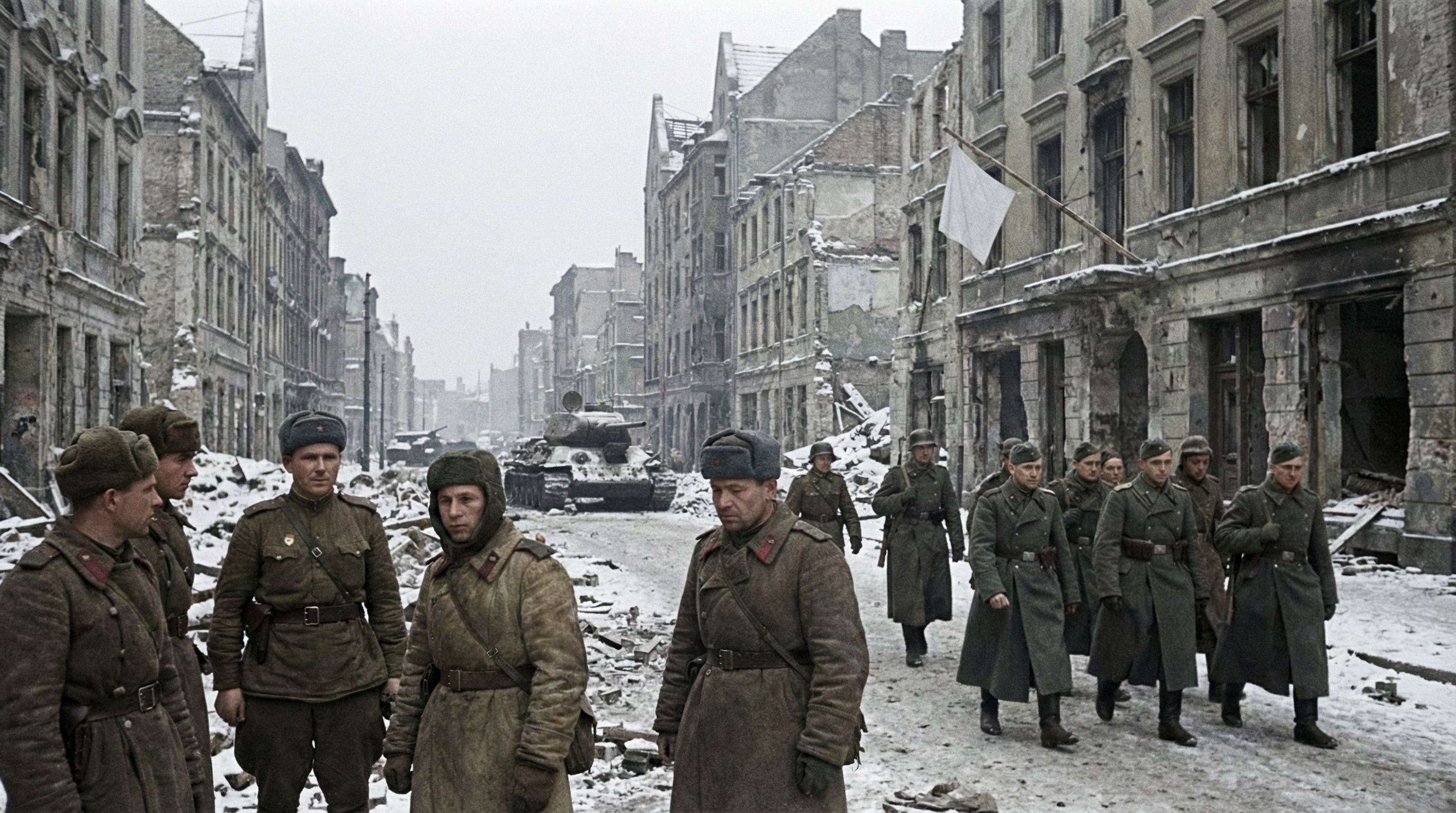
The image of a city’s liberation often conjures scenes of cheering crowds, flower-strewn tanks, and a swift retreat by a defeated foe. Popular memory of the Eastern Front in early 1945 frequently compresses the chaotic collapse of the Third Reich into a singular, unstoppable Soviet surge toward Berlin, treating intermediate stops like the city of Poznań as mere speed bumps on the road to the Reichstag. However, the documented records of the Battle of Poznań reveal a reality far removed from the tidy narratives of inevitable momentum. On February 23, 1945, when the German garrison finally capitulated, they left behind a city that had been transformed into a charnel house by a month of grinding, medieval-style siege warfare. The discrepancy between the sanitized “liberation” myth and the brutal tactical evidence of “Festung Posen” (Fortress Poznań) highlights the desperate lengths to which the collapsing Nazi regime went to stall the inevitable, often at the cost of the very populations they claimed to defend.
What People Commonly Get Wrong
A prevalent misconception regarding the events leading up to February 23, 1945, is that the city was reclaimed solely through Soviet military might while the local Polish population remained passive observers. While the Soviet Union provided the overwhelming bulk of the heavy artillery and armored divisions, the “liberation” was not a unilateral Red Army operation. In reality, thousands of local Polish civilians-often referred to as the Cytadelowcy (Citadellists)-were pressed into service or volunteered to assist the Soviet 8th Guards Army. These locals provided critical intelligence on the German bunker systems and even participated in the direct assault on the Citadel, the final German stronghold.
Another common error is the underestimation of the “Fortress” status of the city. Many historical summaries suggest that the German defense was a disorganized rout. On the contrary, Adolf Hitler had designated Poznań a Festung (fortress) in early 1945, a status that legally and militarily compelled the garrison to fight to the last man. This was not a tactical retreat; it was a deliberate, suicidal stand. The German garrison, commanded by General Ernst Gonell, consisted of a patchwork of remnants from various units, yet they were heavily entrenched in 19th-century Prussian fortifications that proved remarkably resistant to modern 1945-era weaponry.
What the Evidence Shows
The empirical data from the siege paints a picture of staggering attrition. By the time the capitulation was signed on February 23, 1945, approximately 90% of the city’s Old Town and its historic center lay in ruins. Records from the Soviet 8th Guards Army, led by General Vasily Chuikov (the hero of Stalingrad), indicate that the assault on the final redoubt-Fort Winiary-required the use of heavy 203mm howitzers fired at point-blank range. This was not a battle of maneuver but a high-intensity urban siege involving flamethrowers, hand grenades, and room-to-room fighting in the subterranean tunnels of the city’s fort system.
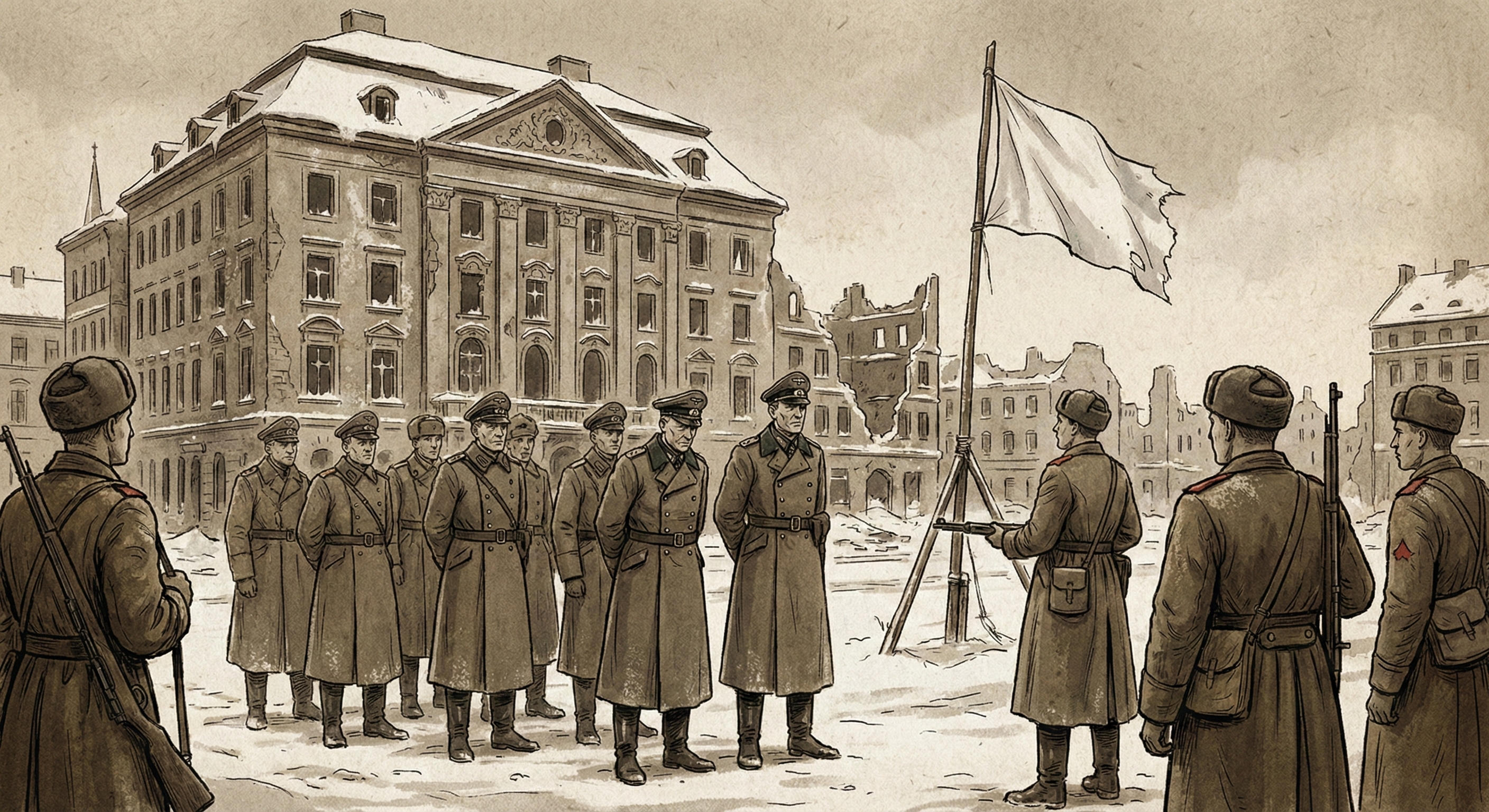
The German garrison was initially estimated at roughly 40,000 to 60,000 personnel, though modern archival analysis suggests the effective combat strength was closer to 30,000, bolstered by Volkssturm (militia) and police units. On the morning of February 23, 1945, General Gonell, realizing the hopelessness of the situation, committed suicide in the Citadel. His successor, Colonel Ernst Mattern, surrendered the remaining 12,000 troops shortly thereafter. The logistical evidence shows that the Soviet forces expended more ammunition on Poznań than in many of the larger engagements of the Vistula-Oder Offensive, proving that the German defense was far more than a symbolic gesture.
Main Turning Points
The encirclement of the city was completed by January 25, 1945, effectively cutting off the German forces from any hope of reinforcement or resupply from the west.
As the Soviet ring tightened, the German high command ordered a desperate breakout attempt for the night of February 17, 1945. This maneuver failed catastrophically, forcing the remaining defenders to retreat into the core of the Citadel, a massive 19th-century fort situated on a hill overlooking the city. This retreat consolidated the German defense but also trapped them in a confined space where Soviet artillery could concentrate its fire.
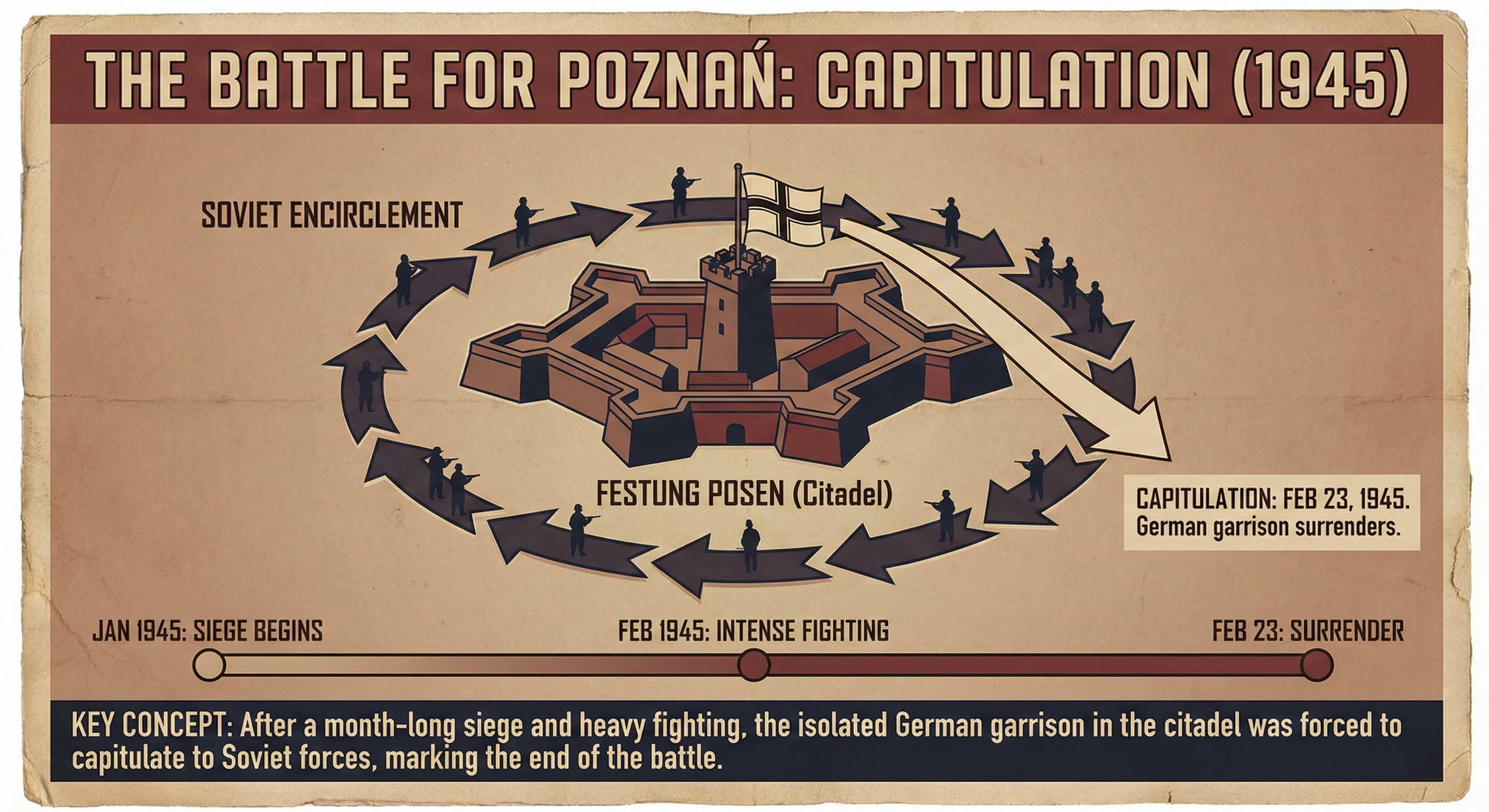
The final assault on the Citadel began on February 18, 1945. For five days, the Soviet and Polish forces cleared the moats and ramparts of the fort. A critical moment occurred when Soviet engineers managed to bridge the deep moats surrounding Fort Winiary, allowing tanks and heavy guns to approach the inner walls. By the evening of February 22, 1945, the inner courtyard had been breached, leading to the formal surrender the following morning.
The fortress that was meant to hold for months fell in thirty days.
Sources, Bias, and Debate
The historiography of the Battle of Poznań has long been a battlefield of its own, particularly during the decades of the Cold War. Soviet-era accounts heavily emphasized the “eternal friendship” between the Red Army and the Polish people, often airbrushing the complexities of the Soviet occupation that followed the German defeat. These sources tended to maximize the numbers of German casualties while minimizing Soviet losses to project an image of total tactical superiority. Conversely, some Western and German post-war memoirs attempted to frame the defense of Poznań as a heroic “shield” that saved millions of refugees fleeing westward, a narrative that conveniently ignores the fact that the “Fortress” strategy primarily served to prolong the life of the Nazi regime at the expense of civilian lives.
The debate remains active among historians regarding the strategic necessity of the siege. Some military analysts argue that the Soviet command could have simply bypassed Poznań, leaving the garrison to wither away, much like the German forces trapped in the Courland Pocket. However, the prevailing view among modern researchers is that Poznań was a vital rail and road hub; leaving a large German force in control of these transport lines would have crippled the Soviet logistical chain as it moved toward the Oder River. The tension in the records lies in balancing the military necessity of the assault with the profound destruction of one of Poland’s oldest and most culturally significant cities. This analytical conflict persists because the primary documents-unit journals, after-action reports, and civilian diaries-often provide contradictory views of the “liberators” and the “defenders” based on the observer’s political or national allegiance.
What Changed Afterward
The immediate consequence of the February 23, 1945, surrender was the clearing of the path to Berlin, but for Poznań itself, the changes were seismic. The city underwent a demographic and physical transformation. Following the Potsdam Agreement later in 1945, the German population that had not already fled was expelled, and the city was re-integrated into the Polish state. The physical reconstruction of Poznań took decades, with architects painstakingly rebuilding the Old Market Square based on historical paintings and photographs to erase the scars of the “Festung” era.
Politically, the liberation marked the beginning of the Soviet-aligned socialist period in Poland. The same Soviet 8th Guards Army that broke the German garrison remained as an occupying presence, influencing the formation of the new Polish administration. The “Citadellists” who fought alongside the Soviets were initially celebrated as heroes, but as the Cold War intensified, their legacy became a complex symbol of the nuanced and often forced cooperation between the Polish resistance and the Soviet Union. On a broader scale, the fall of Poznań signaled the total collapse of German authority in the Warthegau, the territory the Nazis had illegally annexed in 1939, effectively ending the German occupation of western Poland.
Sources
- Battle of Poznań (1945): https://wikipedia.org/wiki/Battle_of_Pozna%C5%84_(1945)
- History of Poland (1939-45): https://wikipedia.org/wiki/History_of_Poland_(1939%E2%80%9345)
- Nazi Germany: https://wikipedia.org/wiki/Nazi_Germany
- Poznań: https://wikipedia.org/wiki/Pozna%C5%84
- Soviet Union: https://wikipedia.org/wiki/Soviet_Union
- “The Siege of Poznań 1945” by Zbigniew Szumowski (Reference lookup recommended).
- “Festung Posen: Chronicles of the 1945 Siege” - Municipal Archives of Poznań (Reference lookup recommended).