On This Day: 1933 - United States Congress
February 20, 1933, stands as the moment the United States federal government officially admitted that its fourteen-year social experiment in coerced sobriety had reached a state of terminal failure. On this Monday aft...
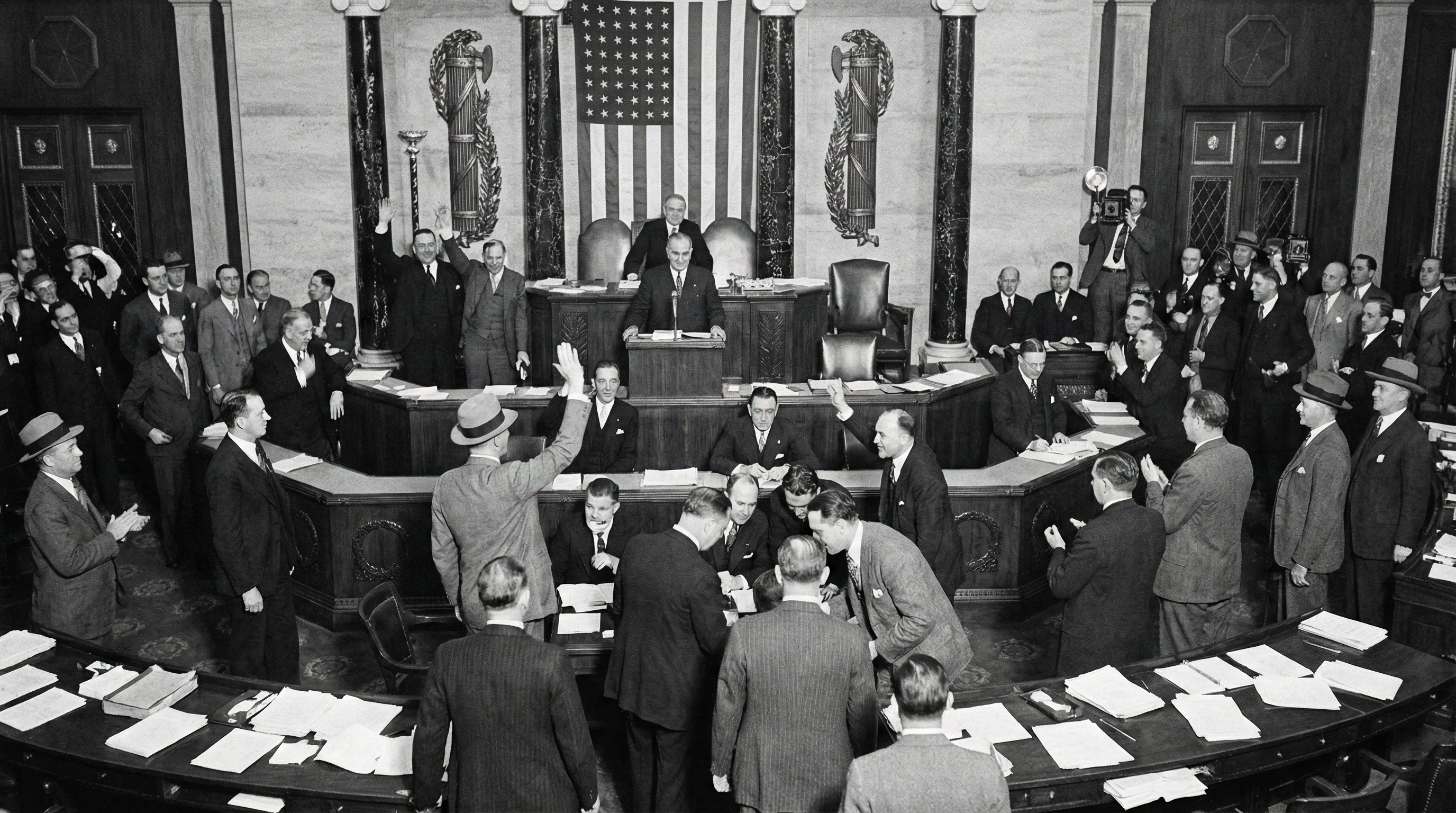
February 20, 1933, stands as the moment the United States federal government officially admitted that its fourteen-year social experiment in coerced sobriety had reached a state of terminal failure. On this Monday afternoon, the House of Representatives voted 289 to 121 to approve the Blaine Act, a joint resolution previously passed by the Senate that proposed what would become the Twenty-first Amendment to the United States Constitution. This legislative action did not immediately return legal alcohol to the American public, but it provided the necessary constitutional mechanism to repeal the Eighteenth Amendment. For the first and only time in American history, Congress stipulated that the amendment be ratified not by state legislatures, but by state ratifying conventions-a tactical maneuver designed to bypass rural, “Dry” politicians and go directly to the voters in a nation weary of the Great Depression and the unintended consequences of the Volstead Act.
Fast Background
The road to February 20, 1933, began with the ratification of the Eighteenth Amendment on January 16, 1919. Proponents of Prohibition, spearheaded by the Anti-Saloon League and the Woman’s Christian Temperance Union, believed that the ban on the “manufacture, sale, or transportation of intoxicating liquors” would eliminate poverty, reduce crime, and improve the moral fiber of the American household. When the Volstead Act took effect on January 17, 1920, it provided the federal teeth needed to enforce the ban. However, the “Noble Experiment” quickly collided with reality.
Instead of a moral utopia, the 1920s saw the explosive growth of organized crime syndicates, the rise of the speakeasy, and a widespread public disregard for federal law. By the time the stock market crashed in October 1929, the political calculus regarding Prohibition had shifted dramatically. The onset of the Great Depression rendered the cost of enforcement-and the loss of potential tax revenue from alcohol-unbearable for a government facing massive deficits and record unemployment.
By 1932, the “Wet” movement had gained significant political momentum. Franklin D. Roosevelt and the Democratic Party ran on a platform that included the repeal of Prohibition, arguing that legalizing and taxing alcohol would provide a much-needed influx of revenue to the federal treasury. Following Roosevelt’s landslide victory in November 1932, the “Lame Duck” session of the 72nd Congress felt the immense pressure of a public mandate. The result was the Blaine Act, named for Senator John J. Blaine of Wisconsin, which sought to dismantle the Eighteenth Amendment once and for all.
Timeline of Key Moments
- January 16, 1919: The Eighteenth Amendment is ratified by the required number of states, setting the stage for nationwide Prohibition.
- January 17, 1920: Prohibition officially begins across the United States as the Volstead Act goes into effect.
- November 8, 1932: Franklin D. Roosevelt is elected President, signaling a massive shift in public sentiment against Prohibition and for economic relief.
- February 16, 1933: The United States Senate passes the Blaine Act with a vote of 63 to 23, proposing the repeal of the Eighteenth Amendment.
- February 20, 1933: The House of Representatives passes the Blaine Act (289 to 121). The resolution is formally sent to the states for ratification.
- March 22, 1933: President Roosevelt signs the Cullen-Harrison Act, which amends the Volstead Act to allow the manufacture and sale of 3.2% beer and light wines, effective April 7, 1933.
- April 10, 1933: Michigan becomes the first state to hold a convention and vote for the ratification of the Twenty-first Amendment.
- December 5, 1933: Utah becomes the 36th state to ratify the Twenty-first Amendment. With three-quarters of the states in agreement, Prohibition is officially repealed at 5:32 p.m. EST.
Inflection Point
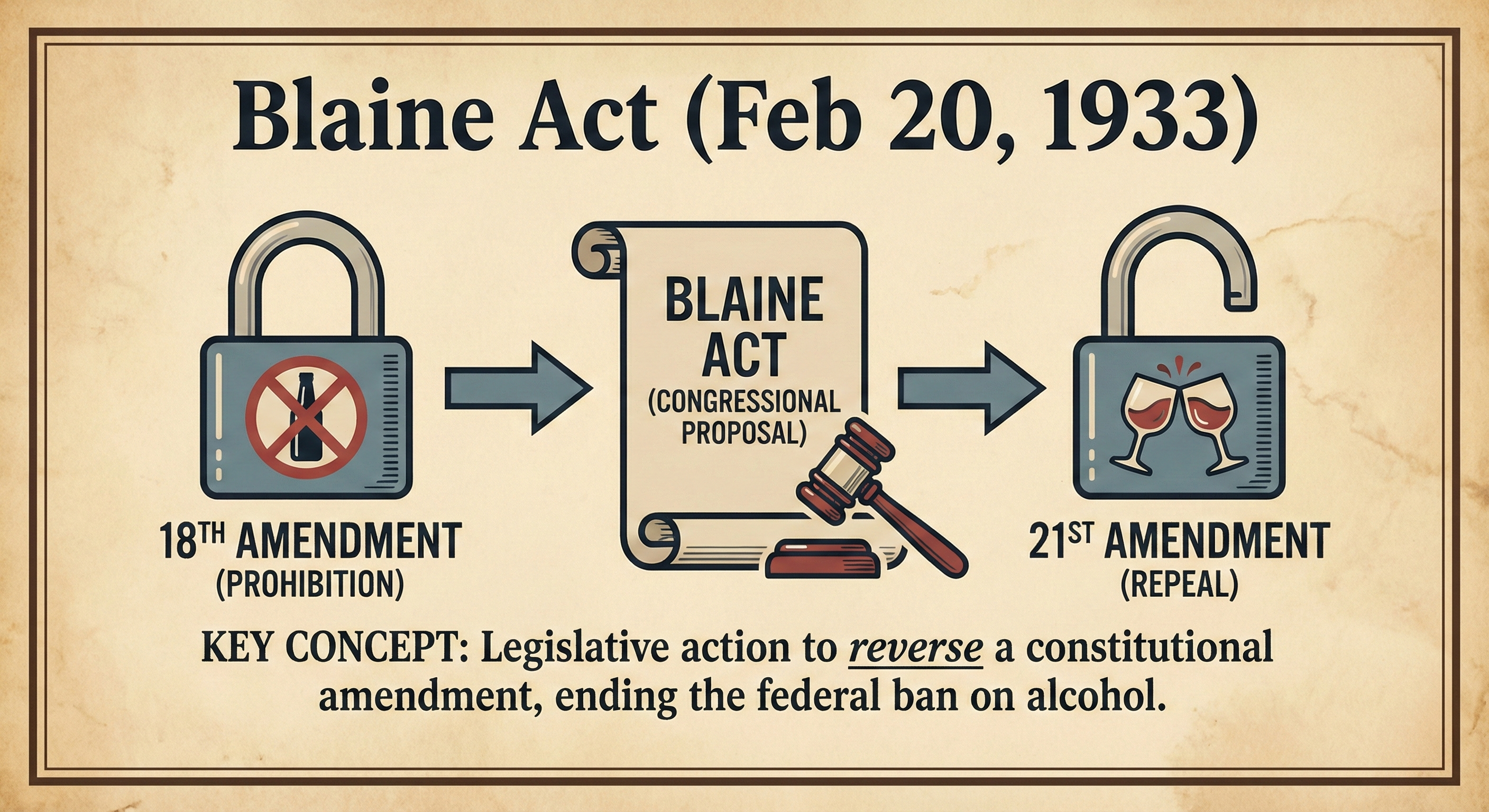
The true significance of February 20, 1933, lies in the specific language used within the Blaine Act regarding the ratification process. Article V of the United States Constitution provides two methods for states to ratify a proposed amendment: approval by three-fourths of the state legislatures or by three-fourths of state ratifying conventions. Prior to February 20, 1933, every single amendment to the Constitution had been ratified through state legislatures.
Congress chose the convention method for the Twenty-first Amendment as a deliberate political strategy. Lawmakers feared that “Dry” interests still held a disproportionate amount of influence within state legislative bodies, particularly in rural districts where the temperance movement remained entrenched. By mandating state ratifying conventions, the Blaine Act ensured that delegates would be elected specifically for their stance on this single issue. This allowed the “Wet” majority in the general population to express its will directly, bypassing the potential gridlock of state houses.
This procedural choice was a radical departure from constitutional tradition. It reflected a deep-seated urgency to resolve the Prohibition crisis and a recognition that the standard political machinery was perhaps too slow or too compromised to reflect the immediate needs of a country in economic freefall. The vote on February 20, 1933, was essentially an admission by Congress that the normal legislative channels could not be trusted to undo a policy that had become so fundamentally unpopular and economically disastrous.
What Followed
The passage of the Blaine Act on February 20, 1933, set off a rapid series of state-level elections. Throughout the spring and summer of 1933, voters across the country went to the polls to select delegates for their respective state conventions. The momentum was overwhelmingly in favor of repeal. Even while the ratification process was underway, the Roosevelt administration moved to provide immediate relief. The Cullen-Harrison Act, signed on March 22, 1933, re-defined “intoxicating” to exclude low-alcohol beer, allowing the industry to begin rehiring workers and generating tax revenue before the constitutional change was finalized.
When Utah became the 36th state to ratify on December 5, 1933, the Twenty-first Amendment became part of the Constitution. It remains unique not only for being the only amendment to repeal a previous one but also for the way it handled the transition of power. Section 2 of the amendment granted states the authority to regulate the transportation or importation of intoxicating liquors within their borders. This effectively ended the era of federal enforcement and gave rise to the “patchwork” of alcohol laws that still exists across the United States, including the persistence of “dry counties” in certain regions.
Economically, the repeal provided a significant boost. Thousands of jobs were created in the brewing, distilling, and hospitality sectors. More importantly for the government, the re-introduction of federal excise taxes on alcohol provided a vital source of funding for New Deal programs during the mid-1930s. Socially, the end of Prohibition did not result in the wave of public drunkenness that temperance advocates had feared; instead, it dismantled the primary revenue stream for many organized crime syndicates and restored a measure of public faith in the rule of law. The vote on February 20, 1933, remains the pivotal moment when the federal government successfully navigated a constitutional “u-turn” to align the law of the land with the reality of the American people.
Sources
- United States Congress: https://wikipedia.org/wiki/United_States_Congress
- Blaine Act: https://wikipedia.org/wiki/Blaine_Act
- Prohibition in the United States: https://wikipedia.org/wiki/Prohibition_in_the_United_States
- Twenty-first Amendment to the United States Constitution: https://wikipedia.org/wiki/Twenty-first_Amendment_to_the_United_States_Constitution
- State ratifying conventions: https://wikipedia.org/wiki/State_ratifying_conventions
- The War on Alcohol: Prohibition and the Rise of the American State by Lisa McGirr (Reference lookup recommended)
- Last Call: The Rise and Fall of Prohibition by Daniel Okrent (Reference lookup recommended)