On This Day: 1933 - In Miami, Giuseppe Zangara attempts to assassinate US President-elect Franklin D
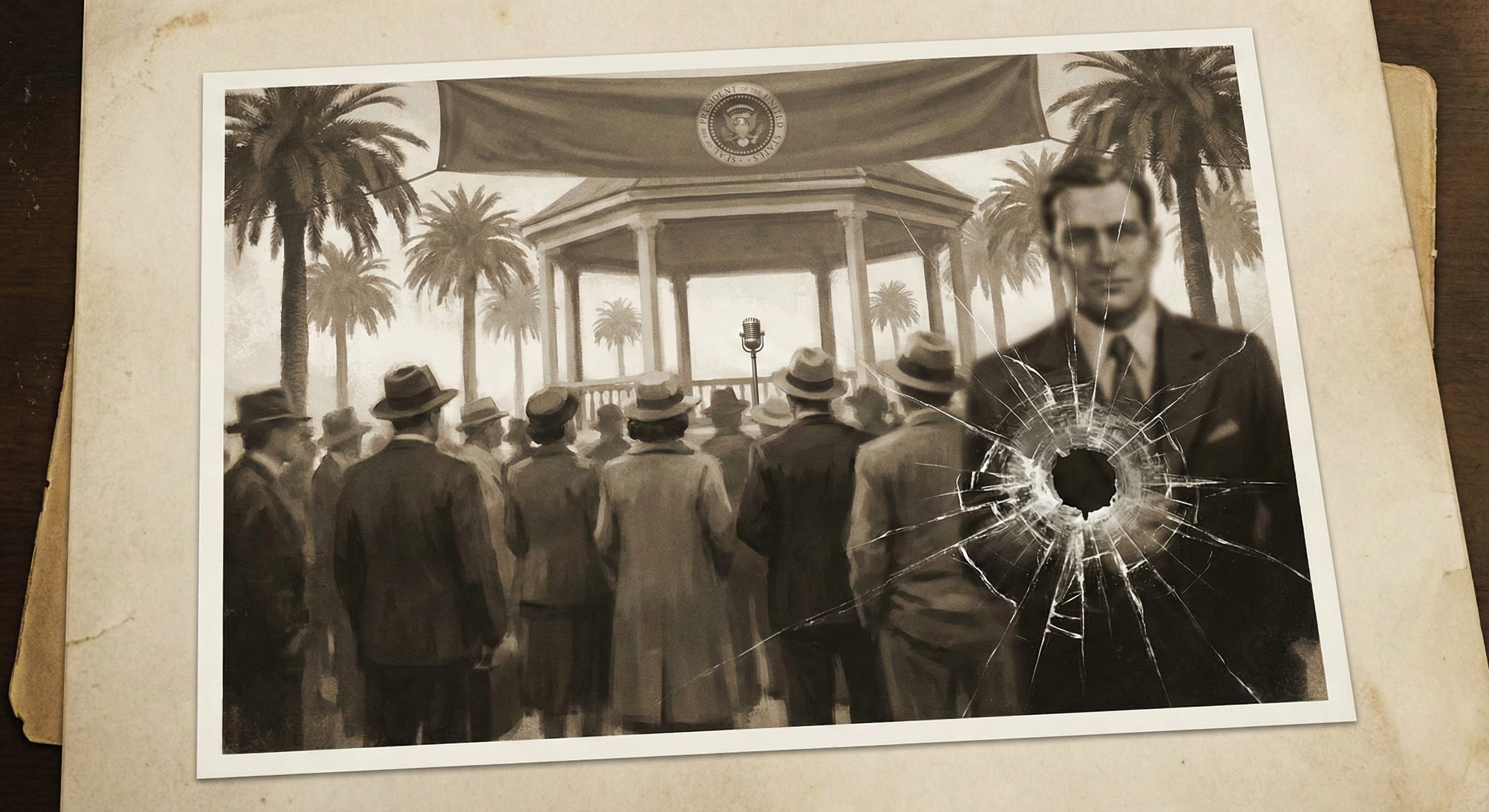
The scene at Bayfront Park in Miami on the evening of February 15, 1933, remains one of the most scrutinized moments in American political history. A crowd of thousands had gathered to hear President-elect Franklin D. Roosevelt speak from the back of an open Buick. As Roosevelt finished his brief remarks and began to slide back into his seat, five shots rang out. When the smoke cleared, five people were wounded, including Chicago Mayor Anton J. Cermak, who would eventually succumb to his injuries on March 6, 1933.
For decades, a persistent narrative has suggested that the gunman, Giuseppe Zangara, was not actually trying to kill Roosevelt. This theory posits that Zangara was a professional hitman hired by the Chicago Outfit to eliminate Mayor Cermak, who was known for his aggressive stance against organized crime. Proponents of this theory point to the fact that Zangara missed Roosevelt entirely despite being only thirty feet away, while hitting Cermak in the chest. They argue that the “assassination attempt” on the President-elect served as a convenient cover for a mob hit. However, a closer examination of Zangara’s personal history, his psychological profile, and the physical evidence of the shooting reveals a much simpler, though perhaps more chaotic, reality.
What People Commonly Get Wrong
The most pervasive misconception regarding the February 15, 1933, shooting is the “Organized Crime” hypothesis. Many amateur historians and conspiracy theorists suggest that Giuseppe Zangara was a pawn of Frank Nitti or Al Capone. This narrative gained significant traction because Anton J. Cermak was a reformer who had made many enemies in the Chicago underworld. By framing Cermak as the primary target, theorists create a story of calculated underworld vengeance rather than the random act of a disgruntled individual.
Another common error involves Zangara’s technical proficiency. He is often described as either a “skilled marksman who missed” or a “bungling amateur.” Neither description is entirely accurate. Zangara had served in the Italian Army during World War I, where he received basic weapons training. However, his physical condition on February 15, 1933, was severely compromised. He suffered from chronic, debilitating abdominal pain-which he attributed to his time in the trenches but was later identified as severe gallstones-which left him physically frail and prone to bouts of irrational rage.
Furthermore, the idea that Zangara had a specific political agenda beyond general hatred for “the rich and powerful” is often overstated. While he is frequently labeled an “anarchist,” his brand of anarchism was not rooted in deep philosophical study or membership in specific political cells. His ideology was reactionary and intensely personal, driven by a belief that his physical suffering was a direct result of the capitalist system and the leaders who represented it. To Zangara, any head of state was a valid target.
What the Evidence Shows
The evidence gathered by the FBI and local Miami police in the immediate aftermath of the shooting points away from a mob conspiracy and toward a lone-actor scenario. Giuseppe Zangara’s own testimony, provided during his interrogation and trial, was remarkably consistent. He repeatedly stated that he did not hate Mayor Cermak personally; he simply hated all presidents and kings. When asked why he shot, he famously replied, “I have the stomach ache. I have it all the time… I want to kill the President because I want to make it even.”
Physical evidence at the scene also contradicts the “professional hitman” theory. Zangara was only five feet, one inch tall. To get a clear view of Roosevelt over the crowd at Bayfront Park, he had to stand on a rickety, folding metal chair. As he fired his first shot, a bystander named Lillian Cross grabbed his arm. This intervention, combined with the instability of his perch, caused the subsequent four shots to be wildly inaccurate. A professional assassin would unlikely choose such a precarious position or use a cheap, .32-caliber US Revolver Co. pistol-a weapon known for its lack of stopping power and accuracy at distance.
The Chicago mob theory falls apart when one examines the timeline of Zangara’s movements. He had been living in Miami for some time before the shooting, struggling with his health and working sporadically as a bricklayer. There were no financial links, phone records, or witness testimonies connecting him to the Chicago Outfit. His purchase of the pistol for $8.00 at a local pawn shop was a spontaneous decision fueled by a newspaper announcement of Roosevelt’s visit.
Main Turning Points
The first major turning point occurred at approximately 9:35 PM on February 15, 1933, the moment Lillian Cross perceived the danger. By grabbing Zangara’s arm, she redirected the barrel of the gun. While this action arguably saved Franklin D. Roosevelt, it likely resulted in the bullets striking Anton J. Cermak and four other bystanders: Margaret Kruis, Joseph Gill, William Sinnott, and Russell Caldwell. The redirection of the weapon shifted the course of American history, ensuring that the New Deal era would proceed under its architect.
The second turning point was Roosevelt’s reaction in the moments following the gunfire. Instead of allowing the Secret Service to speed away, Roosevelt ordered the car to stop so that the wounded Cermak could be pulled into the vehicle. During the frantic drive to Jackson Memorial Hospital, Roosevelt held Cermak in his arms, reportedly keeping him conscious and calm. This display of composure and leadership, occurring just weeks before his inauguration on March 4, 1933, solidified Roosevelt’s image as a man of steel who could handle the crises of the Great Depression.
The final turning point was the death of Anton J. Cermak on March 6, 1933. Until that moment, Zangara had been sentenced to eighty years in prison for attempted murder. Once Cermak died, the charges were upgraded to first-degree murder. In a legal process that would be considered impossibly fast by modern standards, Zangara was re-indicted, pleaded guilty, and was sentenced to death within days.
What Changed Afterward
The assassination attempt led to an immediate and permanent overhaul of presidential security protocols. Prior to February 15, 1933, it was common for presidents and presidents-elect to appear in highly accessible, open-air environments with minimal crowd buffering. The Miami shooting prompted the Secret Service to demand stricter controls over public appearances and better screening of crowds. This event served as a grim precursor to the more rigid security measures that would eventually define the modern presidency.
Politically, the event martyred Anton J. Cermak and elevated Roosevelt to a near-mythic status before he even took the oath of office. The “Cermak quote”-“I’m glad it was me instead of you”-though its authenticity has been debated by historians, became a powerful piece of American folklore. It symbolized a sacrifice that allowed the nation’s “savior” to live. This narrative helped Roosevelt galvanize public support for the radical economic changes he would introduce during his first hundred days in office.
Zangara’s execution on March 20, 1933, also marked a conclusion to one of the shortest gaps between a crime and the death penalty in US history. His final words in the electric chair-”Push the button!”-reflected the same defiant, erratic anger that had driven him to Bayfront Park. His death ended the legal proceedings, but the debate over his motives ensured that the shooting would remain a focal point for those studying the intersection of political violence and mental health in the early 20th century. The events of February 15, 1933, remain a chilling reminder of how a single, unstable individual can nearly alter the entire trajectory of a global superpower.
Sources
- Miami: https://wikipedia.org/wiki/Miami
- Giuseppe Zangara: https://wikipedia.org/wiki/Giuseppe_Zangara
- Franklin D. Roosevelt: https://wikipedia.org/wiki/Franklin_D._Roosevelt
- Mayor of Chicago: https://wikipedia.org/wiki/Mayor_of_Chicago
- Anton J. Cermak: https://wikipedia.org/wiki/Anton_J._Cermak
- “The Assassination of Anton Cermak,” Chicago Historical Society (Reference lookup recommended).
- “The Man Who Tried to Kill FDR,” National Archives and Records Administration (Reference lookup recommended).