On This Day: 1988 - The 1988 Black Sea bumping incident: The U
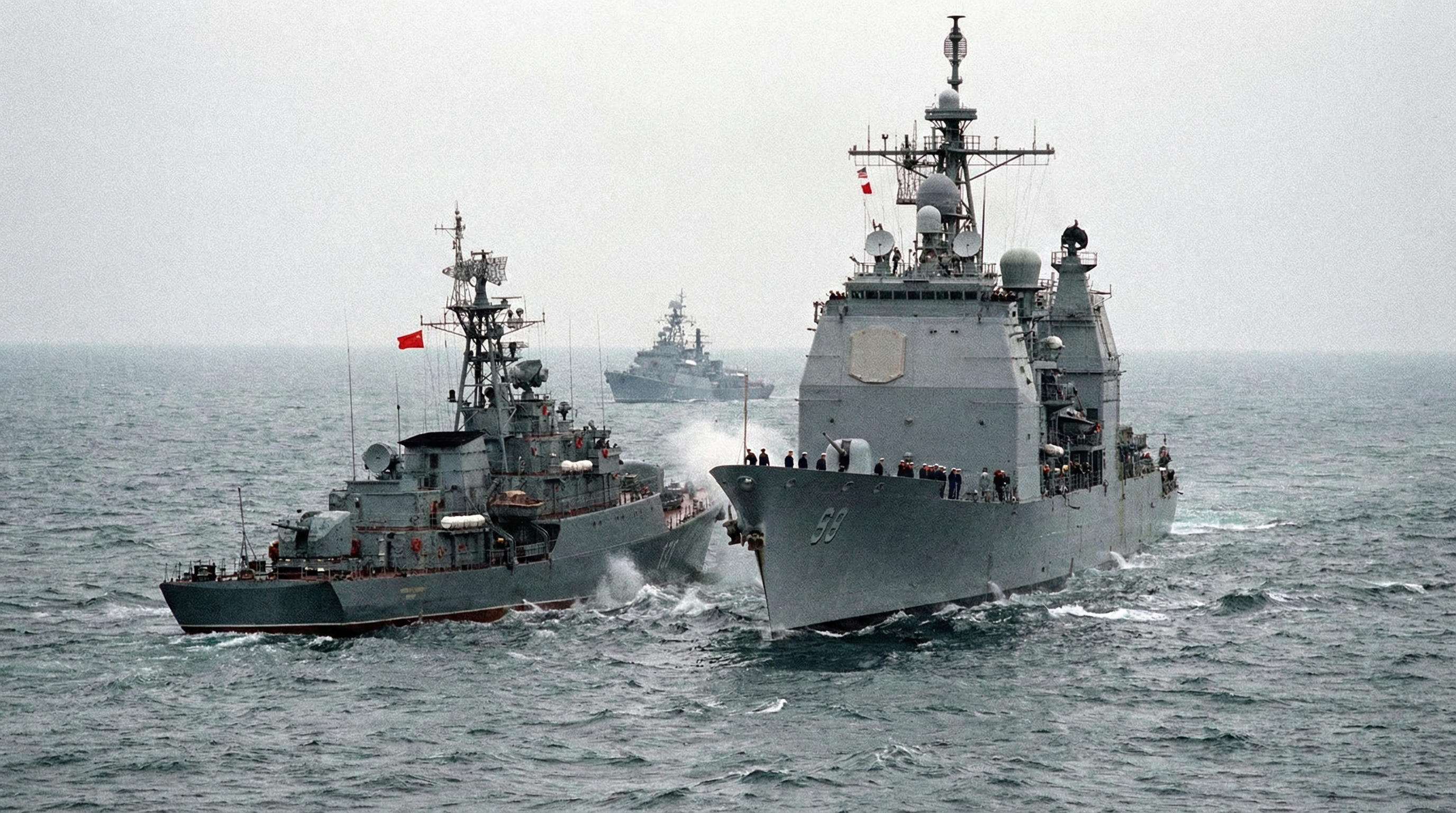
On February 12, 1988, the frigid waters of the Black Sea served as the backdrop for one of the most unusual and dangerous physical confrontations of the late Cold War. Two United States Navy vessels, the Aegis cruiser USS Yorktown (CG-48) and the destroyer USS Caron (DD-970), were deliberately rammed by Soviet warships while exercising the right of “innocent passage” within the Soviet Union’s claimed territorial waters. This incident, often referred to as the “bumping incident,” represented the peak of maritime tension between the two superpowers regarding the interpretation of international law and the freedom of navigation.
Fast Background
The geopolitical friction leading to the 1988 encounter was rooted in a fundamental disagreement over the 1982 United Nations Convention on the Law of the Sea (UNCLOS). While the United States had not ratified the treaty, the Reagan administration maintained that the convention’s provisions regarding “innocent passage” reflected customary international law, which all nations were bound to respect. Under these rules, a foreign warship is permitted to pass through the territorial waters of another state-defined as 12 nautical miles from the coast-as long as the passage is continuous, expeditious, and not prejudicial to the peace or security of the coastal state.
The Soviet Union held a much more restrictive view. The Kremlin argued that foreign warships could only exercise innocent passage in specific, designated sea lanes, none of which existed in the sensitive regions of the Black Sea near the Crimean Peninsula. To the Soviets, the Black Sea was a “closed” or “semi-closed” sea where American presence was viewed as a direct provocation.
In 1979, the United States launched the Freedom of Navigation (FON) program. This policy directed the U.S. Navy to actively challenge “excessive maritime claims” by sailing through disputed waters. By February 1988, the Black Sea had already seen similar brushes. On March 13, 1986, the Yorktown and Caron had entered Soviet territorial waters in the same region, prompting a diplomatic protest from Moscow but no physical contact. The 1988 mission was a planned repeat, intended to solidify the American legal position that the 1986 passage had established a precedent.
Timeline of Key Moments
The sequence of events on February 12, 1988, unfolded with mechanical precision, escalating from verbal warnings to physical impact over the course of a single morning.
- February 10, 1988: The USS Yorktown and USS Caron enter the Black Sea via the Bosporus. They are immediately picked up and shadowed by Soviet surveillance.
- February 12, 1988, 08:00 AM: The American ships begin their approach toward the Crimean coast. The Soviet Krivak-class frigate Bezzavetnyy and the Mirka-class frigate SKR-6 take up positions to intercept.
- 09:45 AM: The Yorktown and Caron cross the 12-mile limit of the Soviet territorial sea. The Soviet vessels issue a radio warning: “Soviet ships have orders to prevent violation of territorial waters, state border of the USSR is violated. I am authorized to ram your ship.”
- 10:15 AM: The American commanders maintain their course, responding that they are engaged in innocent passage and are operating in accordance with international law.
- 10:55 AM: The Bezzavetnyy moves alongside the Yorktown, while the SKR-6 positions itself near the Caron. The distance between the hulls closes to a few meters.
- 11:02 AM: The “bumping” occurs. The Bezzavetnyy strikes the port side of the Yorktown toward the aft. Simultaneously, the SKR-6 strikes the Caron.
- 11:05 AM - 11:45 AM: The Soviet ships continue to maneuver aggressively. The Bezzavetnyy makes a second, more significant impact on the Yorktown, riding up onto the cruiser’s quarterdeck and causing damage to the guardrails and the Harpoon missile canisters.
- 12:00 PM: After nearly an hour within the 12-mile limit, the American ships transition back into international waters. No shots are fired by either side, and the vessels eventually disengage.
Inflection Point
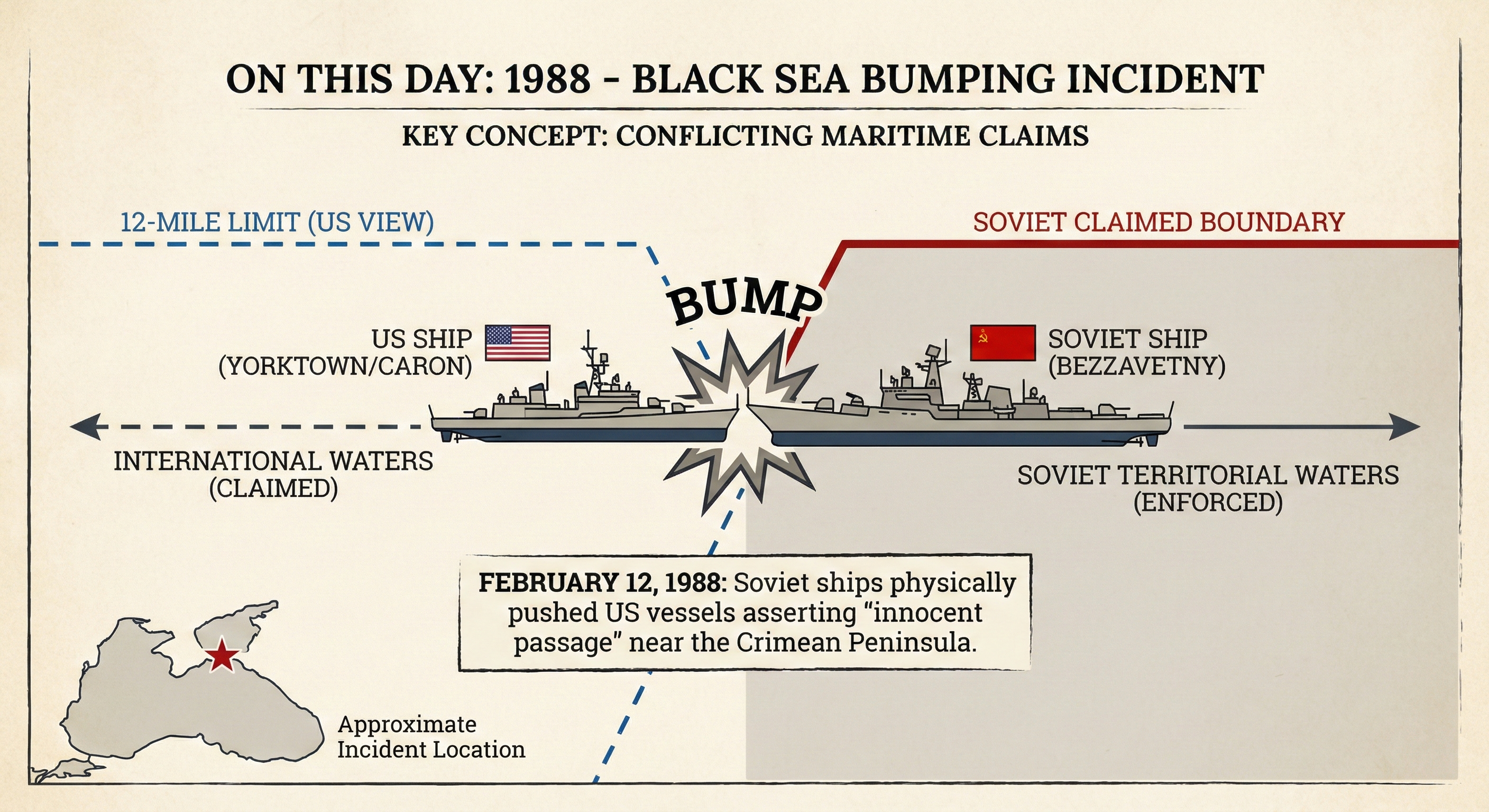
The moment of contact at 11:02 AM was the inflection point where a legal dispute became a potential catalyst for armed conflict. The physical dynamics of the “bump” were harrowing. The Bezzavetnyy, though smaller than the Yorktown, had a reinforced bow designed for such maneuvers. When it struck the American cruiser, the Soviet frigate’s bow actually climbed over the Yorktown’s deck.
Onboard the Yorktown, sailors stood at their stations with cameras rather than weapons, as the U.S. command had issued strict orders not to escalate the confrontation into a shooting war. The Harpoon missile launchers on the Yorktown’s stern were damaged, and the Soviet ship’s anchor was torn loose during the scraping of the hulls. This was not a mere grazing; it was a violent assertion of sovereignty. The tension was magnified by the fact that the Yorktown was one of the most advanced ships in the world, carrying the Aegis combat system. To have it physically manhandled by an older Soviet frigate was a significant symbolic blow, yet the restraint shown by both crews prevented the incident from spiraling into a missile exchange that could have ignited a broader conflict during the sensitive final years of the Cold War.
What Followed
The diplomatic fallout was immediate. The United States State Department sent a sharp note of protest to Moscow, labeling the Soviet actions as a violation of the “Agreement on the Prevention of Incidents On and Over the High Seas” (INCSEA) signed in 1972. The Soviets countered by accusing the United States of “premeditated provocation” and a “violation of state borders.”
However, beneath the public posturing, both nations recognized that the situation was unsustainable. The risk of an accidental war starting over a maritime technicality was too high. This realization led to a series of high-level meetings between U.S. Secretary of State James Baker and Soviet Foreign Minister Eduard Shevardnadze.
On September 23, 1989, the two nations signed the “Uniform Interpretation of Rules of International Law Governing Innocent Passage,” often known as the Jackson Hole Agreement. This document was a landmark in maritime law. The Soviet Union agreed that all ships, including warships, have the right of innocent passage through territorial seas without prior notification or authorization, provided they follow UNCLOS guidelines. In exchange, the United States tacitly agreed to avoid provocative FON maneuvers in sensitive areas if the legal right was no longer in question.
The ships involved in the incident went on to have varied legacies. The USS Yorktown continued its service until it was decommissioned on December 3, 2004. The Soviet frigate Bezzavetnyy had a more complex end; following the collapse of the Soviet Union, the vessel was transferred to the Ukrainian Navy on August 1, 1997, and renamed the Dnipropetrovsk. It was eventually decommissioned and scuttled in the Black Sea in 2005.
The 1988 Black Sea bumping incident remains a primary case study for naval officers and international lawyers. It serves as a reminder of a period when the boundaries of global law were not just debated in courtrooms, but were tested by the steel hulls of warships in the lonely stretches of the sea.
Sources
- Cold War: https://wikipedia.org/wiki/Cold_War
- 1988 Black Sea bumping incident: https://wikipedia.org/wiki/1988_Black_Sea_bumping_incident
- USS Yorktown (CG-48): https://wikipedia.org/wiki/USS_Yorktown_(CG-48)
- Ukrainian frigate Dnipropetrovsk: https://wikipedia.org/wiki/Ukrainian_frigate_Dnipropetrovsk
- Territorial waters: https://wikipedia.org/wiki/Territorial_waters
- Innocent passage: https://wikipedia.org/wiki/Innocent_passage
- “The United States Navy: A History” (reference lookup recommended)
- “Soviet Naval Tactics and Strategy” (reference lookup recommended)
- U.S. Department of State Archive, “Joint Statement by the United States and the Union of Soviet Socialist Republics,” September 23, 1989 (reference lookup recommended)