On This Day: 1943 - Attempting to completely lift the Siege of Leningrad, the Soviet Red Army engages German troops
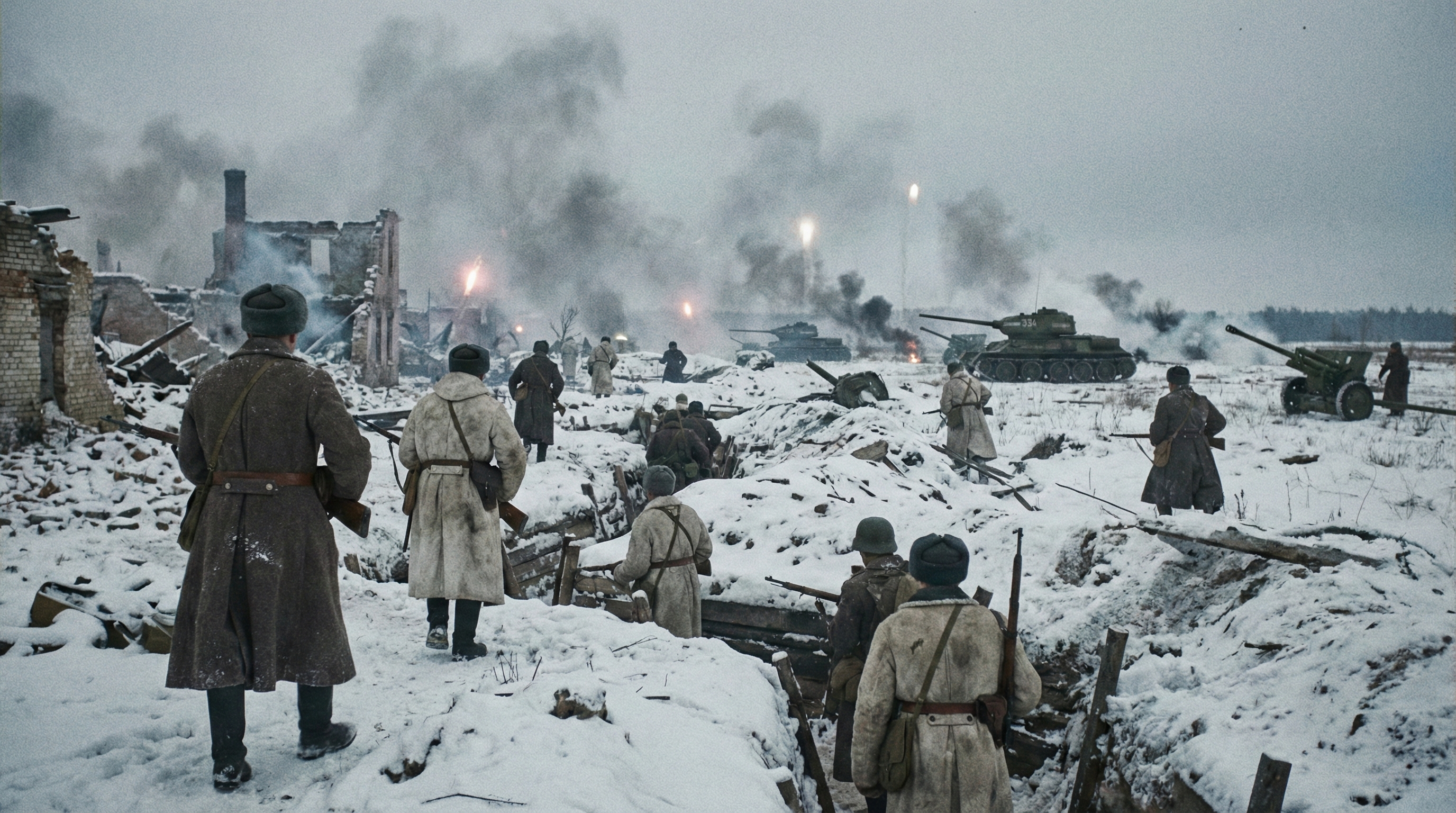
The strategic necessity to widen the narrow land corridor feeding the starving inhabitants of Leningrad compelled the Soviet Red Army to launch a massive offensive on February 10, 1943, an engagement known as the Battle of Krasny Bor which, despite failing to achieve a total strategic breakthrough, decimated the volunteer forces of Francoist Spain and paved the way for the ultimate collapse of the German blockade. This tactical collision between a desperate Soviet Union and an overextended Wehrmacht represented a pivotal attempt to transform a fragile lifeline into a secure supply artery. While the immediate objective of seizing the Moscow-Leningrad railway was not fully realized, the sheer scale of the Soviet onslaught forced a redistribution of German reserves, ensuring that the siege, which had strangled the city since September 8, 1941, could no longer be maintained with the same suffocating intensity.
Immediate Causes
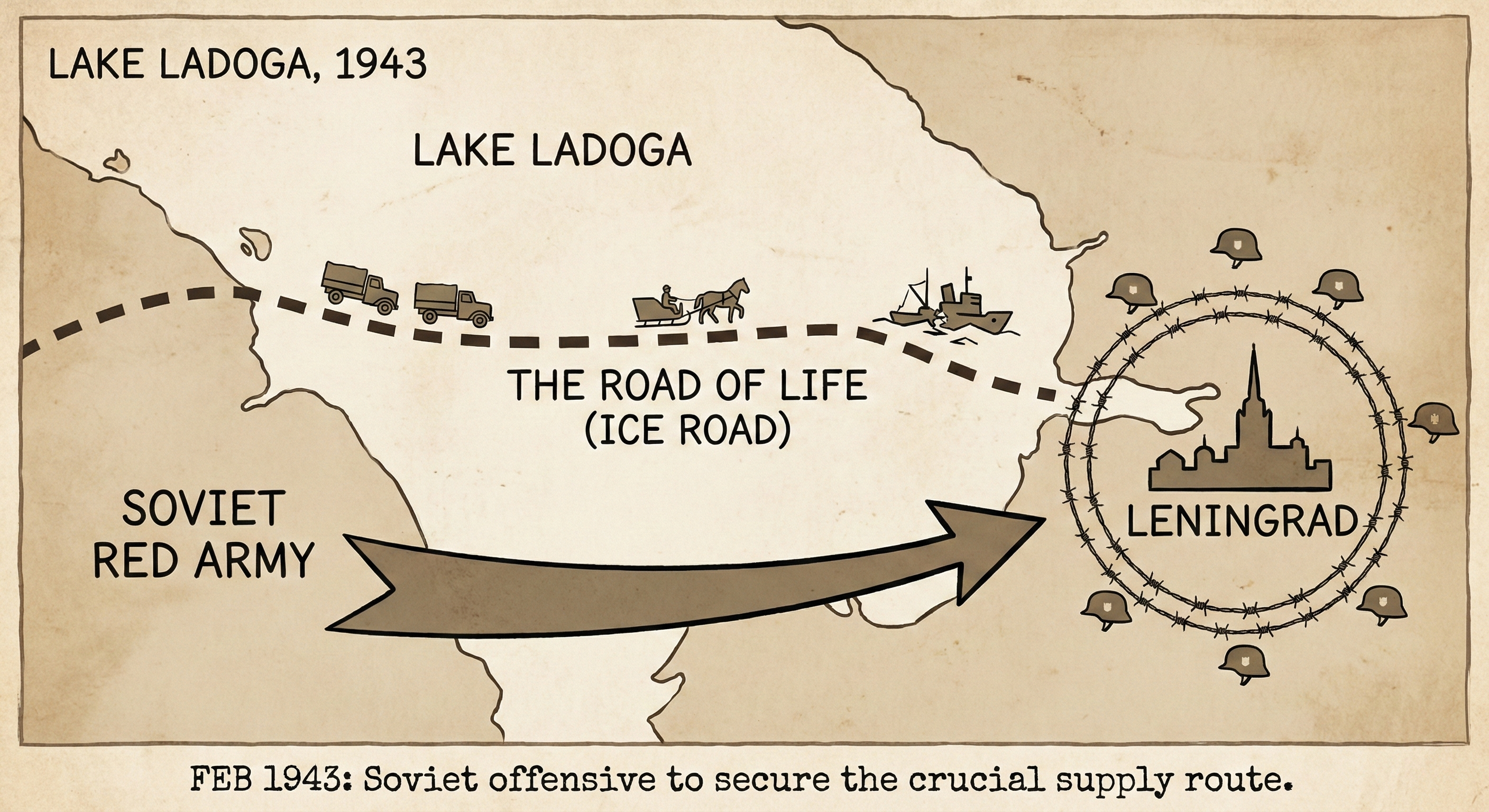
The genesis of the engagement on February 10, 1943, lay in the modest success of Operation Iskra (Spark) earlier that year. By January 18, 1943, the Red Army had successfully pierced the German encirclement, establishing a thin strip of land along the southern shore of Lake Ladoga. While this “Road of Victory” allowed for the limited transport of food and fuel, it remained precariously narrow-only eight to ten kilometers wide-and was constantly subjected to German artillery fire from the surrounding heights.
Soviet leadership, specifically the Stavka, recognized that Leningrad remained in a state of terminal peril. The city’s industrial capacity was shattered, and its population continued to perish from malnutrition and exposure. To secure the city’s future, the Soviet high command conceived Operation Polyarnaya Zvezda (Polar Star), a grand strategic encirclement designed to crush Army Group North. The centerpiece of this operation was a concentrated strike by the 55th Army toward the town of Krasny Bor.
The primary objective was the liberation of the Moscow-Leningrad railway. By seizing this vital infrastructure, the Red Army intended to bypass the frozen, unreliable paths across Lake Ladoga and restore a high-capacity supply route directly into the city’s heart. Defending this sector was the Spanish 250th Infantry Division, known as the “Blue Division,” a unit composed of volunteers sent by Francisco Franco to assist Nazi Germany on the Eastern Front. The presence of these troops, situated in a vital bottleneck of the German line, provided the immediate geographical target for the Soviet winter offensive.
The Event Itself
At 6:45 AM on February 10, 1943, the silence of the winter morning was shattered by one of the most concentrated Soviet artillery barrages of the war. Approximately 800 Soviet guns and mortars rained shells upon the Spanish positions at Krasny Bor for nearly two hours. The intention was total annihilation of the forward defensive crust. When the barrage lifted, the 55th Army, supported by tank brigades and mobile units, surged forward across the snow-covered plains.
The Soviet force was formidable, numbering roughly 44,000 men. They faced approximately 4,500 Spanish soldiers who had survived the initial bombardment. The geography of the battlefield played a significant role; the Izhora River and the local railway embankments provided the only real cover in an otherwise flat, exposed landscape. As the Soviet infantry advanced, they expected to find a defeated and demoralized enemy. Instead, the Spanish volunteers, though suffering horrific casualties, utilized the ruins of Krasny Bor and the surrounding trenches to engage in brutal, close-quarters combat.
Throughout the day of February 10, 1943, the battle devolved into a series of desperate standoffs. Soviet T-34 tanks bypassed Spanish strongpoints only to be engaged by anti-tank teams using grenades and Molotov cocktails. The town of Krasny Bor was eventually taken by Soviet forces by the afternoon, but the advance stalled shortly thereafter. A sudden thaw turned the frozen ground into a morass of mud and slush, significantly slowing the movement of Soviet heavy equipment and reinforcements.
Despite the breakthrough at the frontline, the Red Army failed to capitalize on the initial shock. The Spanish troops held their secondary positions with a tenacity that surprised the Soviet commanders, buying enough time for German reinforcements, including the 4th SS Police Division and several Wehrmacht infantry units, to arrive and stabilize the perimeter. By nightfall, the Soviet 55th Army had gained about five kilometers of territory, but the overarching goal of capturing the railway junction at Mga remained out of reach.
Direct Consequences
The immediate aftermath of the battle on February 10, 1943, was characterized by staggering loss of life. The Spanish Blue Division was effectively neutralized as a cohesive fighting force; in a single day of fighting, they suffered nearly 4,000 casualties, representing approximately 75% of the troops engaged in that specific sector. For the Red Army, the human cost was even higher, with estimates suggesting between 10,000 and 12,000 casualties during the initial phase of the offensive.
Tactically, the battle resulted in a stalemate. While the Red Army had liberated Krasny Bor and pushed the German-Spanish line back several kilometers, they had not achieved the decisive breakthrough required to fully lift the siege. The Moscow-Leningrad railway remained within range of German guns, and the “Road of Victory” remained the only viable land route into the city. The failure to seize the high ground at Sinyavino and the railway hub at Mga meant that the blockade would continue for several more months.
However, the engagement forced the German high command to reconsider the stability of the northern front. The massive expenditure of Soviet shells and manpower proved that the Red Army possessed the resources to launch high-intensity operations even in the depths of winter. The German 18th Army was forced to pull reserves from other sectors to plug the hole created at Krasny Bor, weakening the overall German defensive posture in the region.
Long-Term Impact
The events of February 10, 1943, echoed far beyond the immediate battlefield. For the Soviet Union, the Battle of Krasny Bor served as a harsh lesson in the difficulties of offensive operations against entrenched positions in winter conditions. It led to a refinement of Soviet “Deep Battle” tactics, emphasizing better coordination between armor and infantry to prevent the kind of stagnation witnessed at the Izhora River. The pressure maintained by the 55th Army contributed to the gradual exhaustion of Army Group North, making the final liberation of Leningrad on January 27, 1944, possible.
Politically, the battle had a profound effect on the international standing of Francoist Spain. The slaughter of the Blue Division at Krasny Bor signaled the beginning of the end for Spanish involvement in the German war effort. As the tide of World War II shifted decisively in favor of the Allies following the German defeat at Stalingrad on February 2, 1943, the disaster at Krasny Bor provided Francisco Franco with the domestic and diplomatic impetus to begin withdrawing his forces. By late 1943, the Blue Division was officially disbanded and replaced by a much smaller “Blue Legion,” as Spain sought to pivot toward a more neutral stance to avoid Allied retribution.
Ultimately, February 10, 1943, stands as a testament to the sheer endurance of the combatants and the astronomical cost of the struggle for Leningrad. While the Soviet attempt to completely lift the siege in early 1943 failed in its primary objective, it succeeded in grinding down the Axis periphery. This attrition was essential for the eventual Soviet winter offensive of 1944, which finally cleared the German presence from the outskirts of the city, ending 872 days of starvation and fire. The bravery and the brutality seen at Krasny Bor remain a stark chapter in the history of the Eastern Front, illustrating the transition from German dominance to Soviet resurgence.
Sources
- World War II: https://wikipedia.org/wiki/World_War_II
- Siege of Leningrad: https://wikipedia.org/wiki/Siege_of_Leningrad
- Red Army: https://wikipedia.org/wiki/Red_Army
- Nazi Germany: https://wikipedia.org/wiki/Nazi_Germany
- Francoist Spain: https://wikipedia.org/wiki/Francoist_Spain
- Battle of Krasny Bor: https://wikipedia.org/wiki/Battle_of_Krasny_Bor
- Glantz, David M. (2002). The Battle for Leningrad, 1941-1944. University Press of Kansas. (Reference lookup recommended)
- Scurr, John (1980). Germany’s Spanish Volunteers 1941-45. Osprey Publishing. (Reference lookup recommended)